





Instead of simply stating today’s exchange rate, this guide explains why the value of 1 US dollar changes in Nigeria, how official and parallel market rates differ, what affects pricing, where Nigerians can exchange dollars safely, and what buyers should know before converting foreign currency.
Current Price Summary
As of recent market data:
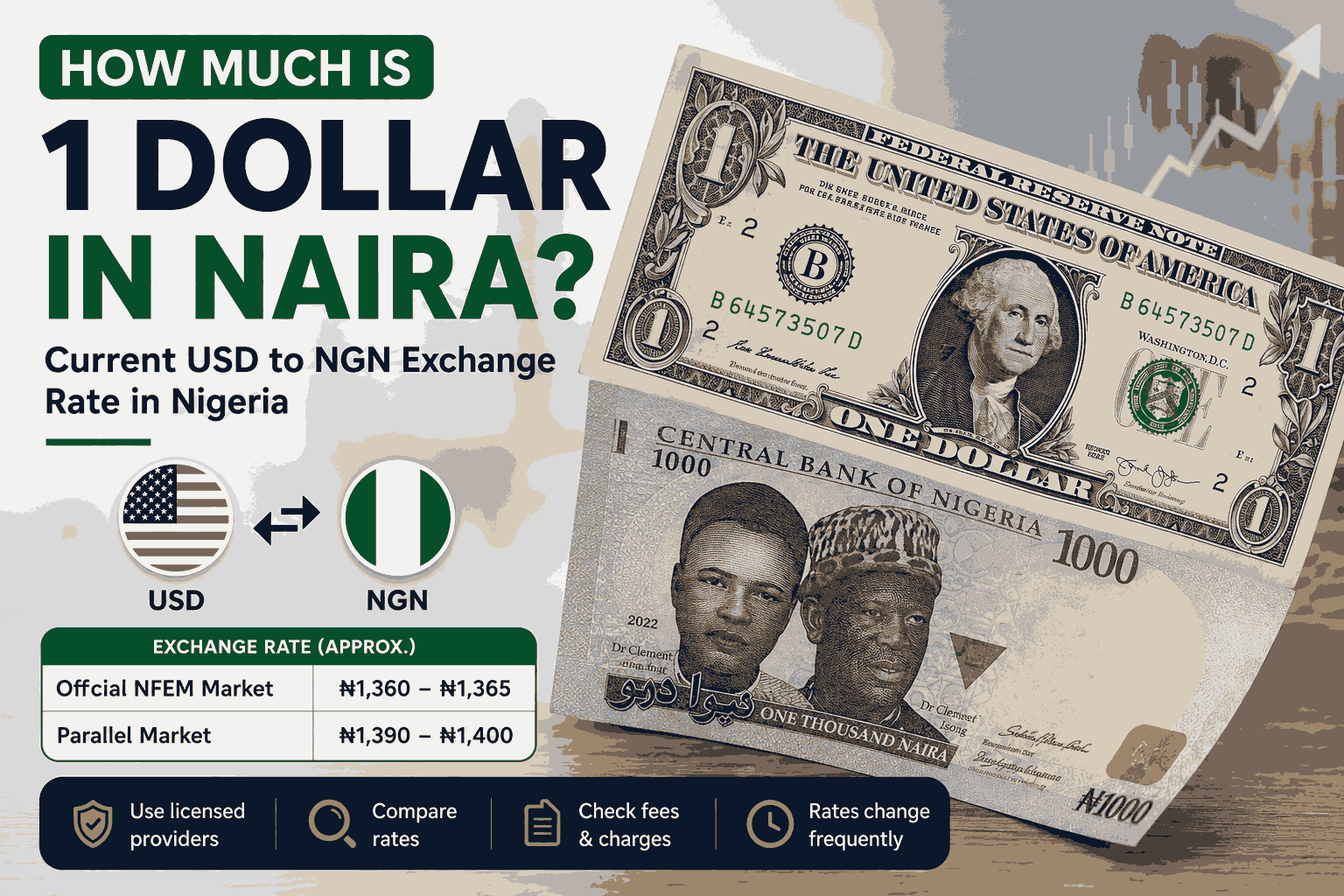
- Official Nigerian Foreign Exchange Market (NFEM): approximately ₦1,360–₦1,365 per US$1
- Parallel (black) market: roughly ₦1,390–₦1,400 per US$1
These figures fluctuate daily depending on demand, liquidity, Central Bank policies, and market conditions. Always confirm the latest exchange rate before making a transaction.
How Much Is 1 Dollar in Naira? A Complete Guide to Today’s USD to NGN Exchange Rate
The question “How much is 1 dollar in naira?” is one of the most searched financial queries in Nigeria. Whether you are receiving money from abroad, paying international tuition, shopping online, travelling, investing, or running a business, understanding the current US dollar to Nigerian naira (USD/NGN) exchange rate can help you make better financial decisions.
Unlike products with fixed retail prices, the value of one US dollar changes constantly. Exchange rates are influenced by market demand, government policy, global economic conditions and foreign exchange liquidity. As a result, the amount of naira you receive for one dollar today may be different tomorrow.
This guide explains the current exchange rate, why prices vary, where to exchange dollars safely, and what Nigerians should know before buying or selling US currency.
Quick Exchange Rate Summary
| Market | Estimated Rate for US$1 |
|---|---|
| Official NFEM Market | Around ₦1,360–₦1,365 |
| Parallel (Black) Market | Around ₦1,390–₦1,400 |
These are market estimates based on recent published exchange data. Banks, bureaux de change and money transfer providers may quote slightly different rates depending on transaction size and service charges.
Why Doesn’t 1 Dollar Have One Fixed Price?
Many people expect a single nationwide exchange rate.
In reality, several exchange rates exist because foreign currency is traded in different markets.
The main ones include:
- Official Nigerian Foreign Exchange Market (NFEM)
- Commercial banks
- Licensed Bureau De Change operators
- International money transfer companies
- Parallel market
Each market has different levels of foreign currency supply and demand, resulting in different prices.
Understanding the Official Exchange Rate
Nigeria currently operates a market-based foreign exchange system under the Nigerian Foreign Exchange Market (NFEM), where exchange rates are largely determined by willing buyers and willing sellers, with oversight from the Central Bank of Nigeria (CBN).
The official rate is commonly used for:
- International school fees
- Medical payments abroad
- Corporate transactions
- Approved business imports
- Certain banking transactions
Commercial banks may also add small margins or processing fees.
Why Is the Parallel Market Rate Higher?
The parallel market often trades above the official market because:
- Demand for dollars exceeds supply.
- Some buyers cannot access official foreign exchange channels.
- Importers frequently require immediate access to dollars.
- Speculation can increase demand during periods of uncertainty.
Although many Nigerians monitor parallel market rates, exchange rates from unofficial sources can vary significantly depending on location and dealer.
Factors That Affect the Dollar to Naira Exchange Rate
1. Demand for US Dollars
When more Nigerians need dollars for imports, travel, tuition or international payments, demand increases.
Higher demand usually pushes exchange rates upward.
2. Foreign Exchange Supply
Nigeria earns much of its foreign exchange from crude oil exports.
Higher foreign exchange inflows generally improve dollar availability.
3. Central Bank Policies
The CBN regularly introduces reforms aimed at improving liquidity, transparency and market efficiency.
Changes in policy can quickly influence exchange rates.
4. Inflation
Persistent inflation weakens purchasing power and can put pressure on the naira over time.
5. Global Economic Conditions
Interest rates in the United States, oil prices and international investment flows also affect Nigeria’s foreign exchange market.
What Can 1 Dollar Buy in Nigeria?
Although exchange rates fluctuate, one US dollar converted into naira can typically cover small everyday expenses such as:
- Mobile airtime
- Local transportation
- Snacks or beverages
- Internet data bundles
- Small household purchases
The purchasing power depends on inflation and current market prices.
Is the Dollar Expected to Rise or Fall?
No one can predict exchange rates with certainty.
The value of the naira depends on numerous variables including:
- Oil export earnings
- Foreign investment
- Inflation
- Government policy
- Foreign reserve levels
- Global financial markets
Short-term movements can be significant, so it is unwise to rely on speculation alone.
Common Reasons People Convert Dollars to Naira
Nigerians exchange US dollars for many purposes, including:
- Family remittances
- Freelance income
- International salaries
- Tuition payments
- Import business
- Medical expenses
- Travel
- Online shopping
- Investment income
Each purpose may qualify for different exchange channels or service providers.
Where Can You Exchange Dollars Safely?
Safer options include:
- Commercial banks
- Licensed Bureau De Change operators
- Authorised foreign exchange dealers
- Reputable international money transfer services
Avoid exchanging money through unverified individuals, especially for large transactions.
Tips Before Exchanging Dollars
Compare Rates
Exchange providers often quote different buying and selling prices.
Understand Fees
Some providers advertise attractive exchange rates but charge hidden commissions or transfer fees.
Check Market Timing
Rates can change several times in one day.
Use Licensed Providers
Using authorised channels reduces fraud risks and improves transaction security.
Common Misconceptions
“The black market always gives the best value.”
Not necessarily.
After accounting for fees and risks, authorised providers may sometimes offer more competitive overall value.
“Banks always use the CBN rate.”
Banks generally follow official market pricing but may include spreads or service charges.
“Exchange rates only matter for travellers.”
Exchange rates affect:
- Imported goods
- Electronics
- Fuel costs
- Tuition fees
- Inflation
- Online subscriptions
- International investments
Nearly every Nigerian is indirectly affected by movements in the USD/NGN rate.
Also Read: How to Reset Moniepoint Business PIN in Nigeria
How to Choose the Right ₦1,000-a-Day Strategy
The best way to approach how to earn 1k daily in Nigeria is to match the method with what you already have: a skill, a customer network, available capital, transport, equipment or time. A person with no inventory budget may be better suited to a service, while someone with local customers may be able to start a small reselling operation.
Start with the asset you already have
If you already know how to write, design, teach, edit videos, manage social media or repair something, test that skill before spending money on stock. If you already have access to a reliable supplier and know what people around you buy, product reselling may make more sense.
For readers considering product sales, our guide on what you can sell to make money every day in Nigeria explains how to test demand, manage stock and calculate real profit.
Think in monthly averages
Daily income will naturally fluctuate. Instead of becoming discouraged because one day produces nothing, track your total weekly and monthly profit. A business that produces ₦7,000 across a week is still meeting the mathematical equivalent of ₦1,000 per day on average.
If you want to move beyond the first milestone, compare this guide with our article on how to earn ₦5,000 per day in Nigeria. The important progression is to increase the value of each customer, improve repeat purchases or serve more customers without allowing expenses to grow faster than revenue.
How to Turn Small Daily Earnings Into Working Capital
Making the first ₦1,000 is only useful if you manage it carefully. Consider separating business money from personal spending. If every small profit is immediately withdrawn for personal use, the business may remain at the same size indefinitely.
- Record the sale: Write down what came in.
- Subtract direct costs: Include stock, transport, data, packaging or platform charges.
- Set aside operating money: Keep enough to serve the next customer.
- Reinvest deliberately: Spend only where additional capital can reasonably improve the business.
- Keep a reserve: Small businesses can experience slow days, damaged stock or unexpected expenses.
Readers who already have capital can also compare this approach with our guide on how to make money with ₦500,000 and our guide to businesses that can be started with ₦500,000. More capital does not automatically produce more profit; the business model still has to work.
How to Test an Income Idea Before Spending More Money
A simple test can prevent many beginners from losing money. Define one customer, one problem, one offer and one price. Then try to obtain a small number of genuine customers before buying more equipment or inventory.
For example, someone offering social-media graphics could create three sample designs and approach local businesses that clearly need promotional material. Someone selling phone accessories could begin with a small quantity of products instead of filling a room with stock. Someone offering tutoring could start with one or two learners and improve the lesson process before expanding.
Track evidence instead of excitement
After the test, record how many people were contacted, how many responded, how many bought, how much was spent to acquire each customer and how much net profit remained. This evidence is more useful than screenshots showing someone else’s income.
If your goal eventually becomes larger wealth rather than only a daily side income, you can also read our guide on becoming a millionaire in Nigeria. The same principle applies: build measurable income first, then improve saving, reinvestment and business capacity over time.
How to Use a Dollar-to-Naira Rate When Planning Your Budget
The exchange rate becomes much more useful when you connect it to an actual spending decision. Instead of looking only at the headline rate, calculate the naira value of the amount you need to pay. For example, someone planning to buy a $100 item can estimate the naira cost by multiplying the applicable exchange rate by 100, then adding delivery, taxes, payment charges and any other relevant costs.
The rate you see online may also differ from the rate applied by your bank, card provider, money-transfer service or licensed currency dealer. Before making a payment, check the actual rate offered to you and the total amount that will leave your account.
Why the Rate You See May Not Be the Rate You Receive
Exchange services can apply different rates because of their pricing structure, transaction costs, liquidity, payment method and other operating factors. A quoted rate may also change between the time you begin a transaction and the time it is completed.
For this reason, compare the total naira cost rather than comparing the headline exchange rate alone. A slightly different rate can be outweighed by a transfer fee or other charge. This is particularly important when converting larger amounts.
How Exchange Rates Affect Everyday Prices in Nigeria
Changes in the naira value can affect businesses that import finished goods, raw materials, spare parts, electronics or other products priced in foreign currency. The effect is not always immediate or identical because businesses may have existing inventory, supplier agreements and different operating costs.
Consumers should therefore avoid assuming that every price will move by exactly the same percentage as the exchange rate. When comparing prices, consider the seller’s current stock, replacement cost, demand and other expenses.
This is especially relevant when researching smartphones. Our guides to Samsung phone prices in Nigeria, Tecno phones and prices and Redmi phones and prices provide product-specific buying information.
Converting USD to NGN for Common Amounts
A quick conversion can be done with a simple formula: USD amount × applicable USD/NGN rate = estimated naira value. If the applicable rate changes, the naira result changes as well. For a transaction involving fees, calculate those separately so that the final amount reflects the real cost.
| USD amount | Calculation |
|---|---|
| $10 | 10 × applicable exchange rate |
| $50 | 50 × applicable exchange rate |
| $100 | 100 × applicable exchange rate |
| $500 | 500 × applicable exchange rate |
| $1,000 | 1,000 × applicable exchange rate |
These examples deliberately use the applicable rate rather than a fixed number because USD/NGN values change. Always confirm the live rate for the specific transaction you are about to make.
What Businesses Should Check Before Buying Dollars
If your business needs foreign currency for imports or international services, record the exchange rate used for each transaction. Also record bank or provider fees, shipping costs and the naira selling price of the finished product or service. This helps you understand your true cost rather than relying on the exchange rate alone.
Businesses can then decide whether a price needs to change, whether suppliers should be compared, or whether the transaction should be postponed. Keeping these records is particularly useful when exchange rates move frequently.
How to Protect a Budget From Exchange-Rate Changes
If you know you will need dollars later, avoid building a budget around a single exchange-rate assumption when the transaction is not immediate. Use a reasonable planning range, keep a contingency amount where possible and confirm the actual cost before committing to a purchase.
Do not borrow or invest money simply because you expect the exchange rate to move in a particular direction. Currency movements are uncertain, and a personal budget should be able to withstand changes that go against your expectation.
How to Compare Exchange Offers
When comparing providers, check the rate, transaction fee, receiving amount, payment method, speed and any restrictions. A provider advertising a better headline rate may not produce the lowest total cost once fees are included.
Use regulated and reputable channels appropriate for the transaction. Keep receipts and transaction records so you can reconcile the amount sent, the exchange rate used and the amount received.
Exchange Rates and Your Personal Financial Planning
People who earn in naira but pay for subscriptions, education, travel, software, imported goods or other dollar-linked expenses should include exchange-rate changes in their planning. A foreign-currency expense can become more expensive in naira even when the dollar price itself has not changed.
If you are trying to increase income to cope with changing costs, our guides on legitimate ways to make extra money in Nigeria and earning ₦5,000 per day provide practical ideas for building additional cash flow.
Editorial Verdict
For anyone asking “How much is 1 dollar in naira?”, the most important point is that there is no permanently fixed answer. Exchange rates change throughout the trading day and differ between official channels, banks and the parallel market.
Instead of focusing only on today’s figure, it is more useful to understand the factors that influence the USD/NGN exchange rate. Doing so helps individuals and businesses make better decisions when sending, receiving or converting foreign currency.
Before exchanging dollars, compare rates from reputable providers, account for any fees, and verify the latest market data.
Buying Recommendation
If you need to exchange US dollars:
- Check the latest official and market rates before proceeding.
- Compare quotes from banks and licensed Bureau De Change operators.
- Factor in service charges, not just the headline exchange rate.
- Use authorised providers for larger or business-critical transactions.
- If your transaction is not urgent, monitoring short-term market movements may help you secure a more favourable rate, although future movements cannot be guaranteed.
Verification Notes
- Exchange-rate information is based on recent publicly available NFEM data and reputable financial reporting.
- The Central Bank of Nigeria operates a market-based foreign exchange framework, and rates are subject to change during trading sessions.
- Parallel market rates are indicative only and can vary by location, dealer, transaction size and timing.
Final Quality Assessment
This article goes beyond a simple exchange-rate lookup by:
- Explaining why 1 dollar does not have a single fixed price in Nigeria.
- Comparing official and parallel market exchange channels.
- Analysing the economic factors that drive USD/NGN movements.
- Providing practical guidance on where and how to exchange dollars safely.
- Addressing common misconceptions and answering real user questions.
- Helping readers understand exchange-rate mechanics rather than merely listing numbers.
Because foreign exchange markets are highly dynamic, the current exchange-rate figures and any short-term market commentary should be reviewed and updated regularly to maintain accuracy.












[…] Also Read: How Much Is 1 Dollar in Naira […]
[…] When comparing prices, check whether delivery, warranty coverage or accessories are included. A slightly higher price from an established seller may include services that are absent from a cheaper listing. For wider context on currency movements, see our USD to Naira guide. […]
[…] storage variant from several reputable sellers rather than comparing different configurations. Our USD to Naira guide provides additional currency […]