







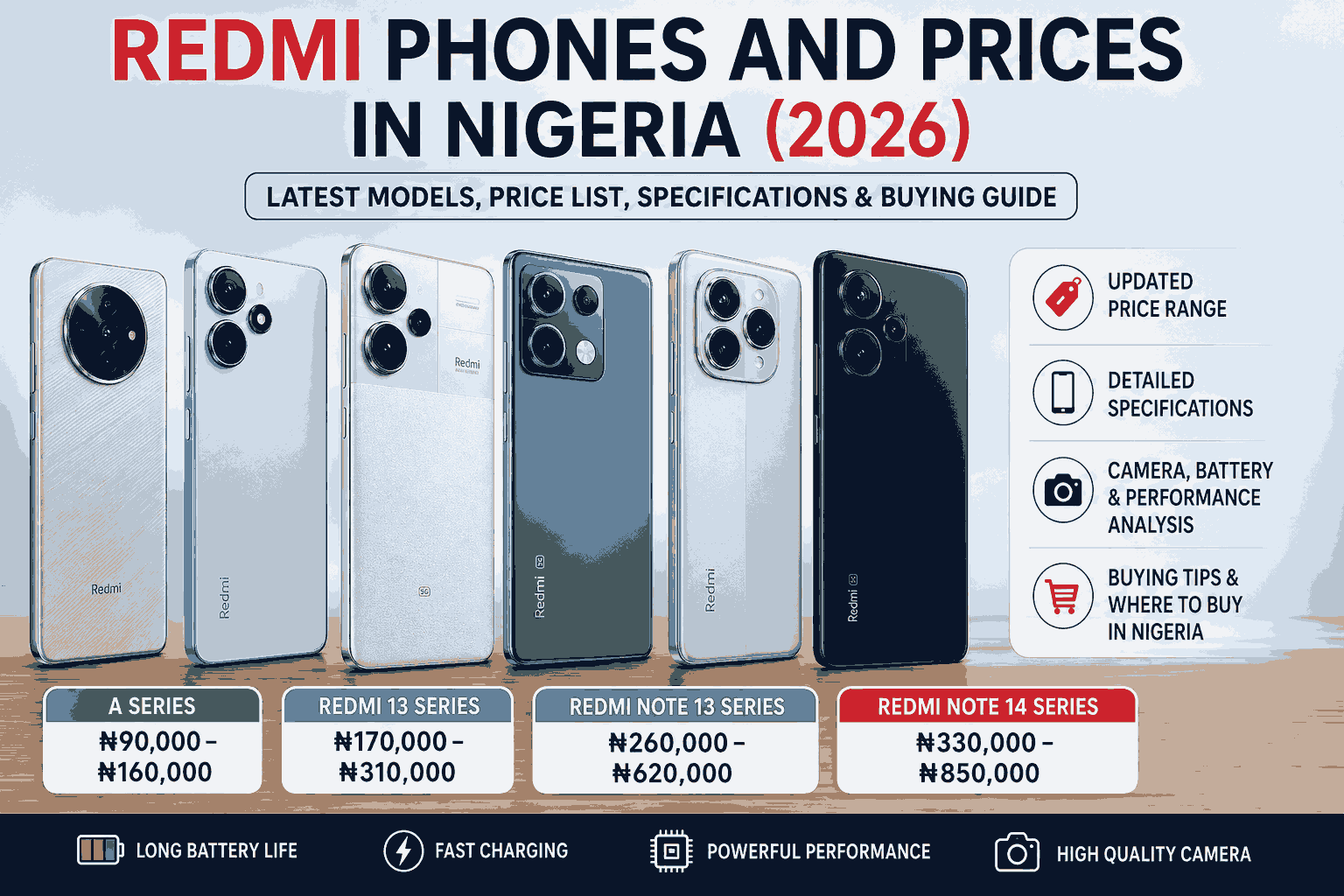
Instead of simply listing Redmi smartphone prices, this guide explains why prices differ, which Redmi model suits different types of buyers, what features justify the cost, and how Redmi compares with competing brands such as Samsung Galaxy A Series, Infinix, Tecno Spark, Tecno Camon, and POCO.
The goal is to help Nigerian buyers make informed purchasing decisions rather than simply showing prices.
Current Price Summary
Redmi smartphones remain among the most affordable Android devices available in Nigeria. Depending on the model, RAM configuration, storage capacity, and retailer, buyers can expect prices to range from approximately:
| Series | Estimated Price Range (₦) |
|---|---|
| Redmi A Series | ₦90,000 – ₦160,000 |
| Redmi 13 Series | ₦170,000 – ₦310,000 |
| Redmi Note 13 Series | ₦260,000 – ₦620,000 |
| Redmi Note 14 Series | ₦330,000 – ₦850,000 |
These prices are based on recent listings from reputable Nigerian electronics retailers and marketplaces. Actual prices may vary because of exchange rates, promotions, stock availability, colour options, and warranty coverage.
Redmi has established itself as one of the most popular smartphone brands in Nigeria by offering impressive features at competitive prices. Manufactured by Xiaomi, Redmi devices are particularly appealing to students, professionals, gamers, content creators, and anyone seeking good performance without paying flagship prices.
Unlike many budget smartphones that compromise heavily on display quality or processing power, Redmi often combines modern designs, large batteries, capable cameras, and efficient processors into affordable devices.
However, choosing the right Redmi phone is not always straightforward. Several models look similar, yet their processors, camera systems, charging speeds, and software experience can differ significantly. Prices also fluctuate regularly because most Redmi devices are imported, making them sensitive to changes in exchange rates and import costs.
This guide explains the latest Redmi phone prices in Nigeria while providing detailed analysis of each model to help you identify the best value for your budget.
Quick Price Summary
Below is a quick overview of popular Redmi smartphones currently available in Nigeria.
| Redmi Phone | Estimated Price (₦) |
|---|---|
| Redmi A3 | ₦90,000 – ₦125,000 |
| Redmi A5 | ₦120,000 – ₦160,000 |
| Redmi 13 | ₦180,000 – ₦250,000 |
| Redmi 13 5G | ₦230,000 – ₦310,000 |
| Redmi Note 13 (4G) | ₦260,000 – ₦340,000 |
| Redmi Note 13 5G | ₦330,000 – ₦430,000 |
| Redmi Note 13 Pro | ₦420,000 – ₦560,000 |
| Redmi Note 13 Pro+ | ₦560,000 – ₦650,000 |
| Redmi Note 14 | ₦330,000 – ₦430,000 |
| Redmi Note 14 Pro | ₦500,000 – ₦650,000 |
| Redmi Note 14 Pro+ | ₦650,000 – ₦850,000 |
Important: Prices are estimates based on Nigerian retail listings and can change frequently.
Redmi Phone Prices in Nigeria by Series
Redmi A Series
The Redmi A Series is Xiaomi’s entry-level smartphone lineup. These devices prioritise affordability while still offering essential smartphone features such as large displays, long battery life, and Android software.
Redmi A3
Estimated Price: ₦90,000–₦125,000
Ideal for:
- Students
- First-time smartphone users
- Basic social media
- YouTube
- Calls and messaging
Main Features
- 6.71-inch display
- MediaTek Helio G36 processor
- 5000mAh battery
- Up to 128GB storage
Strengths
- Excellent battery life
- Attractive design
- Affordable
Weaknesses
- Limited gaming performance
- Slow charging
Redmi A5
Estimated Price: ₦120,000–₦160,000
Compared to the A3, the Redmi A5 offers modest improvements in processing speed, camera performance, and overall responsiveness.
It is better suited to users who keep many apps open simultaneously or require a smoother everyday experience.
Redmi 13 Series
The Redmi 13 Series bridges the gap between entry-level and mid-range smartphones.
Redmi 13
Estimated Price:
₦180,000–₦250,000
Key Specifications
- 6.79-inch FHD+ display
- 90Hz refresh rate
- MediaTek Helio G91 Ultra
- 108MP main camera
- 5030mAh battery
- 33W fast charging
Editorial Analysis
The Redmi 13 offers one of the best combinations of display quality and camera resolution in its price category. While the 108MP camera does not always outperform lower-resolution competitors in every lighting condition, it captures detailed daylight images and performs well for casual photography.
Redmi 13 5G
Estimated Price:
₦230,000–₦310,000
Highlights
- Snapdragon processor
- 5G connectivity
- Better future-proofing
- Improved efficiency
- Excellent battery endurance
For buyers planning to keep their phone for several years, the Redmi 13 5G represents better long-term value than the standard Redmi 13.
Redmi Note 13 Series
The Redmi Note lineup has consistently been Xiaomi’s most successful smartphone range because it combines premium features with relatively affordable pricing.
Redmi Note 13 (4G)
Estimated Price:
₦260,000–₦340,000
Key Features
- AMOLED display
- 120Hz refresh rate
- Snapdragon processor
- 108MP camera
- 5000mAh battery
- 33W fast charging
Editorial Opinion
This model is an excellent choice for buyers who value display quality above raw performance. The AMOLED screen provides deeper blacks, richer colours, and better outdoor visibility than many competing LCD displays.
Redmi Note 13 5G
Estimated Price:
₦330,000–₦430,000
Major Improvements
- 5G connectivity
- Faster processor
- Better power efficiency
- Improved gaming
- Faster downloads
Redmi Note 13 Pro
Estimated Price:
₦420,000–₦560,000
Key Upgrades
- 200MP primary camera
- Faster charging
- More RAM
- Better image processing
- Improved performance
The Redmi Note 13 Pro appeals to photography enthusiasts and power users who want flagship-like features without paying flagship prices.
Redmi Note 13 Pro+
Estimated Price:
₦560,000–₦650,000
Premium Features
- Curved AMOLED display
- IP68 water resistance
- 120W HyperCharge
- Premium glass construction
- Advanced camera system
This is one of Redmi’s most premium offerings and is suitable for users seeking flagship-level features at a lower cost than many competing premium smartphones.
Redmi Note 14 Series
The Redmi Note 14 series builds upon the success of the Note 13 lineup with upgraded processors, enhanced cameras, brighter displays, and improved software support.
Redmi Note 14
Estimated Price: ₦330,000–₦430,000
Designed for users who want a balance of performance and affordability, the Redmi Note 14 typically offers an AMOLED display with a high refresh rate, a capable mid-range processor, and a large battery that comfortably lasts a full day under normal use.
Redmi Note 14 Pro
Estimated Price: ₦500,000–₦650,000
The Pro variant introduces a more powerful chipset, improved image processing, faster charging, and a higher-quality camera system. It is well suited for mobile photography enthusiasts, multitaskers, and users who regularly play graphics-intensive games.
Redmi Note 14 Pro+
Estimated Price: ₦650,000–₦850,000
As the flagship model in the Note 14 range, the Pro+ includes premium features such as ultra-fast charging, a high-end AMOLED display, advanced camera capabilities, and enhanced durability. It competes closely with upper mid-range smartphones from Samsung, POCO, and Motorola while generally maintaining Redmi’s reputation for strong value.
Key Specifications at a Glance
| Model | Display | Processor | Camera | Battery | Charging |
|---|---|---|---|---|---|
| Redmi A3 | 6.71-inch LCD | Helio G36 | 8MP AI Dual | 5000mAh | 10W |
| Redmi A5 | 6.88-inch LCD | Unisoc T7250 | 32MP AI | 5200mAh | 15W |
| Redmi 13 | 6.79-inch FHD+ LCD, 90Hz | Helio G91-Ultra | 108MP | 5030mAh | 33W |
| Redmi 13 5G | 6.79-inch FHD+, 120Hz | Snapdragon 4 Gen 2 | 108MP | 5030mAh | 33W |
| Redmi Note 13 | 6.67-inch AMOLED, 120Hz | Snapdragon 685 | 108MP | 5000mAh | 33W |
| Redmi Note 13 Pro | 6.67-inch AMOLED, 120Hz | Helio G99 Ultra (4G) / Snapdragon (5G variant) | 200MP | 5000mAh | 67W |
| Redmi Note 13 Pro+ | 6.67-inch Curved AMOLED | Dimensity 7200 Ultra | 200MP | 5000mAh | 120W |
Design and Build Quality
One of Redmi’s biggest strengths is its ability to deliver smartphones that look and feel more premium than their price suggests. Even entry-level models such as the Redmi A3 feature modern styling with slim bezels and textured rear panels that resist fingerprints better than glossy finishes.
The Redmi 13 and Redmi Note series introduce glass-like backs, flatter frames, and more refined camera modules that closely resemble higher-end devices. The Note Pro and Pro+ variants further improve durability with better water and dust resistance and stronger display protection, making them suitable for users who want a more premium in-hand experience.
Performance Overview
Performance varies significantly across the Redmi range, making it important to choose a model that matches your needs.
For basic tasks such as browsing, messaging, streaming videos, and social media, the Redmi A series provides adequate performance at a very affordable price.
The Redmi 13 series offers a noticeable improvement in speed thanks to more capable processors and faster storage, making it suitable for moderate multitasking and casual gaming.
The Redmi Note series is aimed at users who demand more from their smartphones. Higher-end models handle intensive gaming, video editing, and productivity tasks far more effectively, while also benefiting from smoother displays and faster charging.
Camera Performance
One of the main reasons Redmi phones remain popular in Nigeria is their strong camera performance relative to price. While megapixel numbers often receive the most attention, image quality depends on several factors, including the sensor size, image processing software, lens quality, and lighting conditions.
Redmi A Series
The Redmi A series is designed for everyday photography rather than professional use. The cameras are suitable for:
- WhatsApp status updates
- Facebook and Instagram posts
- Video calls
- Document scanning
- Casual daylight photography
Photos captured in good lighting are generally clear, but image quality drops noticeably in low-light environments. These models are best suited to users with basic photography needs.
Redmi 13 Series
The Redmi 13 represents a significant improvement over the A series. Its 108MP primary camera captures more detail in daylight, and Xiaomi’s image processing enhances colour accuracy and sharpness.
Users can expect:
- Better portrait photography
- Improved HDR performance
- Sharper landscape shots
- Higher-quality videos for social media
While the high-resolution sensor is impressive, users should not assume that more megapixels automatically result in better photos. The quality of image processing remains equally important.
Redmi Note Series
The Redmi Note series targets users who enjoy mobile photography.
Higher-end models feature:
- Larger camera sensors
- Optical Image Stabilisation (on selected variants)
- Improved night photography
- Better portrait effects
- Enhanced AI scene recognition
- More detailed 4K video recording on supported models
The Redmi Note 13 Pro and Redmi Note 14 Pro series offer some of the best camera systems available in the upper mid-range segment.
Display Quality
Display quality has become one of Redmi’s strongest selling points.
LCD Displays
Entry-level Redmi phones use LCD panels that provide:
- Good brightness indoors
- Decent colour reproduction
- Lower manufacturing costs
- Better affordability
These displays are perfectly suitable for everyday use but cannot match the deep blacks and vibrant colours of AMOLED screens.
AMOLED Displays
Most Redmi Note models feature AMOLED displays that offer:
- Richer colours
- Higher contrast
- Deeper blacks
- Better outdoor visibility
- Lower power consumption when using dark mode
- Always-On Display support on compatible models
For users who stream Netflix, YouTube, or other video content, the AMOLED-equipped Redmi Note models provide a noticeably better viewing experience.
Battery Life
Battery endurance is one of Redmi’s biggest strengths.
Most recent Redmi smartphones include batteries of around 5,000mAh, with some newer models offering slightly larger capacities.
Under typical usage, many users can expect:
- Up to two days of light use
- A full day of moderate to heavy use
- Several hours of gaming before requiring a recharge
Battery performance will naturally vary depending on screen brightness, network conditions, and the applications being used.
Fast Charging
Charging speeds vary by model:
| Series | Charging Speed |
|---|---|
| Redmi A Series | 10W–15W |
| Redmi 13 | 33W |
| Redmi Note 13 | 33W |
| Redmi Note 13 Pro | 67W |
| Redmi Note 13 Pro+ | 120W |
| Redmi Note 14 Pro+ | Up to 120W (variant dependent) |
Faster charging is particularly useful for busy professionals and students who need to top up their phones quickly during the day.
Software Experience
Modern Redmi smartphones run Xiaomi’s Android-based software (marketed as HyperOS on newer devices). The interface includes features such as:
- Split-screen multitasking
- Floating windows
- Extensive customisation
- Enhanced security options
- Device optimisation tools
- AI-assisted features on supported models
As with many budget and mid-range Android phones, some pre-installed applications may be included. Many of these can be disabled or removed if they are not required.
Advantages of Redmi Phones
Redmi smartphones offer several compelling advantages:
- Excellent value for money.
- Competitive pricing across multiple budget levels.
- Large batteries with dependable battery life.
- Strong display quality, especially on AMOLED-equipped models.
- Capable cameras for everyday photography.
- Attractive modern designs.
- Reliable performance for daily tasks and moderate gaming.
- Wide range of models to suit different budgets.
- Good availability of spare parts and accessories in Nigeria.
Disadvantages of Redmi Phones
Despite their strengths, Redmi devices are not without drawbacks.
Potential disadvantages include:
- Software updates may arrive later than on some premium brands.
- Entry-level models have limited gaming performance.
- Camera performance declines in poor lighting on budget models.
- Some variants include pre-installed applications.
- After-sales support may vary depending on whether the phone was purchased through an authorised retailer or an unofficial importer.
Who Should Buy Redmi Phones?
Redmi smartphones are particularly well suited to:
Students
Affordable models provide excellent battery life and reliable performance for online learning, messaging, and entertainment.
Working Professionals
The Redmi 13 and Redmi Note series offer dependable multitasking, quality displays, and long battery life for work-related tasks.
Mobile Gamers
Higher-end Redmi Note Pro models include faster processors and smoother displays, making them suitable for games such as Call of Duty: Mobile, PUBG Mobile, and eFootball.
Content Creators
The Redmi Note Pro series offers higher-resolution cameras, improved image processing, and faster performance for recording videos and editing content.
Who Should Consider Alternatives?
Depending on your priorities, another brand may be a better fit.
- If you prioritise long-term software support, Samsung’s Galaxy A series may be worth considering.
- If you prefer a cleaner Android experience with fewer pre-installed apps, Motorola or Nokia devices could appeal.
- If your budget is very limited, Tecno Spark and Infinix Smart models often provide competitive alternatives.
- If gaming performance is your main concern, POCO smartphones frequently deliver more powerful processors at similar prices.
Redmi vs Competing Brands
Redmi vs Samsung Galaxy A Series
Samsung typically provides a more refined software experience and longer update support. Redmi, however, often offers faster charging, more powerful hardware, and better value at the same price point.
Redmi vs Tecno
Tecno competes aggressively in the entry-level segment, but Redmi generally delivers stronger processors and more consistent software performance in comparable price ranges.
Redmi vs Infinix
Infinix appeals to users seeking gaming-oriented features and large displays. Redmi counters with stronger camera systems and a more balanced overall experience.
Redmi vs POCO
POCO and Redmi share the same parent company and often use similar hardware. POCO models tend to focus more on raw performance, while Redmi devices emphasise balanced features, camera quality, and everyday usability.
Buying Tips
Before purchasing a Redmi smartphone in Nigeria, consider the following:
- Buy from reputable retailers or authorised Xiaomi distributors whenever possible.
- Compare prices across multiple stores before making a purchase.
- Confirm the amount of RAM and internal storage, as these affect both performance and price.
- Ensure the device includes a valid warranty.
- Check that the phone supports the network bands used by your preferred mobile operator.
- If buying online, review the seller’s ratings and return policy.
- Be cautious of unusually low prices, which may indicate refurbished or unofficially imported devices.
Where to Buy Redmi Phones in Nigeria
Redmi smartphones are widely available through:
- Xiaomi-authorised retail stores.
- Established electronics retailers.
- Trusted online marketplaces.
- Mobile phone dealers with verified warranty support.
When comparing offers, consider more than just the purchase price. Warranty coverage, after-sales service, and the seller’s reputation can provide better long-term value than choosing the cheapest available option.
Also Read: Tecno Phones and Prices in Nigeria
How to Choose the Right ₦1,000-a-Day Strategy
The best way to approach how to earn 1k daily in Nigeria is to match the method with what you already have: a skill, a customer network, available capital, transport, equipment or time. A person with no inventory budget may be better suited to a service, while someone with local customers may be able to start a small reselling operation.
Start with the asset you already have
If you already know how to write, design, teach, edit videos, manage social media or repair something, test that skill before spending money on stock. If you already have access to a reliable supplier and know what people around you buy, product reselling may make more sense.
For readers considering product sales, our guide on what you can sell to make money every day in Nigeria explains how to test demand, manage stock and calculate real profit.
Think in monthly averages
Daily income will naturally fluctuate. Instead of becoming discouraged because one day produces nothing, track your total weekly and monthly profit. A business that produces ₦7,000 across a week is still meeting the mathematical equivalent of ₦1,000 per day on average.
If you want to move beyond the first milestone, compare this guide with our article on how to earn ₦5,000 per day in Nigeria. The important progression is to increase the value of each customer, improve repeat purchases or serve more customers without allowing expenses to grow faster than revenue.
How to Turn Small Daily Earnings Into Working Capital
Making the first ₦1,000 is only useful if you manage it carefully. Consider separating business money from personal spending. If every small profit is immediately withdrawn for personal use, the business may remain at the same size indefinitely.
- Record the sale: Write down what came in.
- Subtract direct costs: Include stock, transport, data, packaging or platform charges.
- Set aside operating money: Keep enough to serve the next customer.
- Reinvest deliberately: Spend only where additional capital can reasonably improve the business.
- Keep a reserve: Small businesses can experience slow days, damaged stock or unexpected expenses.
Readers who already have capital can also compare this approach with our guide on how to make money with ₦500,000 and our guide to businesses that can be started with ₦500,000. More capital does not automatically produce more profit; the business model still has to work.
How to Test an Income Idea Before Spending More Money
A simple test can prevent many beginners from losing money. Define one customer, one problem, one offer and one price. Then try to obtain a small number of genuine customers before buying more equipment or inventory.
For example, someone offering social-media graphics could create three sample designs and approach local businesses that clearly need promotional material. Someone selling phone accessories could begin with a small quantity of products instead of filling a room with stock. Someone offering tutoring could start with one or two learners and improve the lesson process before expanding.
Track evidence instead of excitement
After the test, record how many people were contacted, how many responded, how many bought, how much was spent to acquire each customer and how much net profit remained. This evidence is more useful than screenshots showing someone else’s income.
If your goal eventually becomes larger wealth rather than only a daily side income, you can also read our guide on becoming a millionaire in Nigeria. The same principle applies: build measurable income first, then improve saving, reinvestment and business capacity over time.
How to Compare Redmi Prices Before Buying
The price of a Redmi phone should be compared with the exact model, RAM and storage configuration, condition, warranty and seller. Two phones that appear to have the same name can have different specifications or market prices. Before paying, confirm the model number and storage capacity rather than relying only on the name shown in an advert.
It is also useful to compare the total purchase cost. Delivery charges, accessories, warranty arrangements and payment terms can affect the final amount you spend. A slightly cheaper listing may not be the cheaper option if it has no meaningful warranty or requires additional expenses immediately after purchase.
Check the Condition of the Phone
For a used or UK-used Redmi phone, inspect the screen, cameras, charging port, speakers, microphone, battery condition and network connectivity. Check whether the phone has been repaired and whether the device is properly reset before you take ownership.
For a new device, check the packaging, model details and warranty information. Keep your receipt or other proof of purchase in case you need after-sales support.
Storage and RAM Can Change the Value
When comparing Redmi phones, do not treat storage and RAM as minor details. More storage can be useful for people who keep many photos, videos, apps and documents, while adequate RAM can help when several applications are open. However, paying more only makes sense when the additional capacity matches your actual usage.
Before choosing a configuration, consider how you use your current phone. If you regularly run out of storage, a larger capacity may solve a real problem. If your main activities are calls, messaging and light browsing, spending substantially more for a higher configuration may not provide the same practical benefit.
Redmi Pricing and Exchange-Rate Changes
Imported smartphones can be affected by changes in currency costs, shipping, supplier pricing and local inventory. This means the price of a particular Redmi model can change even when the phone itself has not received a new hardware version.
When researching prices, record the date and seller of the quote. If you are comparing several phones, compare their prices under similar conditions instead of mixing new, used and refurbished devices in one list.
For broader market comparisons, you can also read our guides to Tecno phones and prices in Nigeria and Samsung phone prices in Nigeria. If you are considering another Xiaomi-related option, our latest Redmi phone guide can also help with model selection.
How to Decide What You Can Actually Afford
A phone budget should include more than the amount on the price tag. If buying a phone will consume money needed for rent, food, transport, school fees, business stock or emergency expenses, consider whether the purchase can wait.
One practical method is to set a maximum phone budget before shopping and then compare models within that limit. This reduces the temptation to keep increasing the budget because a more expensive model has one additional feature.
Questions to Ask a Seller Before Payment
- Is the phone new, used or refurbished?
- What are the exact RAM and storage specifications?
- Is the device network-unlocked and compatible with the networks I use?
- What warranty or return arrangement is provided?
- Has the phone been repaired or had major components replaced?
- What is included in the box?
- Is the advertised price the final price or are there additional charges?
How to Avoid Buying Based Only on a Low Price
A low price can be useful, but it should trigger verification rather than an immediate purchase. Check the seller, inspect the device where possible and compare the offer with several other sellers. Be cautious if a deal is dramatically below comparable listings and the seller cannot clearly explain the condition or source of the phone.
If your budget is limited, our guide to phones you can get for ₦200,000 in Nigeria provides another way to compare options by budget. You can also review our general smartphone buying guide before making a final choice.
Make the Phone Fit Your Actual Needs
The most useful Redmi phone is not necessarily the model with the highest specification. Think about your daily activities: calls, WhatsApp, social media, photography, gaming, streaming, work applications and storage. Then identify the features that directly affect those activities.
This approach helps you avoid paying for specifications you will rarely use while ensuring that important requirements such as battery life, camera quality, storage and network compatibility are not overlooked.
Editorial Verdict
Redmi continues to offer one of the most balanced smartphone line-ups available in Nigeria. Whether you are purchasing your first smartphone, replacing an older device, or upgrading to a feature-rich mid-range model, there is likely to be a Redmi phone that matches your needs and budget.
The Redmi A series is ideal for essential smartphone use, while the Redmi 13 series provides a strong balance of affordability and everyday performance. For buyers seeking premium displays, advanced cameras, and faster charging without paying flagship prices, the Redmi Note series remains one of the strongest options in its class.
Rather than focusing solely on headline specifications, buyers should choose a model based on how they intend to use the phone. Factors such as software support, camera quality, charging speed, and overall user experience often have a greater impact on long-term satisfaction than processor benchmarks alone.
Buying Recommendation
- Best budget choice: Redmi A3 or Redmi A5 for basic communication, browsing, and social media.
- Best value for money: Redmi 13 for users who want dependable performance and a capable camera at a reasonable price.
- Best mid-range option: Redmi Note 13 or Redmi Note 14 for an excellent balance of display quality, performance, and battery life.
- Best premium Redmi: Redmi Note 14 Pro+ for buyers seeking flagship-inspired features, advanced cameras, and ultra-fast charging at a lower price than many flagship competitors.
Verification Notes
- Specifications in this guide are based on Xiaomi’s official product information and publicly available device specifications.
- Nigerian price ranges are indicative and compiled from established retailers and major online marketplaces.
- Prices are not fixed and may change due to exchange rates, import duties, stock levels, seasonal promotions, storage capacity, colour variants, and warranty options.
- Buyers should confirm the latest pricing and availability with the retailer before making a purchase.
Final Quality Assessment
This guide goes beyond a standard product listing by combining current market price ranges with practical buying advice, technical explanations, and editorial analysis tailored to Nigerian consumers. Rather than simply repeating specifications, it explains how features such as display technology, battery capacity, charging speed, and processor choice affect everyday use.
It also compares Redmi with key competitors, identifies the strengths and limitations of different series, and highlights which models suit different types of buyers. This provides readers with the context needed to make informed purchasing decisions instead of relying solely on price.
Because smartphone prices in Nigeria are influenced by exchange rates, import costs, retailer promotions, and product availability, the pricing information should be reviewed periodically to ensure it remains current.















[…] related guides can help you compare Samsung with other brands: Redmi phones and prices in Nigeria and Tecno phones and prices in Nigeria. You can also review our general smartphone buying guide if […]