




This article treats “How can I become a millionaire in Nigeria?” as a practical wealth-building question rather than a get-rich-quick search. The central argument is that reaching ₦1 million in net worth is achievable for many people, but the more meaningful goal is to build an income-generating system that can continue growing after the first ₦1 million.
The guide therefore focuses on increasing earning power, controlling expenses, building a small business or valuable skill, investing responsibly, avoiding scams, and protecting wealth from unnecessary financial risks.
For this article, “millionaire” means having at least ₦1,000,000 in net worth the value of what you own minus what you owe. That distinction matters because someone earning ₦1 million a month is not necessarily a millionaire, while someone with modest monthly income could eventually become one by accumulating savings, investments and business assets.
How Can I Become a Millionaire in Nigeria? A Realistic Step-by-Step Guide
If you have searched “How can I become a millionaire in Nigeria?”, you may be hoping for one investment, business idea or secret strategy that can transform your finances quickly. Unfortunately, building genuine wealth rarely works that way.
Becoming a naira millionaire is possible, but the dependable route is usually less exciting: increase your income, spend less than you earn, save consistently, acquire productive assets, invest carefully and give your money enough time to compound.
There is also an important distinction between becoming a ₦1 million millionaire and becoming financially wealthy. In today’s Nigeria, ₦1 million is a useful milestone, but it should be treated as the beginning of a wealth-building journey rather than the finish line.
Nigeria’s financial environment also makes the strategy important. The Central Bank of Nigeria’s Monetary Policy Committee retained the Monetary Policy Rate at 26.5% in July 2026, illustrating how expensive money remains in the economy. At the same time, the Securities and Exchange Commission continues to warn Nigerians about unregistered online investment schemes promising unrealistic returns.
So, how can I become a millionaire in Nigeria? The practical answer is to build a system that consistently turns your skills, labour or capital into more capital.
What Does It Actually Mean to Be a Millionaire in Nigeria?
The simplest definition is having a net worth of at least ₦1,000,000.
Your net worth can include:
- Cash and savings
- Investments
- Business ownership
- Valuable equipment used to generate income
- Property or land
- Other assets with genuine economic value
You subtract your outstanding debts from those assets.
For example, imagine someone has:
- ₦400,000 in savings
- ₦300,000 invested
- A small business worth ₦500,000
- ₦100,000 in outstanding debt
Their approximate net worth is:
₦400,000 + ₦300,000 + ₦500,000 − ₦100,000 = ₦1.1 million
That person could technically be a naira millionaire even without earning ₦1 million every month.
This is why the question “How can I become a millionaire in Nigeria?” should really be reframed as:
How can I consistently create more financial value than I consume?
That question leads to a much more useful strategy.
How Much Money Do You Need to Save to Reach ₦1 Million?
The mathematics of becoming a millionaire becomes much less intimidating when the target is broken into smaller amounts.
| Amount saved monthly | Approximate time to save ₦1 million* |
|---|---|
| ₦20,000 | 50 months |
| ₦30,000 | 34 months |
| ₦50,000 | 20 months |
| ₦75,000 | 14 months |
| ₦100,000 | 10 months |
| ₦150,000 | 7 months |
| ₦200,000 | 5 months |
*This is simple arithmetic and does not account for investment returns, taxes, fees, emergencies or changes in the value of money.
The important lesson is that income matters enormously.
Someone earning ₦80,000 and spending nearly all of it may struggle to accumulate wealth. Someone earning ₦300,000 who can consistently retain ₦100,000 has a much clearer path.
That is why simply telling people to “save more” is incomplete advice.
For many Nigerians, the first priority should be increasing the amount of money coming in.
How Can I Become a Millionaire in Nigeria?
Start by Increasing Your Income
There are three broad levers in personal finance:
- Earn more.
- Keep more of what you earn.
- Put the surplus to productive use.
If your income is extremely low, cutting expenses alone has a ceiling. There is only so much you can save when your entire income is already being used for basic necessities.
Increasing earning power therefore deserves serious attention.
Learn a Skill People Are Willing to Pay For
A valuable skill can become an income-producing asset.
Examples include:
- Web development
- Graphic design
- Video editing
- Copywriting
- Digital marketing
- Software development
- Data analysis
- Virtual assistance
- Social media management
- Photography
- Tailoring
- Hairdressing and beauty services
- Electrical work
- Plumbing
- Phone repair
- Catering
- Sales
The best skill is not necessarily the trendiest one.
A better question is:
Can I solve a problem for which someone is willing to pay me?
For example, learning graphic design is not automatically profitable. Being able to create promotional materials that help businesses communicate with customers is more commercially useful.
The same principle applies to almost every skill.
Consider Selling Services Before Starting a Capital-Heavy Business
One of the easiest ways to test entrepreneurship is to start with a service.
Suppose you have ₦100,000 available. You could spend the entire amount purchasing inventory for a business you have never tested.
Or you could use a smaller portion to acquire the tools and knowledge required to offer a service and keep more of your capital available.
Service businesses can include:
- Website creation
- Social media management
- Cleaning
- Catering
- Photography
- Repairs
- Tutoring
- Personal training
- Event support
- Digital advertising
- Business documentation
- Printing and design
The advantage is that you are selling your skill and time, rather than carrying large amounts of inventory.
That does not make services automatically profitable. You still need customers, good pricing, reliability and proper cost control.
But it can reduce the amount of capital required to test a business idea.
Build a Small Business That Can Grow Beyond Your Labour
If you want to know how can I become a millionaire in Nigeria through entrepreneurship, think beyond simply “starting a business”.
The real objective is to build something with:
- Repeat customers
- Healthy profit margins
- Reliable suppliers
- Good record-keeping
- Predictable demand
- Processes that can be repeated
- Potential to employ or outsource work
For example, selling 20 items personally every month may produce useful income.
But if you develop a system that allows 200 items to be sold without personally handling every transaction, you have created something more scalable.
Nigeria’s small and medium-sized businesses are economically significant. The World Bank describes MSMEs as the backbone of the Nigerian economy, accounting for most businesses, nearly half of GDP and a large share of jobs. However, it also reports that fewer than one in 20 MSMEs has access to bank credit, highlighting the importance of managing capital carefully rather than assuming cheap financing will always be available.
Formalise the Business When It Makes Sense
As a business grows, formalisation can become useful for credibility, contracts, banking and access to certain opportunities.
Nigeria’s Corporate Affairs Commission provides official business-name and company registration services. Its current process allows business-name registration through the online Company Registration Portal.
The CAC also states that registration can provide legal recognition and help businesses establish credibility with customers, partners and financial institutions.
However, registering a business does not make the business profitable.
Do not confuse formal registration with business success.
The customer, economics and execution still matter.
Use the Internet to Reach Customers Beyond Your Immediate Location
The internet has changed the potential market for a Nigerian entrepreneur.
A person in Lagos, Ibadan, Abuja, Benin City, Kano or Enugu can potentially sell services to customers elsewhere in Nigeria or internationally.
This is particularly relevant for digital services.
A person who earns in foreign currency can potentially build naira wealth faster than someone whose income remains fixed in naira, although foreign clients also bring challenges such as competition, payment costs, taxes and exchange-rate fluctuations.
Instead of thinking:
“What business can I start with ₦1 million?”
consider asking:
“What problem can I solve for someone who can pay me repeatedly?”
That shift in thinking can be more valuable than searching endlessly for a supposedly perfect business idea.
Don’t Ignore Your Existing Job
You do not necessarily need to quit your job to become a millionaire.
A salary can provide something extremely valuable: predictable cash flow.
If your job pays your essential bills, you can potentially use additional income from a side business or freelance service to accelerate wealth accumulation.
For example:
- Salary pays household expenses.
- Side income builds an emergency fund.
- Business profits are reinvested.
- Long-term surplus is invested.
This creates several financial engines instead of depending entirely on one source of income.
The objective is not to have five jobs that leave you exhausted.
The objective is to gradually build multiple sources of productive income.
Create a Millionaire Plan Based on Your Current Income
A realistic plan should begin with your actual financial position.
If You Earn ₦100,000 Per Month
Your first goal may not be investing.
It may be increasing your earning capacity.
If you can eventually move from ₦100,000 to ₦200,000 or ₦300,000 through a better skill, job, business or side income, the wealth-building equation changes dramatically.
If You Earn ₦300,000 Per Month
You have more room to build:
- Emergency savings
- Skill-development capital
- Business capital
- Investments
- Long-term savings
If You Earn ₦500,000 or More
The focus can increasingly shift towards:
- Asset accumulation
- Diversification
- Business expansion
- Investments
- Tax and financial planning
- Protecting wealth
There is no universal percentage that works for everyone.
Rent, food, transport, dependants, school fees, healthcare and debt obligations differ enormously between households.
The principle is more important than the exact percentage:
Create a predictable gap between your income and expenses, then direct that gap towards wealth-building.
Build an Emergency Fund Before Taking Serious Investment Risk
One common mistake is investing every available naira while having no emergency reserve.
Imagine you invest ₦500,000 and then lose your income the following month.
If you need money immediately, you may be forced to sell an investment at an inconvenient time or borrow at an expensive rate.
A basic emergency fund can reduce that pressure.
Depending on your circumstances, you might aim gradually for several months of essential expenses rather than trying to reach an arbitrary figure immediately.
The exact amount depends on:
- Job stability
- Number of dependants
- Monthly expenses
- Existing insurance
- Access to family support
- Business volatility
An emergency fund is not designed to make you rich.
It is designed to prevent one emergency from destroying your wealth-building progress.
Invest After You Understand What You Are Buying
Saving money is only one part of wealth creation.
Over the long term, productive investments can help your money grow, but investment always involves some level of risk.
Nigeria’s Securities and Exchange Commission encourages investors to establish clear goals, understand their risk tolerance, conduct research and diversify investments.
Potential investment categories may include:
- Government securities
- Regulated money-market products
- Shares
- Bonds
- Mutual funds
- Business ownership
- Property
- Other regulated investment products
The appropriate choice depends on your objectives, time horizon, liquidity needs and risk tolerance.
Do Not Invest Simply Because Someone Promises a High Return
This is particularly important in Nigeria’s current online investment environment.
In May 2026, the SEC warned Nigerians about increasing promotion of unregistered online investment schemes on platforms including WhatsApp, Instagram, Telegram, Facebook and TikTok. The regulator specifically warned against schemes promising unrealistic or guaranteed returns.
The SEC has also issued multiple warnings about specific unregistered investment operations and platforms.
A simple rule is useful:
If you cannot explain how the investment makes money, you should not invest your money in it.
And before using an investment company or platform, verify its regulatory status where applicable.
The SEC provides investor-education resources and tools for checking registered operators.
Why “Double Your Money Quickly” Is Usually the Wrong Strategy
Suppose someone tells you:
“Give me ₦200,000 and I will return ₦400,000 in 30 days.”
The promise sounds attractive because it appears to solve the millionaire problem immediately.
But extraordinary returns generally involve extraordinary risk — and guaranteed extraordinary returns should be treated as a major warning sign.
The SEC’s investor guidance identifies unrealistic high returns, unregistered operators and recruitment-dependent models as characteristics associated with Ponzi schemes.
The safest millionaire strategy is usually much less dramatic:
Earn → save → invest/reinvest → repeat.
That process may feel slow.
But sustainable wealth is supposed to be boring compared with gambling.
Understand the Difference Between Business Revenue and Profit
Another common misconception is thinking:
“My business made ₦5 million, so I am rich.”
Not necessarily.
Imagine a business generates:
- ₦5 million revenue
- ₦3.8 million inventory and operating costs
- ₦500,000 transport and marketing costs
- ₦300,000 other expenses
The remaining ₦400,000 is much closer to the economic benefit of the business before considering other obligations.
Revenue is not profit.
Profit is not automatically personal wealth either.
If the ₦400,000 is spent immediately, your net worth may barely change.
A stronger wealth-building business uses some profits to:
- Increase inventory
- Improve equipment
- Acquire customers
- Build reserves
- Reduce expensive debt
- Invest in productive assets
This is how income can gradually become wealth.
Use Compound Growth: Don’t Depend on Unrealistic Returns
Compounding means your returns can themselves generate additional returns.
For example, if you invest money and it earns a return, leaving the earnings invested can increase the base on which future returns are calculated.
However, the exact return is never guaranteed for most investments.
That distinction matters.
Do not build your millionaire plan around statements such as:
“This investment will definitely give me 20% every month.”
Instead, model several scenarios.
Ask:
- What happens if returns are lower than expected?
- What happens if I lose part of my investment?
- What happens if I need the money earlier?
- What fees apply?
- Is the investment regulated?
- What happens after inflation?
The Central Bank of Nigeria currently maintains a relatively high monetary-policy rate, and its July 2026 MPC decision retained the MPR at 26.5%. This is one reason investors should avoid assuming that a particular deposit, bond or other product will automatically provide a certain return simply because market rates are elevated.
Inflation Changes What “₦1 Million” Means
There is an important problem with the question “How can I become a millionaire in Nigeria?”
A million naira is a fixed number, but its purchasing power is not fixed.
As prices rise over time, ₦1 million may buy less than it did several years earlier.
Therefore, you should have two goals:
Goal 1: Reach ₦1 million in net worth
This gives you a measurable first milestone.
Goal 2: Build wealth that grows faster than your lifestyle and, where possible, preserves purchasing power
This is the more important long-term objective.
A person who reaches ₦1 million and immediately spends it has completed a milestone but not necessarily built lasting wealth.
A person who reaches ₦1 million and continues accumulating productive assets has created momentum.
Five Realistic Ways to Reach Your First ₦1 Million
1. Salary + disciplined saving
This works best when your income is stable and you can consistently save part of it.
The weakness is that your progress may be slow if income is low.
The solution can be improving your career prospects.
2. Freelancing
If you have a marketable digital skill, freelancing can create an additional income stream.
The biggest challenge is not learning the skill alone.
It is consistently finding paying clients and delivering work that generates referrals.
3. Small business
Trading, food, fashion, services, repairs and other businesses can generate useful cash flow.
But focus on profit and turnover quality, not simply sales volume.
4. Commission-based sales
Sales can be powerful because income can sometimes rise with performance.
Examples include legitimate sales roles, property-related services where properly licensed, business-to-business sales and other commission structures.
5. Combining income streams
For many people, this is the most realistic route.
For example:
Salary + freelance work + disciplined saving + long-term investing
can be more resilient than depending on one source alone.
A Simple 12-Month Millionaire Challenge
If your circumstances allow it, you can turn the goal into monthly targets.
Months 1–2: Audit your finances
Write down:
- Total income
- Essential expenses
- Debts
- Subscriptions
- Transport costs
- Food costs
- Existing savings
- Existing investments
You cannot manage what you do not measure.
Months 3–4: Choose one income skill
Do not attempt to learn ten skills simultaneously.
Choose one skill with a realistic market and become useful enough to charge for it.
Months 5–6: Find your first customers
Your first objective is not becoming rich.
It is proving that someone will pay you.
Months 7–9: Increase your monthly surplus
As your income improves, avoid immediately upgrading your lifestyle.
Direct part of the additional money towards savings, business reinvestment or appropriate investments.
Months 10–12: Build systems
Create repeatable processes.
Keep financial records.
Separate business and personal money where appropriate.
Review your progress.
If you do not reach ₦1 million in 12 months, that does not mean the plan failed.
The bigger objective is to build a system that can eventually reach and exceed the target.
What Should I Do If I Have No Capital?
This is one of the most important questions.
If you have almost no money, starting with investment may not be the highest-impact move.
Your most valuable asset may be your ability to work and learn.
Consider starting with services that require little equipment.
For example, if you have access to a smartphone and internet connection, you might explore:
- Social media assistance
- Writing
- Customer support
- Online research
- Basic design
- Video editing
- Virtual assistance
- Tutoring
- Digital sales
The objective is to convert available resources into income.
Once income exists, you can begin converting part of that income into savings and assets.
What If I Already Have ₦1 Million?
Then the question changes.
Instead of asking “How can I become a millionaire in Nigeria?”, ask:
“How can I avoid losing my first million and grow it responsibly?”
Do not assume that having ₦1 million means you should immediately buy a luxury car, expensive phone or fashionable lifestyle items.
Your first million can potentially become:
- Emergency reserves
- Business capital
- Investment capital
- Education and skill-development capital
- A deposit towards a productive asset
The correct allocation depends on your circumstances.
The key principle is that your first million should ideally create future economic value, rather than simply disappear into consumption.
Common Mistakes That Stop Nigerians From Becoming Millionaires
Lifestyle inflation
You receive a salary increase and immediately increase your spending by the same amount.
Your income rises, but your wealth does not.
Borrowing to look wealthy
Expensive phones, cars, clothes and parties may create the appearance of success without creating financial security.
Gambling instead of investing
Sports betting, casino-style gambling and speculative trading can consume capital that could otherwise be used to build assets.
Chasing every business trend
One month it is fashion.
The next month it is cryptocurrency.
Then agriculture.
Then another social-media business.
Constantly changing direction can prevent you from becoming good at anything.
Mixing business money with personal money
This makes it difficult to know whether the business is genuinely profitable.
Taking expensive debt unnecessarily
Interest can work against you just as compounding can work for you.
Trusting unverified investment platforms
The SEC has repeatedly warned about unregistered operators and fraudulent investment schemes.
Can a Salary Alone Make You a Millionaire in Nigeria?
Yes.
A salary can be enough to accumulate ₦1 million if your income, expenses and savings rate make that possible.
The difficulty is that the time required differs dramatically from person to person.
For example, someone who consistently saves ₦100,000 per month would accumulate ₦1 million in ten months before considering investment returns or unexpected expenses.
But someone who can save only ₦20,000 monthly would need roughly 50 months under the same simplified calculation.
The solution is not necessarily to live an extremely restrictive life.
It can be to increase income while maintaining reasonable spending.
Should I Start a Business or Invest My Money?
It depends on what you currently have.
If you have a small amount of money and a strong skill or business opportunity with proven demand, investing in your own earning capacity may potentially produce greater economic value than placing the entire amount into a passive investment.
But that does not mean every business is a good investment.
Before committing capital, ask:
- Who is the customer?
- What problem am I solving?
- What does it cost to deliver?
- How much will customers pay?
- How often will they buy?
- What are my competitors doing?
- What happens if sales fall by 30%?
- How quickly can I recover my capital?
A business should be treated as an economic project, not simply a dream.
Where Should I Keep or Invest My Money?
There is no single answer for every Nigerian.
The right option depends on the purpose of the money.
Money needed soon should generally not be exposed to the same level of risk as money intended for long-term wealth building.
For investments connected to the Nigerian capital market, use regulated channels and research the underlying asset.
The SEC recommends defining investment objectives, understanding risk tolerance, conducting research and diversifying rather than concentrating everything in one place.
For current government-security information, the CBN publishes data on government securities and auction activity.
The important point is not to chase the highest advertised percentage.
It is to understand risk, liquidity, return, fees and regulation.
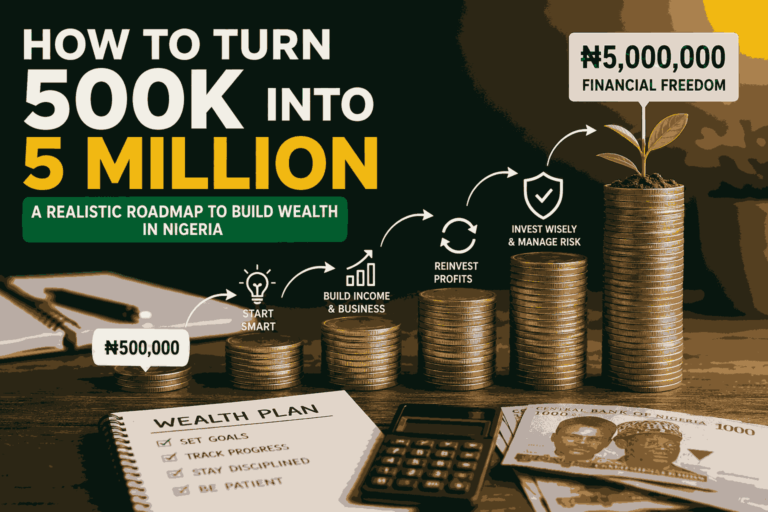
Also Read: How to Turn 500k into 5 Million in Nigeria
How to Turn Your First ₦1 Million Into a Stronger Financial Base
Reaching ₦1 million is an important milestone, but what you do next can matter just as much as reaching it. Instead of treating the money as permission to increase spending immediately, consider how much of it can remain available for emergencies, productive business activity, skills, or carefully researched investments.
For example, someone who has built ₦1 million through savings could decide to keep an appropriate emergency reserve while directing another portion toward an income-producing activity. Someone who already owns a profitable business may have a different priority, such as improving equipment, increasing inventory or reaching more customers.
The key is to avoid confusing a milestone with financial independence. Your net worth becomes more resilient when your assets can continue producing value rather than being consumed immediately.
If you are considering a larger capital goal, our guide on turning ₦500,000 into ₦5 million explains why capital growth should be approached as a process of income generation, reinvestment, risk management and time.
Compare Saving, Business and Investing by Purpose
Saving, business and investing serve different purposes, so they should not be treated as identical strategies. Savings are useful for liquidity and short-term needs. A business can potentially increase active income but comes with operating risks. Investments can provide exposure to productive assets but involve market, credit, liquidity or other risks depending on the product.
Before putting money anywhere, identify what the money is supposed to do. Money needed for an emergency should not be exposed to the same level of risk as money that you will not need for many years. Likewise, business capital should not be mistaken for personal spending money.
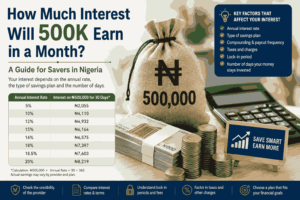
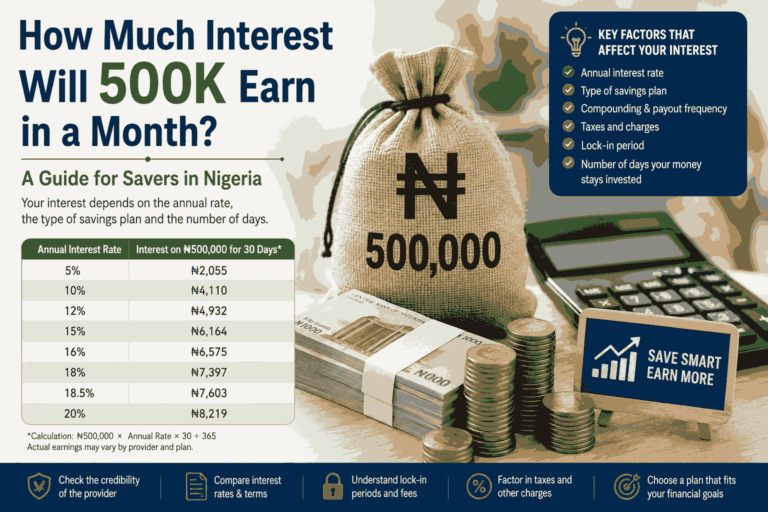
If you are specifically interested in what a ₦500,000 balance could earn from savings or interest-bearing products, see our separate guide on how much interest ₦500,000 can earn in a month. Actual rates, fees and product conditions must always be checked with the relevant provider before making a decision.
Build Multiple Financial Engines Gradually
You do not need five businesses to become financially stronger. In many cases, one reliable primary income source plus one well-managed additional income stream is easier to control than several poorly managed side hustles.
A practical progression could look like this: improve your main income, create a small side service, build an emergency reserve, reinvest some business profit, and then allocate long-term surplus to suitable investments. As one system becomes stable, you can decide whether another source of income is actually necessary.
For readers exploring entrepreneurship, our guide to businesses people consider for building wealth in Nigeria discusses different business models and the practical factors that affect their potential. The important point is to assess demand, costs and execution rather than assuming any business automatically creates wealth.
Use Profit, Not Revenue, to Measure Progress
A business can have impressive sales and still leave its owner with very little wealth. Track the money that remains after inventory, transport, advertising, wages, platform fees, utilities and other operating costs. That amount gives you a much clearer picture of what the business is contributing to your financial position.
Keep personal withdrawals separate from business reinvestment where practical. If all the cash generated by a business is immediately spent, increasing sales may not increase net worth by much.
If you are looking for products with recurring consumer demand, our guide to products Nigerians buy most can be used as a starting point for researching possible markets. Demand alone is not enough; you still need to calculate sourcing costs, margins, competition and delivery.
Create a Personal Millionaire Scorecard
Review your finances at least periodically using a small set of numbers: total income, essential expenses, savings, investments, business assets, debts and estimated net worth. This makes the goal measurable without requiring you to obsess over daily market movements.
You can also record how much additional income your skills or business generated during the month. If your net worth is rising because your income is increasing, expenses are controlled and productive assets are accumulating, you have evidence that the underlying system is improving.
If your goal is to increase income before investing heavily, our guide on businesses you can start with ₦500,000 in Nigeria offers another way to think about deploying limited capital while testing customer demand.
What to Do When Your Plan Falls Behind
Not every month will go according to plan. An unexpected medical expense, family obligation, job loss, business slowdown or major price increase can interrupt saving. A setback does not mean you should respond by taking extreme investment risks.
Instead, review what changed. Reduce non-essential spending where possible, rebuild your cash reserve, increase income if you can, and adjust the target date. A flexible plan that survives difficult months is more useful than an aggressive plan that depends on everything going perfectly.
The same principle applies when a business performs poorly. Identify whether the problem is low demand, pricing, costs, customer acquisition or execution before putting more money into the business.
Five Habits That Make the Millionaire Goal More Sustainable
- Track your net worth: know what you own and what you owe.
- Increase earning power: improve skills that customers and employers actually value.
- Protect your surplus: avoid automatically increasing lifestyle spending whenever income rises.
- Reinvest selectively: put money into activities or assets with a clear economic purpose.
- Verify before investing: research providers, understand risks and be suspicious of guaranteed or extraordinary returns.
These habits are deliberately simple. The goal is not to make wealth-building sound mysterious. It is to create a repeatable financial process that can continue after the first ₦1 million has been reached.
Editorial Verdict: How Can I Become a Millionaire in Nigeria?
If you are serious about the question “How can I become a millionaire in Nigeria?”, forget the idea that there must be one secret investment or business that guarantees success.
The more reliable framework is:
Increase your income → control expenses → create a surplus → build productive assets → invest responsibly → reinvest → repeat.
If your income is low, prioritise skills and earning power.
If your income is growing, prioritise savings and financial discipline.
If you have accumulated capital, learn how to allocate it intelligently.
If you have a successful business, reinvest selectively and build systems that reduce your dependence on your own time.
And throughout the process, protect yourself from scams.
The first ₦1 million is valuable because it proves that you can accumulate capital. The bigger achievement is developing the financial habits and income-producing assets that can take you from ₦1 million to ₦5 million, ₦10 million and beyond.
That is the more useful answer to “How can I become a millionaire in Nigeria?”
You do not need a magic formula.
You need a valuable skill, a reliable income strategy, financial discipline, sensible risk management and enough consistency to keep moving forward.
Buying Recommendation
Because this is a wealth-building guide rather than a product review, there is no product to recommend.
For a reader starting from zero, my practical recommendation is:
- Do not begin by chasing investments. First establish a dependable income source.
- Develop one marketable skill that can increase your earning capacity.
- Create a separate savings/emergency reserve.
- Build a side income or small business once your basic cash flow is stable.
- Invest only through properly researched and, where applicable, regulated channels.
- Reinvest part of your profits instead of immediately upgrading your lifestyle.
- Treat ₦1 million as the first milestone, not the final definition of wealth.
The SEC’s investor guidance supports setting clear goals, understanding risk, researching investments and diversifying.
Verification Notes
- The CBN’s July 2026 MPC decision was checked for the current monetary-policy environment; the MPR was retained at 26.5%.
- Current CBN government-securities information was checked to avoid presenting invented investment yields.
- The SEC’s current investor warnings were checked, including its May 2026 warning about unregistered online investment schemes and unrealistic or guaranteed returns.
- SEC investor-education material was used to support the discussion of investment goals, risk tolerance, research and diversification.
- CAC’s current business-registration information was checked. CAC says business names can be registered through its online Company Registration Portal and provides official registration and verification services.
- The World Bank’s December 2025 announcement was used for context on Nigerian MSMEs and access to finance.
- The numerical savings examples are simple calculations, not forecasts or investment guarantees.
- No specific investment product, cryptocurrency, trading platform or business opportunity has been presented as guaranteed to make the reader wealthy.
Final Quality Assessment
Original value: The article goes beyond the usual “10 businesses that can make you rich” format by explaining the mathematics of reaching ₦1 million, the difference between income and net worth, the importance of increasing earning power and the transition from the first ₦1 million to sustainable wealth.
Additional analysis: It combines income generation, entrepreneurship, savings, emergency funds, investing, inflation, business profitability, financial scams and capital allocation into one wealth-building framework.
How it differs from ordinary finance articles: Rather than promising a specific return or business idea, it explains why different approaches work, where they fail and how a reader can choose between them based on their starting financial position.
Information requiring future updates: The article’s general principles are relatively durable, but CBN monetary-policy information, government-security yields, regulatory warnings, investment rules, business-registration fees and the purchasing power of ₦1 million can change. Those elements should be reviewed whenever the article is materially updated.
Overall assessment: Strong foundation for a Nigeria-focused personal-finance article, with current regulatory and economic context and without making unrealistic wealth or investment promises.






[…] […]