




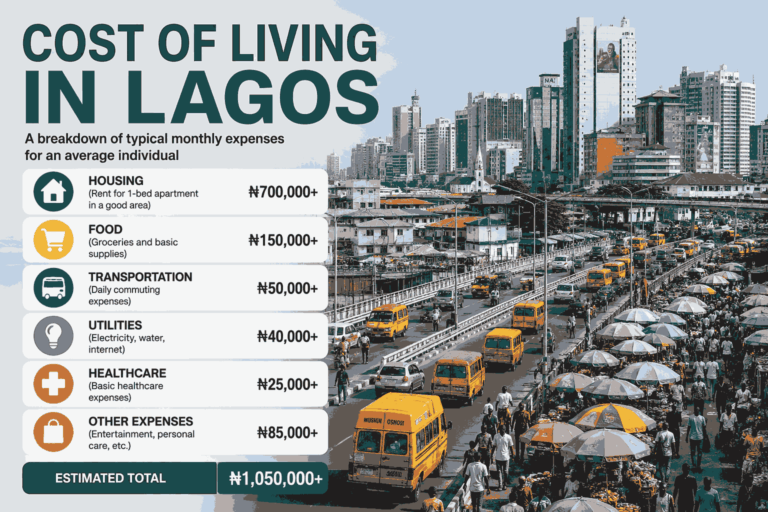
The article focuses on the real cost structure of living in Lagos, rather than giving readers one misleading “average monthly cost”. Housing is treated separately from everyday spending because rent in Lagos can vary dramatically by neighbourhood and is often paid annually.
It also distinguishes between official Nigerian economic data and third-party market estimates, because there is no single government-published figure that represents the monthly cost of living for every Lagos resident.
Nigeria’s latest available NBS data show headline inflation at 15.91%, while food inflation is 17.52% on the NBS’s current rebased CPI series. The NBS says the rebased CPI uses 2023 expenditure weights and 2024 as the price reference year.
For Lagos specifically, third-party databases show substantial variation. Numbeo’s May 2026 Lagos data, for example, put a one-bedroom apartment at about ₦987,631 per month in the city centre and about ₦870,001 outside the centre, while its reported three-bedroom figures were roughly ₦4.90 million and ₦2.36 million, respectively. These figures are crowd-sourced estimates, not official Lagos State rent statistics, so they should be treated as market indicators rather than fixed prices.
Another third-party source, Expatistan, estimated monthly living costs in Lagos at about ₦3.10 million for one person and ₦5.35 million for a family of four in July 2026, but it explicitly warns that its estimates are based on limited data points. This illustrates why a single “average cost” can be misleading.
Cost of Living in Lagos in 2026: Rent, Food, Transport and Monthly Expenses
The cost of living in Lagos depends heavily on where you live, how you commute, the type of accommodation you choose and how much you spend on food, electricity, internet and leisure.
There is no single amount that accurately describes what everyone needs to live in Lagos. A student sharing accommodation in the mainland can have a completely different budget from a professional renting alone in Lekki, Victoria Island or Ikoyi.
That distinction has become particularly important in 2026. Nigeria’s National Bureau of Statistics currently reports headline inflation of 15.91% and food inflation of 17.52% under its rebased Consumer Price Index. Recent reporting also shows that many Nigerian households continue to feel pressure from food, fuel, electricity and housing costs despite some improvement in headline inflation.
For anyone considering moving to Lagos, the most useful question is therefore not simply, “How expensive is Lagos?”
It is:
“How much will my particular lifestyle cost each month, and how much should I budget for housing separately?”
This guide breaks down the major expenses so you can build a more realistic Lagos budget.
What Is the Cost of Living in Lagos in 2026?
The cost of living in Lagos is relatively high compared with many other Nigerian cities, but the amount a person needs varies considerably.
Housing is usually one of the biggest differences between households. Someone living in a shared apartment far from the main business districts may spend considerably less than someone living alone in a premium neighbourhood.
Third-party databases demonstrate just how wide the range can be. Numbeo’s May 2026 data lists a one-bedroom apartment in central Lagos at approximately ₦987,631 per month, compared with about ₦870,001 outside the centre. Its three-bedroom estimates were approximately ₦4.90 million in the centre and ₦2.36 million outside the centre.
These numbers should not be interpreted as official Lagos rent prices. Numbeo relies on user-contributed information, and the ranges are wide.
The practical lesson is more important than any individual figure:
Your neighbourhood can have a bigger effect on your Lagos budget than many other spending decisions.
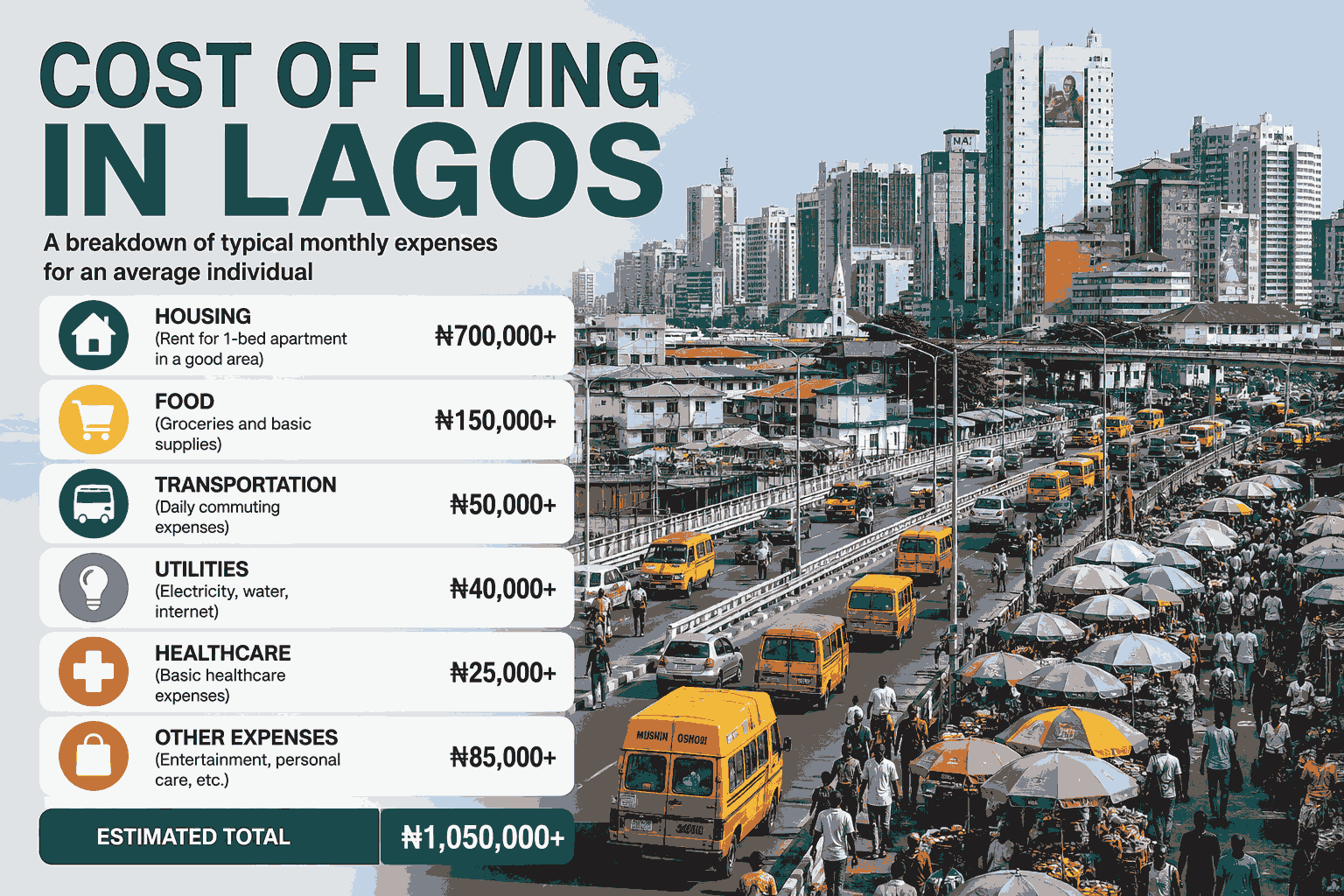
How Much Money Do You Need to Live in Lagos?
There is no universal salary that guarantees a comfortable life in Lagos.
A single person who shares accommodation, cooks regularly and uses public transport may operate on a much smaller budget than someone who rents a private apartment, drives daily and frequently eats at restaurants.
A useful way to plan is to divide your spending into four groups:
| Expense | What it covers |
|---|---|
| Housing | Rent, service charges and housing-related payments |
| Essentials | Food, transport, electricity, water and internet |
| Personal spending | Clothing, entertainment, eating out and leisure |
| Financial commitments | Savings, debt repayment, school fees and family support |
This approach is more useful than simply copying an online “average monthly cost”.
For example, if your rent is ₦2.4 million per year, you should mentally treat that as approximately ₦200,000 per month when building a budget, even though the landlord may require a much larger payment upfront.
That distinction is crucial in Lagos.
Rent and Housing Costs in Lagos
Housing is arguably the most important component of the cost of living in Lagos.
The city has major differences between neighbourhoods, and proximity to employment centres, roads, business districts and amenities can significantly affect rent.
Recent reporting has highlighted how rising rents have pushed some workers towards more distant suburbs, creating longer commuting times. The Guardian reported that some Lagos workers now spend several hours travelling between home and work because housing closer to employment centres has become increasingly unaffordable.
Approximate Lagos rental indicators
Numbeo’s May 2026 data provides the following crowd-sourced estimates:
| Property type | Approximate monthly estimate |
|---|---|
| 1-bedroom, city centre | ₦988,000 |
| 1-bedroom, outside centre | ₦870,000 |
| 3-bedroom, city centre | ₦4.90 million |
| 3-bedroom, outside centre | ₦2.36 million |
These should not be treated as standard Lagos rent prices. They are third-party estimates with broad ranges and can differ substantially from actual asking prices in individual neighbourhoods.
There is another major complication: Nigerian residential rent is often discussed as an annual payment rather than a monthly subscription.
So a property advertised at ₦2.4 million per year is equivalent to ₦200,000 per month for budgeting purposes, but you may still need substantially more cash when signing the tenancy agreement.
Additional housing costs
Do not budget for rent alone.
Depending on the property and transaction, you may encounter:
- Agency fees
- Legal fees
- Agreement fees
- Service charges
- Caution deposits
- Electricity contributions
- Water charges
- Security costs
- Maintenance charges
This is why a house that appears affordable from the advertised rent can become considerably more expensive once all associated payments are included.
Which Areas of Lagos Are More Expensive?
The Lagos property market is extremely location-sensitive.
Premium areas such as Ikoyi, Victoria Island and parts of Lekki generally command higher prices because of their location, amenities, commercial activity, housing quality and demand.
Meanwhile, areas farther from major employment centres can offer lower accommodation costs, although the apparent saving may be partly offset by transportation expenses and longer commuting times.
This creates an important Lagos budgeting principle:
Cheap rent is not necessarily cheap living.
Suppose moving farther away reduces your annual rent substantially but adds thousands of naira to your monthly transport expenses and several hours to your weekly commute.
The cheaper house may not provide the better overall value.
Food Prices and Grocery Costs in Lagos
Food is another major component of the cost of living in Lagos.
The NBS currently reports national food inflation at 17.52%, although national inflation statistics should not be interpreted as a direct Lagos grocery-price index.
Actual food costs depend on where you shop and what you buy.
Buying basic ingredients from local markets can produce a very different bill from shopping primarily at supermarkets or ordering prepared meals.
Third-party Lagos price data from Numbeo lists examples such as:
- 1 kg of rice: about ₦1,542
- 12 large eggs: about ₦2,784
- 500 g loaf of bread: about ₦1,851
- 1 litre of milk: about ₦3,938
These figures are indicative rather than official retail prices, and Numbeo provides ranges around several of them.
Cooking versus eating out
One of the easiest ways to change your food budget is to control how frequently you eat prepared meals.
Numbeo’s May 2026 Lagos data put an inexpensive restaurant meal at roughly ₦4,725, while a mid-range three-course meal for two was around ₦55,115.
For someone eating outside regularly, those individual purchases can accumulate quickly.
A household that cooks most meals at home will generally have more control over food spending than one relying heavily on restaurants, delivery services and convenience foods.
Transportation Costs in Lagos
Transport is one of the defining costs of living in Lagos.
The city is geographically spread out, traffic congestion can be severe and many workers live far from their workplaces because of housing costs.
This means that transportation should be considered together with rent.
For example:
Lower rent + expensive daily commute
can sometimes cost almost as much as:
Higher rent + shorter commute.
The second option may also save significant time.
Public transport, buses, rail services and ride-hailing can all form part of a Lagos transport budget, while private car ownership adds fuel, maintenance, insurance, parking and other expenses.
Fuel prices are particularly important because changes in petrol costs can affect both direct motorists and the wider cost of transporting goods and people.
The NBS currently publishes fuel-price indicators alongside its wider economic statistics, illustrating how closely energy costs remain connected to household spending.
Electricity and Utility Costs in Lagos
Electricity is another expense that should not be treated as a fixed national amount.
The Nigerian Electricity Regulatory Commission states that electricity tariffs vary according to location and the hours of electricity supplied. It also provides information about monthly energy caps and billing arrangements.
That means two households in Lagos can have very different electricity bills.
Your electricity budget can depend on:
- Metering arrangement
- Tariff category
- Consumption
- Hours of supply
- Air-conditioner usage
- Refrigeration
- Water pumping
- Number of occupants
- Backup-power requirements
For households that rely heavily on generators or alternative power systems, the real electricity cost includes more than the amount appearing on a DisCo bill.
Fuel, generator maintenance and servicing can become significant household expenses.
Internet and Mobile Data Costs
Internet access has become a practical household expense for many Lagos residents.
For remote workers, students, freelancers and online businesses, connectivity is not simply entertainment.
It can be essential to earning an income.
A sensible internet budget should therefore consider:
- Mobile data
- Home broadband
- Backup SIMs
- Router costs
- Electricity for networking equipment
- Backup power
Someone working from home may need a more reliable connection than someone who primarily uses mobile data for messaging.
This is another reason why the cheapest available package is not always the most economical choice.
If unreliable internet causes you to miss work or lose clients, the apparent saving can become expensive.
Healthcare Costs in Lagos
Healthcare spending is difficult to express as a single monthly figure because routine expenses and unexpected medical events are very different.
Your budget may include:
- Consultation
- Medication
- Laboratory tests
- Dental care
- Eye care
- Health insurance
- Emergency treatment
People with chronic medical needs may require a substantially larger healthcare allocation than healthy adults with few medical expenses.
For this reason, a realistic Lagos budget should contain an emergency or healthcare reserve, rather than assuming every month will cost exactly the same.
Education and Childcare Costs
For families, education can transform the cost of living in Lagos.
School fees vary dramatically depending on whether a child attends a public school, private Nigerian school or premium international institution.
There can also be additional costs for:
- Uniforms
- Books
- Transport
- Meals
- Extracurricular activities
- Examination fees
- School trips
- Technology
Childcare can also become a significant expense for working parents.
Therefore, families should calculate education costs separately rather than hiding them inside a general “household expenses” figure.
Entertainment and Social Life in Lagos
Lagos offers a large entertainment economy, but enjoying it regularly can have a noticeable effect on your budget.
Spending can include:
- Restaurants
- Bars
- Clubs
- Cinemas
- Beaches
- Concerts
- Events
- Short trips
- Fitness centres
Recent reporting illustrates how leisure costs can also rise. Associated Press reported in July 2026 that some Lagos beach visits have become considerably more expensive as visitors pay for entrance, food, seating and other services.
The lesson is not that entertainment is unaffordable.
It is that leisure needs its own budget.
Someone earning a good income can still struggle financially if discretionary spending grows without limits.
Cost of Living in Lagos for a Single Person
A single person’s budget can vary enormously.
A person who:
- Shares accommodation
- Lives outside premium neighbourhoods
- Uses public transport
- Cooks frequently
- Has no dependants
- Works close to home
can have a very different monthly budget from a professional living alone in an expensive neighbourhood.
Third-party sources provide very different estimates for Lagos because they use different methodologies.
For example, Expatistan’s July 2026 estimate put total monthly costs at about ₦3.10 million for one person, while warning that its calculation was based on only a few data points.
That figure should therefore not be interpreted as the amount every single person needs.
A better approach is to build your own budget from actual expected costs.
Cost of Living in Lagos for a Family of Four
Families face a different cost structure.
In addition to rent and food, they may need to budget for:
- School fees
- Children’s transport
- Healthcare
- Clothing
- Childcare
- Larger accommodation
- Electricity
- Internet
- Family activities
Expatistan estimated July 2026 monthly costs for a family of four in Lagos at approximately ₦5.35 million, while explicitly warning that the estimate was based on limited data.
Again, this is best viewed as a third-party indicator rather than a universal family budget.
A family renting an affordable home, cooking at home and using public schools can spend dramatically less than a family renting premium accommodation and paying private-school fees.
How Salary Relates to the Cost of Living in Lagos
Salary is arguably more important than the headline price of goods.
A ₦500,000 monthly income means something very different to someone who:
- Has free accommodation
- Lives alone
- Has no children
- Works remotely
than it does to someone who:
- Pays annual rent
- Supports a family
- Commutes daily
- Pays school fees
- Supports relatives
Lagos State’s government previously announced a minimum wage of ₦85,000 for state workers, describing it at the time as the highest state minimum wage in Nigeria.
But a minimum wage should not automatically be interpreted as a living-wage benchmark.
The gap between income and necessary expenses is one of the central issues in understanding the cost of living in Lagos.
Why Is Lagos So Expensive?
Several factors contribute to Lagos’s high living costs.
Housing demand
Lagos attracts workers, businesses, students, entrepreneurs and migrants from across Nigeria and beyond.
Strong demand for housing in desirable areas can put upward pressure on rents.
Limited affordable housing
The Guardian reported that Lagos faces a severe housing shortage, while rising construction costs and demand continue to put pressure on the market.
Transportation and congestion
When affordable housing is located far from employment centres, residents may spend more on transport and time commuting.
Inflation
Even when inflation slows, prices do not automatically return to previous levels.
This is an important distinction.
If inflation falls from 25% to 15%, prices may still be increasing; they are simply increasing more slowly.
Fuel and energy costs
Higher transportation and energy costs can feed into the price of food, deliveries, services and other goods.
Exchange-rate effects
Nigeria imports many goods and inputs.
Changes in the naira’s value can therefore affect imported products and businesses that rely on imported materials.
Cost of Living in Lagos Compared With Other Nigerian Cities
Lagos should not be treated as representative of every Nigerian city.
Housing costs, transport requirements, wages and lifestyle expenses vary significantly between locations.
For example, someone comparing Lagos with Ibadan may find that accommodation costs are substantially different.
Wise’s 2026 city data also shows a significant difference between its estimated monthly living costs for Lagos and Ibadan.
However, moving to a cheaper city can also mean giving up some employment opportunities.
This creates an important economic trade-off:
Lower living costs do not necessarily mean higher disposable income if your earning opportunities also fall.
For remote workers, the calculation can be different because income may not depend heavily on local employment.
Lagos Island vs Lagos Mainland
The phrase “Lagos” hides enormous differences.
The Island and mainland are not single-price markets.
Premium areas can command substantially higher housing costs, while mainland neighbourhoods can offer more affordable options.
However, affordability depends on the exact neighbourhood.
When comparing two homes, calculate:
Rent + service charges + transport + utilities + time cost
rather than looking at rent alone.
A ₦500,000 difference in annual rent may not be meaningful if the cheaper property adds ₦60,000 every month in commuting expenses.
How to Reduce the Cost of Living in Lagos
You do not necessarily need to leave Lagos to reduce your expenses.
Small structural changes can make a large difference.
Choose housing based on total cost
Do not select a house solely because the rent looks cheap.
Calculate commuting costs and other housing charges.
Cook more frequently
Restaurant meals and delivery can become expensive when repeated several times each week.
Track transportation
Record your transport spending for one month.
Many people underestimate how much commuting actually costs.
Share housing where practical
For students and some young professionals, shared accommodation can significantly reduce the housing burden.
Avoid lifestyle inflation
A salary increase does not have to produce an equal increase in spending.
If your income rises by ₦200,000, consider directing some of the increase towards savings or debt reduction rather than immediately upgrading every part of your lifestyle.
Compare markets and shops
The same product can have different prices depending on where you buy it.
Build an emergency reserve
Unexpected medical bills, repairs, job interruptions and family obligations can destabilise a budget quickly.
A Practical Lagos Monthly Budget Formula
Instead of copying someone else’s budget, calculate yours using:
Monthly budget = Housing + Food + Transport + Utilities + Healthcare + Personal spending + Savings + Family commitments
For example, a person might create a planning budget like this:
| Category | Example planning amount |
|---|---|
| Rent allocation | ₦200,000 |
| Food | ₦150,000 |
| Transport | ₦100,000 |
| Electricity and utilities | ₦60,000 |
| Internet/data | ₦30,000 |
| Personal spending | ₦50,000 |
| Savings/emergency fund | ₦100,000 |
| Total | ₦690,000 |
This is not an average Lagos budget. It is simply an illustration of how to construct one.
Your actual figures may be substantially higher or lower.
The important thing is to use your real expenses.
How Much Should You Earn to Live Comfortably in Lagos?
There is no universally correct salary.
“Comfortable” is a lifestyle description, not a statistical threshold.
Someone may consider ₦700,000 comfortable if they share accommodation and have no dependants.
Another person earning ₦1.5 million may feel financially stretched because they support children, pay high rent, commute long distances and assist relatives.
A better measure is disposable income.
If your essential expenses consume almost all your income, your salary may be too low for your current lifestyle even if the headline figure sounds large.
A healthier budget leaves room for:
- Emergency savings
- Long-term savings
- Debt repayment
- Healthcare
- Occasional leisure
- Unexpected expenses
Common Misconceptions About the Cost of Living in Lagos
“There is one average amount everyone needs.”
There is not.
Lagos has enormous differences in income, housing and lifestyle.
“Living outside the city centre is always cheaper.”
Not necessarily.
Lower rent can be offset by higher transport costs.
“Falling inflation means things are becoming cheaper.”
Not necessarily.
Lower inflation means prices are increasing more slowly. It does not automatically mean prices have returned to previous levels.
“Rent is the only major housing expense.”
No.
Agency, legal, agreement, service and other charges can materially change the amount you need to move into a property.
“A high salary automatically means a comfortable life.”
Not if expenses rise even faster.
Is Lagos Still Worth Living In?
For many people, yes—but the answer depends on income and priorities.
Lagos remains one of Nigeria’s most important centres for business, technology, entertainment, finance, trade and employment.
That economic opportunity is one reason people continue moving to the city despite its high costs.
The trade-off is that opportunity often comes with:
- Expensive housing
- Traffic
- Long commutes
- High daily expenses
- Competitive employment
- Pressure to maintain a certain lifestyle
The right question is therefore not simply whether Lagos is expensive.
It is whether your expected income and opportunities justify your expected living costs.
Also Read: Cost of Living in Nigeria
How to Use This Lagos Cost-of-Living Guide
The figures in this article are best used as planning indicators, not as promises about what every household will spend. Prices can change by neighbourhood, seller, season, household size and lifestyle. Before making a move, use the categories below to build a personal budget from the costs you are actually likely to face.
Start with the expenses you cannot easily avoid
Begin with housing, food, transport, electricity, water, internet, healthcare and any regular family commitments. These are more useful starting points than an online headline figure because they reflect the expenses that can continue even when you reduce entertainment or other discretionary spending.
If you are comparing Lagos with another Nigerian city, do not look only at rent. Compare the complete monthly picture, including commuting, utilities, food and the income available to you. Our related guide on the cost of living in Nigeria provides a wider national context that can help when making that comparison.
Separate monthly costs from annual or irregular payments
One of the easiest ways to underestimate the cost of living in Lagos is to look only at monthly expenses. Residential rent is commonly paid as a large upfront amount, while school fees, insurance, repairs, medical treatment, clothing and some family obligations may arrive as periodic bills. Convert those expenses into monthly planning amounts even when the actual payment happens once or twice a year.
For example, if your expected annual housing cost is ₦2.4 million, you can reserve about ₦200,000 each month for housing in your personal budget. This does not mean your landlord will accept ₦200,000 every month; it simply prevents an annual bill from appearing unexpectedly when it is time to renew your tenancy.
Consider income as carefully as expenses
The same Lagos budget can be manageable for one person and difficult for another because income and financial responsibilities differ. A person working remotely may choose housing based on affordability and internet reliability, while someone commuting to an office may need to spend more to reduce travel time. A household supporting children or relatives also needs to include those commitments before deciding how much money is genuinely available for savings and personal spending.
If you are trying to increase your income rather than only cut expenses, PriceNiche also covers practical money-making topics. For example, you can read our guide on legitimate ways to make extra money in Nigeria. Readers who are planning to use existing savings to start a business can also review business ideas that can be started with ₦500,000 in Nigeria.
A Better Way to Compare Lagos Living Costs
When comparing two neighbourhoods or two job opportunities, calculate the total cost of the decision rather than comparing one price. A cheaper apartment may require more daily transport. A higher-paying job may require longer commuting or more expensive accommodation. A lower rent may also come with higher electricity, security or maintenance costs.
A simple comparison can use this formula:
Total monthly living cost = housing allocation + food + transport + utilities + internet + healthcare + personal spending + family commitments + savings target.
Then compare that total with your dependable monthly income. This gives you a clearer picture of whether your budget leaves room for emergencies and long-term financial goals.
Watch the exchange rate when your expenses depend on imported goods
Some household costs can be affected by changes in the naira exchange rate because products, equipment, fuel-related inputs and business materials may depend directly or indirectly on imports. If your household buys imported electronics, appliances or other goods, it can be useful to monitor currency movements alongside ordinary inflation data.
For readers who need that information, our guide to the dollar-to-naira exchange rate explains why the rate matters when comparing prices in Nigeria. The exchange rate should not be used to predict the exact price of every product, but it can help explain why some imported items change in price.
What to Check Before Moving to Lagos
Before committing to a new home or job, create a short checklist using your own circumstances. Confirm the actual rent and all additional housing charges. Estimate your daily transport cost using the route you will really travel. Check electricity arrangements, water availability, internet options and security considerations for the property. Then calculate how much money remains after essential expenses.
- Housing: confirm annual rent and additional fees before signing.
- Transport: calculate the real cost of your normal work or school route.
- Food: estimate your actual weekly grocery and meal spending.
- Utilities: include electricity, water, internet and backup-power costs.
- Healthcare: allow for insurance, routine care and unexpected treatment.
- Family obligations: include school fees, dependants and regular support.
- Savings: reserve money for emergencies before treating the remainder as disposable income.
This method makes the article more useful because readers can turn the information into a personal decision rather than simply memorising an average figure. It also makes clear why two people living in the same Lagos neighbourhood can have very different monthly expenses.
Finally, revisit your budget whenever there is a major change in rent, transport, food, electricity, income or family responsibilities. A Lagos budget should be treated as a living financial plan, not a permanent number. If your income increases, you can decide whether the additional money should go towards savings, debt repayment, business capital or improved living conditions. Readers exploring longer-term wealth-building options can also see our guide on how to approach turning ₦500,000 into ₦5 million in Nigeria, while remembering that investment and business outcomes are never guaranteed.
Editorial Verdict
The cost of living in Lagos in 2026 cannot be reduced to one monthly figure.
The biggest mistake is to treat an online average as a personal financial requirement.
Housing location, rent structure, commuting distance, food habits, electricity consumption and family responsibilities can completely change the amount a person needs.
Current economic data show that inflation has moderated substantially from the very high levels seen in earlier years, but food inflation remains elevated at 17.52% in the latest NBS data available for this analysis. At the same time, recent reporting continues to document pressure from food, fuel, electricity and housing costs.
For someone planning to move to Lagos, the best approach is therefore to calculate a personal Lagos budget, not copy a generic “average cost”.
Start with housing.
Add food.
Calculate your actual transport requirement.
Budget for electricity, internet and healthcare.
Then include savings and unexpected expenses.
Most importantly, compare income against total living costs, rather than asking whether Lagos is simply expensive.
For a person with strong earning opportunities, Lagos can still provide significant economic value. For someone whose income is barely covering rent, transport and food, the same city can become financially difficult very quickly.
The best Lagos budget is not necessarily the cheapest one.
It is the one that gives you a realistic balance between income, housing, commuting, quality of life and financial security.
Practical Recommendation
For someone planning to move to Lagos in 2026, I would not use one fixed figure such as “₦X million per month” as the article’s main conclusion.
Instead, encourage readers to calculate:
Annual rent ÷ 12 + food + transport + utilities + internet + healthcare + personal expenses + savings
That is much more useful and trustworthy.
The article should also be updated periodically because rent, food, fuel, electricity and other household costs can change. NBS publishes CPI data monthly, while NERC’s electricity information is also subject to regulatory and tariff changes.








[…] […]