




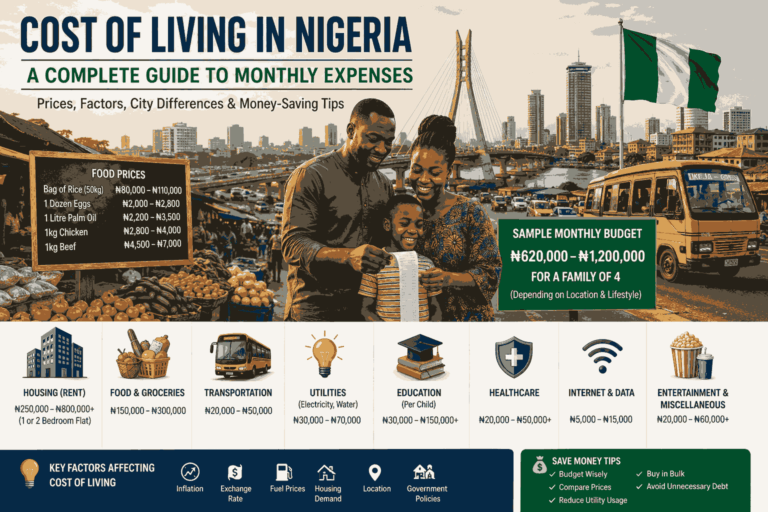
The cost of living in Nigeria varies significantly depending on where you live, your income, household size and the standard of living you expect. A single person renting a modest room in a lower-cost area can have a very different budget from a family renting a three-bedroom flat in Lagos or Abuja.
There is therefore no single amount that accurately represents what every Nigerian needs each month.
Housing, food, transportation, electricity, internet access, healthcare, education and personal spending all contribute to the final figure. Prices also change over time, while differences between cities and neighbourhoods can be substantial.
Nigeria’s National Bureau of Statistics (NBS) maintains monthly datasets covering important household costs, including food prices and transport fares. Its Selected Food Price Watch collects prices across all 774 local government areas and the FCT, while its Transport Fare Watch similarly collects fare information across the country.
The latest NBS headline figures currently displayed on its website put all-items inflation at 15.91% and food inflation at 17.52%, using the rebased Consumer Price Index with a 2024 base period. That means today’s household budget should not simply be based on prices from several years ago.
This guide explains the major components of the cost of living in Nigeria, how expenses differ by location and household type, and how to build a more realistic monthly budget.
What Does Cost of Living Mean in Nigeria?
The cost of living is the amount of money required to pay for the goods and services needed for everyday life.
For an individual or household in Nigeria, these expenses can include:
- Accommodation
- Food and groceries
- Transportation
- Electricity
- Water
- Cooking fuel
- Mobile data and internet
- Healthcare
- Education
- Clothing
- Personal care
- Entertainment
- Household items
- Debt repayments
- Savings and emergency expenses
Not everyone spends money on every category each month.
For example, a homeowner may have no monthly rent but could face maintenance and property-related costs. A student living with parents may spend very little on housing but more on transportation, data and education.
That is why a useful cost-of-living calculation should be based on your actual lifestyle rather than a generic national average.
Current Cost of Living in Nigeria in 2026
The Nigerian cost of living is best understood as a collection of changing prices rather than one fixed figure.
The NBS publishes monthly price data for major categories. Its food-price programme covers all states and the Federal Capital Territory, with data collected across more than 10,000 respondents and locations.
Its transport dataset also covers all 774 local government areas and the FCT, using fares households report actually paying.
This matters because a national average can hide the reality experienced by individual households.
A person in a city with relatively high rent but short commuting distances may have a different total budget from someone in a cheaper neighbourhood who spends considerably more on transportation.
For this reason, readers should treat national figures as reference points rather than personal budgets.
Main Expenses That Determine the Cost of Living in Nigeria
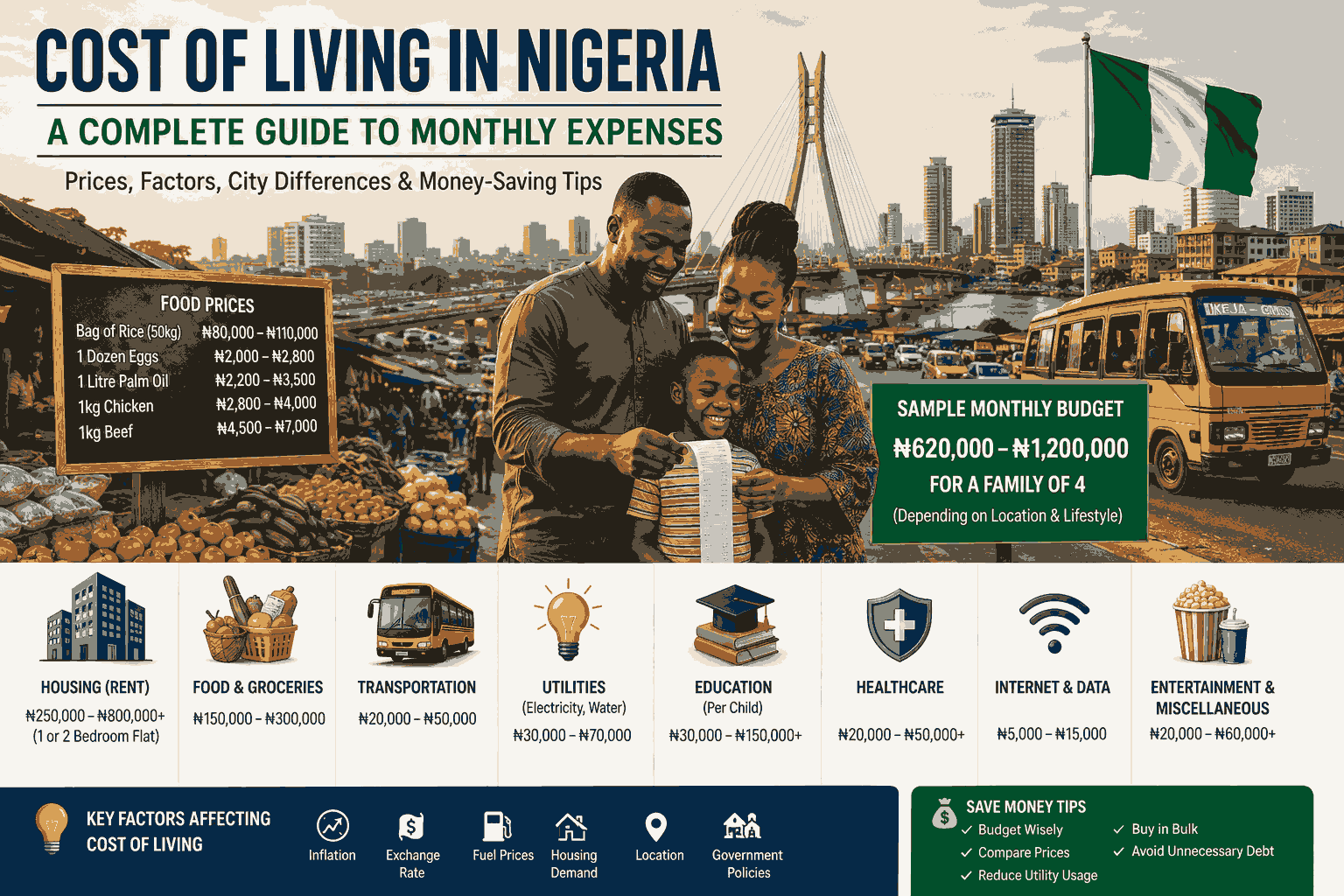
The largest expenses for many households are usually accommodation, food and transportation.
Other costs can become significant depending on the person’s circumstances.
Typical household spending categories
| Expense | How it affects your budget |
|---|---|
| Housing | Often one of the largest recurring or annual expenses |
| Food | Varies with household size and eating habits |
| Transport | Depends on commuting distance and transport method |
| Electricity | Depends on consumption, tariff category and backup-power needs |
| Internet/data | Particularly important for students and remote workers |
| Cooking fuel | Varies according to LPG, electricity, kerosene or other options |
| Healthcare | Can be unpredictable and should have an emergency allowance |
| Education | Major expense for households with school-age children |
| Personal care | Clothing, toiletries and grooming |
| Entertainment | Flexible but can affect disposable income |
| Savings | Essential for building financial resilience |
The key point is that income alone does not determine whether someone is financially comfortable.
Two people earning the same salary can have completely different financial situations because their housing, transport, family and debt obligations differ.
House Rent and Housing Costs in Nigeria
Housing is one of the most important parts of the cost of living in Nigeria.
Rent can vary dramatically according to:
- City
- State
- Neighbourhood
- Property type
- Number of bedrooms
- Security
- Road access
- Water supply
- Electricity availability
- Proximity to employment centres
- Estate facilities
- Furnishing
- Building condition
A room or small flat in a lower-cost area cannot reasonably be compared with a modern apartment in an expensive part of Lagos or Abuja.
Another important issue is that Nigerian tenants may face expenses beyond the advertised rent.
Depending on the transaction, these can include:
- Agency fees
- Legal fees
- Caution fees
- Service charges
- Agreement fees
- Maintenance contributions
- Utility deposits
This means someone comparing properties should calculate the total cost of moving into the property, not just the headline rent.
Annual rent versus monthly income
A major budgeting challenge in Nigeria is that rent is commonly paid annually in many situations.
Someone who earns a monthly salary therefore needs to think about rent differently from someone whose landlord collects monthly payments.
For example, if a household expects a large annual housing bill, setting aside part of each month’s income towards future rent can reduce financial pressure when the payment becomes due.
Food Prices and the Cost of Feeding in Nigeria
Food is another major part of household expenditure.
NBS’s Selected Food Price Watch provides monthly food-price information and is designed specifically to monitor prices across Nigeria. The dataset includes observations from all states and the FCT.
Food expenses depend on:
- Household size
- Location
- Whether food is cooked at home
- How frequently the household eats out
- Type of protein purchased
- Brand choices
- Seasonal availability
- Market used
- Dietary requirements
- Shopping frequency
A household that buys food in bulk may have a different effective cost per meal from someone buying small quantities every day.
Likewise, a person who prepares most meals at home will generally have a different food budget from someone who regularly buys prepared meals.
How to reduce food expenses
One practical approach is to build a weekly food plan before shopping.
Instead of buying whatever looks attractive at the market, determine:
- What meals will be prepared.
- Which ingredients are already available.
- Which items need to be purchased.
- How much each item should cost.
- What can be bought in larger quantities without creating waste.
The objective is not necessarily to buy the cheapest food available.
It is to reduce avoidable spending and waste while maintaining an adequate diet.
Transportation Costs in Nigeria
Transportation is another important component of the cost of living in Nigeria, especially for people who commute daily.
The cost can depend on:
- Distance travelled
- City
- Route
- Type of transport
- Fuel prices
- Traffic
- Number of trips
- Whether the person uses public or private transport
NBS’s Transport Fare Watch monitors fares across Nigeria and covers categories including intra-city bus journeys, intercity bus travel, air travel, motorcycle transport and waterway passenger transport.
The agency’s 2026 transport reports include monthly releases, including January through May 2026.
This highlights why transport should not be treated as a fixed national figure.
Transport can change the value of cheap housing
Suppose someone chooses a much cheaper home far away from work.
The rent may be lower, but the additional daily transport expense can gradually remove the saving.
Therefore, when comparing accommodation, consider:
Rent + transport + commuting time
rather than rent alone.
Electricity and Energy Costs
Electricity is another unusual part of the Nigerian household budget because the amount paid can depend on both electricity consumption and the supply arrangement in the area.
The Nigerian Electricity Regulatory Commission (NERC) explains that electricity tariffs vary according to location and the hours of electricity supplied. NERC’s service-based tariff system classifies customers into Bands A to E according to minimum supply levels.
This means two households can have different electricity costs even when they use similar appliances.
Electricity spending can also extend beyond the electricity bill itself.
Some households spend additional money on:
- Petrol or diesel for generators
- Generator maintenance
- Solar equipment
- Inverters
- Batteries
- Charging services
- Replacement electrical equipment
Consequently, a realistic household energy budget should consider total energy expenditure, not just the amount appearing on an electricity bill.
Internet and Mobile Data Costs
Internet access has become an important household expense for many Nigerians.
Students may need data for research and online classes.
Workers may need it for:
- Remote work
- Video meetings
- Cloud applications
- Customer communication
- Social media
- Online banking
Businesses may also require significantly more data than ordinary consumers.
The cheapest data plan is therefore not automatically the best value.
A better calculation is:
Monthly data cost ÷ actual useful data consumed
Someone who repeatedly buys small bundles at a higher effective cost may spend more over a month than someone using a suitable larger plan.
Healthcare Costs
Healthcare should be included in a serious calculation of the cost of living in Nigeria, even when you do not expect to visit a hospital every month.
Medical expenses are unpredictable.
A household may need to pay for:
- Consultation
- Medication
- Laboratory tests
- Dental care
- Emergency treatment
- Maternal care
- Specialist treatment
- Hospitalisation
This is why a household budget should contain an emergency or healthcare allowance where possible.
Insurance or other legitimate healthcare arrangements may also reduce the financial impact of unexpected medical expenses, depending on the person’s circumstances and the coverage available.
The important lesson is that a budget that leaves no room for emergencies is fragile, even if the monthly arithmetic appears balanced.
Education Costs in Nigeria
For families with children, education can become one of the largest household expenses.
Potential costs include:
- School fees
- Books
- Uniforms
- Transport
- Examination fees
- School supplies
- Meals
- Extracurricular activities
- Accommodation for students studying away from home
The cost differs greatly between public and private institutions and between schools in different locations.
Parents should therefore calculate the total annual education cost, rather than considering tuition alone.
For students, the same principle applies.
A university student may need to budget for accommodation, food, transport, data, learning materials and personal expenses in addition to school charges.
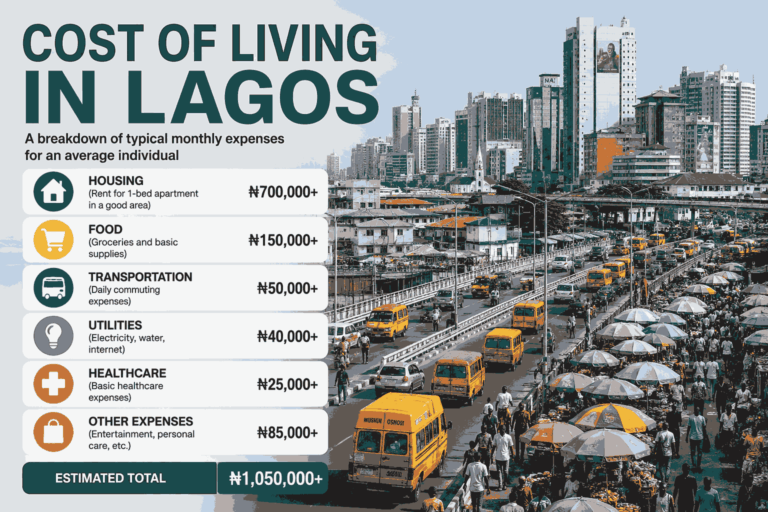
Cost of Living in Lagos
Lagos is one of Nigeria’s most expensive major urban markets, although the actual cost varies enormously between neighbourhoods and lifestyles.
A person living close to work may spend more on rent but less on commuting.
Another person may choose cheaper accommodation farther away and spend significantly more time and money travelling.
Lagos also has wide differences in housing standards.
A budget for a single person living in a modest area should therefore not be compared directly with the lifestyle budget of someone renting a high-end apartment.
What makes Lagos expensive?
Common contributors include:
- Housing demand
- Transportation
- Food
- Commercial activity
- Entertainment
- Services
- Convenience-related spending
The city can nevertheless offer opportunities that may compensate for some of the higher expenses, particularly for people whose employment or business income is tied to the Lagos market.
Cost of Living in Abuja
Abuja also has significant variation in living costs.
Location is particularly important.
Rent, transport requirements, property type and proximity to workplaces can substantially change the monthly budget.
A person living close to their workplace may have a very different financial experience from someone commuting from a more distant area.
Abuja residents should therefore compare total monthly expenditure, rather than simply asking which neighbourhood has the lowest rent.
Cost of Living in Ibadan
Ibadan can offer lower housing costs in some areas than Nigeria’s most expensive major urban markets, but the exact amount required still depends on neighbourhood, household size and lifestyle.
For someone working remotely, living in a lower-cost area may be more attractive if reliable internet and electricity are available.
For someone commuting daily to another city, however, transport can alter the calculation considerably.
This demonstrates an important principle:
The cheapest city is not necessarily the cheapest place for every person.
The best location depends on where you work, study and obtain essential services.
How Much Does a Single Person Need to Live in Nigeria?
There is no responsible single national figure.
A single person’s monthly expenses depend heavily on:
- Whether they rent
- Type of accommodation
- City
- Food choices
- Transport needs
- Electricity requirements
- Data usage
- Healthcare
- Social activities
Someone living with family may spend considerably less than someone paying full rent.
Similarly, a student living in shared accommodation may have a completely different budget from a professional living alone.
A better way to calculate your personal budget
List your actual monthly expenses under five broad categories:
Essential housing
Food
Transportation
Utilities and communication
Other essential and discretionary expenses
Then add an emergency or savings allocation if your income allows it.
This produces a much more useful figure than copying a generic internet estimate.
How Much Does a Family Need to Live in Nigeria?
Families generally face higher total expenses because costs increase with household size.
However, expenses do not always rise proportionally.
A family can share:
- Housing
- Electricity
- Internet
- Household equipment
- Cooking
- Transportation in some situations
At the same time, larger families face additional costs in areas such as:
- Food
- Education
- Clothing
- Healthcare
- Transport
- Childcare
The best approach is therefore to calculate a family budget according to the number and ages of household members.
What Does It Cost to Live Comfortably in Nigeria?
“Comfortably” is subjective.
For one person, comfort may mean having reliable electricity, internet access, decent accommodation and enough disposable income for occasional entertainment.
For another person, it may include a car, private healthcare, international travel, premium housing and substantial savings.
Therefore, there is no objective salary that guarantees a comfortable life throughout Nigeria.
A more useful definition is:
You are financially comfortable when your essential expenses are manageable, unexpected costs do not immediately create a crisis, and you have enough income left for savings and discretionary spending.
That definition focuses on financial resilience rather than a particular salary number.
Why the Cost of Living Differs Across Nigeria
Several factors explain regional differences.
Housing demand
Popular employment and commercial centres can have higher rents.
Transport infrastructure
Poorer transport connections can increase commuting costs and travel times.
Local food markets
Food prices can differ depending on local supply, transportation and seasonality.
Electricity availability
The amount a household spends on grid electricity and alternative power can vary considerably.
Income levels
Areas with higher concentrations of higher-income workers may also have more expensive services and housing.
Lifestyle
Two people in the same neighbourhood can spend very different amounts.
One may cook almost every meal.
Another may order food regularly.
One may use public transport.
Another may drive a private vehicle.
This is why cost-of-living comparisons should always specify location and lifestyle assumptions.
Has the Cost of Living in Nigeria Increased?
The answer requires some care because inflation measures changes in prices rather than directly measuring how much every individual household spends.
NBS currently reports an all-items inflation rate of 15.91% and food inflation of 17.52% on its website under the rebased CPI series.
NBS also continues to publish monthly food and transport price datasets, demonstrating that individual categories can move differently from the overall inflation rate.
For households, this distinction matters.
If food rises faster than some other expenses, a household that spends a large proportion of its income on food may feel more pressure than the headline inflation rate alone suggests.
Likewise, a household with a fixed mortgage or owned home may experience different cost pressures from a tenant facing a rent increase.
How to Create a Monthly Budget in Nigeria
A simple budget can be built around four stages.
Step 1: Calculate income
Include your regular take-home income rather than your gross salary if you want to understand the money actually available for spending.
Step 2: List essential expenses
Include:
- Rent allocation
- Food
- Transport
- Electricity
- Data
- Healthcare
- Education
- Debt payments
Step 3: Identify flexible expenses
These may include:
- Entertainment
- Eating out
- Clothing
- Subscriptions
- Unplanned shopping
Step 4: Allocate something to savings
Even a small consistent amount can be more useful than waiting until you have a large surplus.
The objective is to make your spending visible.
Example Monthly Budget for a Single Person
The following is an illustrative budgeting framework, not an official Nigerian average:
| Category | Example allocation |
|---|---|
| Housing/rent provision | ₦100,000 |
| Food | ₦100,000 |
| Transport | ₦50,000 |
| Electricity/energy | ₦25,000 |
| Data/internet | ₦15,000 |
| Personal care | ₦20,000 |
| Healthcare/emergency | ₦20,000 |
| Entertainment/miscellaneous | ₦20,000 |
| Savings | ₦50,000 |
| Total | ₦400,000 |
The numbers above are deliberately presented as a planning example, not as a claim that ₦400,000 is the official amount a Nigerian single person needs.
A person living with family could spend far less on housing.
Someone renting in an expensive area could spend considerably more.
Someone supporting relatives could also have a very different financial obligation.
The purpose of the example is to show how to construct a budget.
How to Reduce the Cost of Living in Nigeria
Reducing living costs does not necessarily mean sacrificing everything enjoyable.
It means identifying expenses that provide little value.
Review housing
Do not choose a home based solely on rent.
Calculate rent plus transport and other recurring costs.
Plan food purchases
Reduce waste and avoid frequent impulse purchases.
Track transportation
Record how much you actually spend travelling for one month.
The result may be surprising.
Compare service providers
Regularly review data, internet, banking and other recurring charges.
Control energy costs
Use efficient appliances and monitor generator, inverter or other backup-power expenses.
Separate needs from wants
This does not mean eliminating all discretionary spending.
It means knowing which expenses are essential and which can be reduced during difficult months.
Build an emergency fund
Unexpected medical, transport, repair or family expenses can quickly destroy an otherwise balanced budget.
Common Mistakes When Calculating the Cost of Living
Looking only at rent
A cheap house can become expensive if commuting costs are high.
Ignoring annual payments
Rent, school fees and insurance may arrive as large bills rather than monthly expenses.
Convert them into monthly provisions for budgeting purposes.
Using old price information
Nigeria’s prices change.
A figure from several years ago should not automatically be treated as today’s price.
Assuming everyone spends the same amount
Lifestyle and location matter.
Forgetting irregular expenses
Repairs, healthcare, school expenses and family obligations may not occur every month but still need to be planned for.
Confusing income with disposable income
A ₦500,000 salary does not mean you have ₦500,000 available for discretionary spending.
What matters is what remains after essential obligations.
How to Use This Nigeria Cost-of-Living Guide
The figures in a national cost-of-living article should be treated as planning references, not as a fixed bill for every Nigerian household. Prices differ between states, cities, neighbourhoods, markets and households. Your own budget should therefore start with the expenses you actually expect to pay.
Build your budget around your location
Start with the city and neighbourhood where you live or intend to move. Then calculate housing, food, transport, electricity, water, cooking fuel, internet, healthcare and other regular expenses. A person living with family may have little or no rent, while a tenant may need to save throughout the year for a large annual rent payment.
If you want a more detailed look at one of Nigeria’s largest urban markets, see our guide to the cost of living in Lagos. The Lagos article goes deeper into rent, commuting, utilities, food and the way neighbourhood choice can change a household budget.
Separate regular spending from annual bills
Some of the most important Nigerian expenses do not arrive every month. Rent, school fees, insurance, repairs, clothing purchases and some medical costs can appear as large occasional bills. Divide those expected annual expenses by 12 when planning your monthly finances. This makes your monthly budget more realistic even though the actual payment will happen later.
For example, an annual housing cost of ₦1.2 million can be represented as a ₦100,000 monthly provision in your personal budget. That does not change the landlord’s payment terms; it simply means you are deliberately setting aside money for the future bill.
Use official data as a reference, not as a personal spending target
The National Bureau of Statistics publishes recurring information on food prices and transport fares across Nigeria. These datasets are valuable for understanding national and regional price movements, but they do not tell you exactly what one household will spend. Your household size, consumption pattern, location and income still matter.
When comparing prices, also pay attention to the date of the information. A price collected months earlier may not be the price you encounter today. For important purchases, verify the current local price before committing money.
How to Compare the Cost of Living Between Nigerian Cities
Comparing cities using one headline number can hide important differences. Instead, compare the same categories in each location:
- Housing: annual rent, agency and related charges.
- Transport: daily commuting and occasional travel.
- Food: weekly groceries and meals outside the home.
- Utilities: electricity, water, cooking fuel and waste-related costs.
- Connectivity: mobile data, broadband and backup internet.
- Healthcare: routine treatment, insurance and emergency provision.
- Education: school fees, books, transport and other child-related costs.
A city with cheaper rent can become more expensive for someone whose job requires a long daily commute. Likewise, a city with higher housing costs may still fit a person’s finances if it provides substantially better income opportunities or reduces transportation requirements.
The useful comparison is therefore total living cost relative to dependable income, rather than rent or food prices in isolation.
Consider your source of income
Location can have a different financial meaning for a remote worker, employee, student, trader or business owner. A remote worker may be able to choose housing based more heavily on affordability, electricity and internet reliability. Someone whose income depends on a physical workplace may need to give greater weight to commuting time and transport costs.
If your goal is to increase income while managing living costs, PriceNiche also covers practical earning and business topics. You can read our guide on legitimate ways to make extra money in Nigeria or explore business ideas that can be started with ₦500,000. These are informational guides, so actual earnings or business results will depend on the individual circumstances and execution.
A Practical Personal Cost-of-Living Formula
Rather than asking for one universal Nigerian figure, use a formula that reflects your household:
Monthly living cost = housing provision + food + transport + electricity/energy + water + internet/data + healthcare + education + personal spending + debt + family commitments.
After calculating the total, compare it with your dependable monthly income. If the amount left over is very small, the budget may be vulnerable to even a modest unexpected expense. If there is a consistent surplus, you can decide how much should go toward emergency savings, long-term savings, debt repayment or other financial goals.
Do not forget the cost of convenience
Convenience spending can be easy to overlook because each individual payment may seem small. Frequent food delivery, ride-hailing, small daily purchases, subscriptions and impulse shopping can become a significant monthly amount when repeated. Tracking these expenses for 30 days can reveal where money is actually going.
This does not mean every convenience expense should be eliminated. The purpose of tracking is to distinguish deliberate spending from spending that happens simply because it is easy.
Leave room for price changes
A budget based on the exact price of every item today can become outdated. Food, transport, energy and other costs may change at different rates. Keep a reasonable buffer where possible and review your budget whenever there is a significant change in rent, income, household size or regular expenses.
What to Check Before Moving to a New Nigerian City
Before accepting a new job, moving for school or relocating your family, calculate the complete financial effect of the move. Confirm the actual housing cost and additional charges. Estimate your normal transport route. Check electricity and water arrangements. Find out what internet options are available. Then compare the expected total with your income in the new location.
- Check annual rent and all move-in charges rather than rent alone.
- Estimate transport using your real work or school route.
- Check nearby markets and typical grocery costs.
- Include electricity, cooking fuel, water and backup-power expenses.
- Budget for internet and mobile data.
- Consider healthcare access and emergency costs.
- For families, calculate school and childcare expenses separately.
- Include savings and unexpected expenses before deciding what is affordable.
This approach is more useful than relying on a single online average because it connects the cost of living in Nigeria with the reader’s actual circumstances. It also makes it easier to see whether a move that looks cheaper on paper will genuinely reduce total household spending.
When your income changes, recalculate the budget instead of automatically increasing discretionary spending. A higher income can create an opportunity to strengthen savings, reduce debt or build business capital rather than simply increasing recurring expenses.
Editorial Verdict
The cost of living in Nigeria should not be reduced to a single monthly number.
The more useful question is:
“How much will my particular lifestyle cost in the place where I live?”
Housing, food and transportation are usually among the most important categories to examine, but electricity, internet, healthcare, education and personal expenses can materially change the final budget.
Official NBS data is particularly useful because it provides regularly updated information on food prices and transport fares across Nigeria rather than relying on a single city or a handful of market observations.
Electricity also requires a more careful calculation because NERC’s tariff structure varies by location and service level.
For anyone planning their finances, the best approach is therefore to build a personal monthly budget, convert large annual expenses such as rent and school fees into monthly provisions, monitor changing prices and leave room for emergencies.
There is no magic salary that guarantees a comfortable life in every part of Nigeria.
The right income is one that comfortably covers your essential expenses, leaves room for savings and gives you enough financial flexibility to handle unexpected costs.







[…] […]
[…] […]
[…] […]