





The key editorial point is that ₦500,000 does not have one fixed monthly interest amount. The return depends on the annual rate, whether the money is in an ordinary savings account, a fixed savings plan, a money-market investment or another product, and how the provider calculates and pays interest.
For example, at a 16% annual rate, ₦500,000 produces roughly ₦6,575 over 30 days when interest is calculated daily using a 365-day basis. A different product at 10% would produce about ₦4,110 over 30 days. This article therefore gives readers a way to calculate their own expected return instead of presenting one misleading figure.
As of August 2026, the Central Bank of Nigeria’s Monetary Policy Committee has retained the Monetary Policy Rate at 26.5%. This does not mean banks or savings platforms automatically pay savers 26.5%; individual products set their own rates and conditions.
For perspective, current advertised savings products include PiggyVest rates ranging from 12% to 18.5% per annum depending on the product, while other Nigerian savings products advertise rates above 20% under specific conditions.
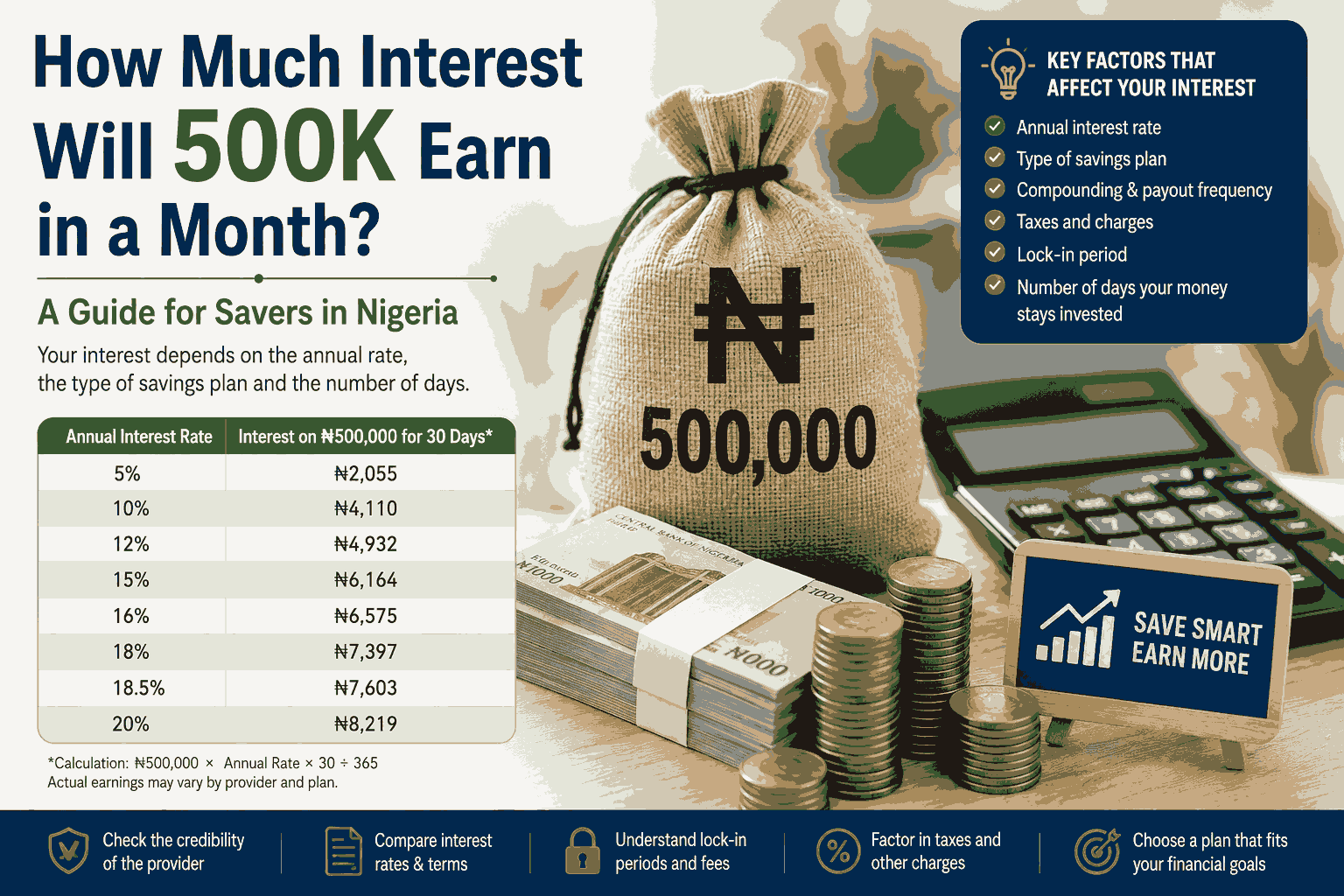
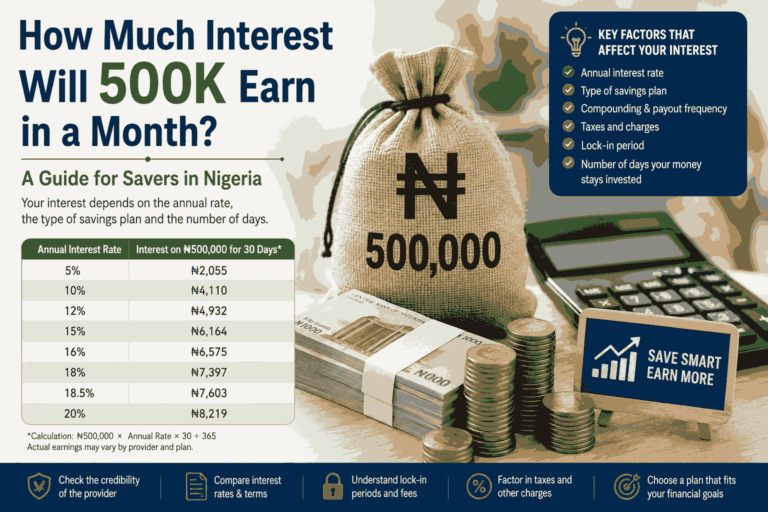
At ₦500,000, that gives the following approximate 30-day gross interest if the advertised annual rate applies throughout the period:
| Annual rate | Approx. 30-day interest* |
|---|---|
| 5% | ₦2,055 |
| 10% | ₦4,110 |
| 12% | ₦4,932 |
| 15% | ₦6,164 |
| 16% | ₦6,575 |
| 18% | ₦7,397 |
| 18.5% | ₦7,603 |
| 20% | ₦8,219 |
| 21.6% | ₦8,877 |
*Illustration using: ₦500,000 × annual rate × 30 ÷ 365. Actual payments can differ according to the provider’s calculation method, applicable conditions, tax treatment, lock-in period and number of days.
A Nigeria Guide to Savings Rates, Calculations and Better Options
If you have ₦500,000 and are considering putting it into a savings account or investment plan, one of the most useful questions to ask is: how much interest will 500K earn in a month?
The short answer is that there is no single figure. The amount depends on the annual interest rate attached to the financial product. At 10% per annum, ₦500,000 could earn roughly ₦4,110 over 30 days using a daily-proration calculation. At 16%, the same money could generate about ₦6,575. At 20%, it could produce approximately ₦8,219.
The difference becomes important when the money remains invested for several months or a full year. If you are comparing interest income with a broader wealth-building plan, see our guide on becoming a millionaire in Nigeria for a separate discussion of long-term financial goals. A saver who focuses only on the advertised percentage can easily overlook withdrawal restrictions, minimum balances, taxes, payment schedules and whether the rate is fixed or variable.
This guide explains how to calculate the return on ₦500,000, examines real Nigerian savings rates, and shows what you should check before choosing a plan.
How Much Interest Will 500K Earn in a Month?
The simplest calculation is:
Monthly interest = Principal × Annual interest rate × Number of days ÷ 365
For ₦500,000 at 12% per annum over 30 days:
₦500,000 × 12% × 30 ÷ 365 = approximately ₦4,932
At 16%:
₦500,000 × 16% × 30 ÷ 365 = approximately ₦6,575
At 18.5%:
₦500,000 × 18.5% × 30 ÷ 365 = approximately ₦7,603
These are illustrations rather than guaranteed payments. Some products use daily calculations, while others may quote an annual rate and apply different payment or compounding arrangements.
For example, Cowrywise explains that interest on its savings plans is stated annually but prorated according to the period for which funds are saved or invested; its stated daily formula uses the principal multiplied by the annual rate and divided by 365.
How Much Does ₦500,000 Earn at Different Interest Rates?
The annual percentage is the biggest factor determining how much your money produces. If your aim is to turn savings into regular income rather than simply earn interest, you can also review our guide on businesses that can bring money faster in Nigeria.
At 5% per annum
₦500,000 at 5% produces:
- About ₦25,000 per year
- About ₦2,055 for 30 days using daily proration
This is relatively modest, but it may be appropriate where access to the money and low risk are more important than maximising returns.
At 10% per annum
At 10%, ₦500,000 produces approximately:
- ₦50,000 over a year
- ₦4,110 over 30 days
The monthly figure is an estimate because a 30-day period is not exactly one-twelfth of a 365-day year.
At 12% per annum
At 12%, the calculation gives approximately:
- ₦60,000 over 12 months before considering compounding or deductions
- ₦4,932 over 30 days
PiggyVest currently lists 12% per annum for Flex Naira, although its rates are subject to change.
At 15% per annum
At 15%, ₦500,000 could produce approximately:
- ₦75,000 over one year
- ₦6,164 over 30 days
PiggyVest currently lists 15% for HouseMoney.
At 16% per annum
At 16%, ₦500,000 could generate approximately:
- ₦80,000 over a year before relevant deductions
- ₦6,575 over 30 days
PiggyVest currently lists 16% per annum for Piggybank.
At 18.5% per annum
At 18.5%, ₦500,000 produces approximately:
- ₦92,500 over a year on a simple annual-rate illustration
- ₦7,603 over 30 days using daily proration
PiggyVest currently advertises up to 18.5% per annum for SafeLock, with the actual rate depending on the chosen lock duration.
Does ₦500,000 Earn Interest Every Month?
Not necessarily.
This is one of the most common misunderstandings about savings products.
An annual interest rate does not always mean the provider will transfer the equivalent monthly amount into your bank account every month.
The product may:
- Calculate interest daily
- Credit interest monthly
- Pay interest at maturity
- Pay interest upfront
- Compound the interest
- Forfeit interest if you withdraw early
PiggyVest, for example, says interest on its core savings and Flex Naira products is accrued daily and paid on the first day of the following month. Its SafeLock product works differently, with interest paid upfront or at maturity depending on the arrangement.
Therefore, “how much interest will 500K earn in a month?” and “when will I receive the interest?” are two separate questions.
What Is the Difference Between Annual Rate and Monthly Interest?
Suppose a savings plan advertises 16% per annum.
That does not mean the provider pays 16% every month.
It means the stated rate is an annual rate.
A simple annual illustration would be:
₦500,000 × 16% = ₦80,000
So the headline annual return is ₦80,000 before considering the provider’s calculation method, compounding, deductions or other conditions.
Using a 30-day daily-proration approach:
₦500,000 × 0.16 × 30 ÷ 365 = ₦6,575
This distinction is essential when comparing financial products.
A platform offering 18% per annum is not offering 18% every month. If it did, the annualised return would be extraordinarily different.
How Much Will 500K Earn in 12 Months?
Looking at a full year provides a better picture of the difference between rates.
| Annual rate | Interest on ₦500,000 for one year |
|---|---|
| 5% | ₦25,000 |
| 10% | ₦50,000 |
| 12% | ₦60,000 |
| 15% | ₦75,000 |
| 16% | ₦80,000 |
| 18% | ₦90,000 |
| 18.5% | ₦92,500 |
| 20% | ₦100,000 |
| 21.6% | ₦108,000 |
These figures use simple annual calculations and are intended for comparison.
Actual returns can be different if interest compounds, is calculated daily, is paid upfront, or depends on maintaining a balance or meeting other conditions.
Why the Highest Interest Rate Is Not Always the Best Plan
A higher percentage looks attractive, but it is only one part of the decision.
Imagine two plans:
Plan A: 18% per annum, but your money is locked for 12 months.
Plan B: 12% per annum, but you can access the money when needed.
If the ₦500,000 is an emergency fund, Plan B may be more appropriate despite the lower rate.
If you already have an emergency fund and the ₦500,000 will not be needed for a year, Plan A could be more attractive.
This is why comparing the effective usefulness of the return matters more than simply searching for the highest advertised percentage.
Current Savings Rates in Nigeria
Nigeria’s interest-rate environment remains relatively high by historical standards.
The CBN’s July 2026 Monetary Policy Committee decision retained the Monetary Policy Rate at 26.5%. The MPR is a central monetary-policy benchmark; it should not be confused with the interest rate a particular savings product pays customers.
Savings products can offer considerably lower rates than the MPR because financial institutions have different funding costs, reserve requirements, operating costs, liquidity requirements and product structures.
The CBN also publishes banking-sector deposit and lending-rate information, demonstrating that deposit rates differ across institutions and products.
Examples of Current Nigerian Savings Plans
Rather than treating all savings products as identical, it is useful to look at how providers structure them.
PiggyVest
PiggyVest currently lists:
- Piggybank: 16% per annum
- Flex Naira: 12%
- HouseMoney: 15%
- Target: 14%
- SafeLock: up to 18.5%
The company states that rates can change according to market conditions.
At a 16% annual rate, ₦500,000 would generate approximately ₦6,575 over 30 days under a 365-day daily-proration illustration.
That does not mean every user will necessarily receive exactly ₦6,575. Product rules and the number of days the money remains in the account matter.
Other Fixed-Savings Products
Prodigy Bank currently advertises up to 12.5% per annum on a 12-month fixed savings plan and uses ₦500,000 as one of its own illustrations, showing ₦62,500 interest over 12 months at that rate. The product is described as fixed for 12 months.
Other Nigerian savings platforms advertise rates above this level, but buyers should look carefully at whether the advertised percentage applies to the entire balance, requires a lock period, is promotional, or has other eligibility conditions.
What About Traditional Bank Savings Accounts?
Traditional bank savings accounts can provide convenience, branch access and easy transfers, but their interest rates can be considerably different from those of specialised savings platforms.
The CBN publishes deposit-rate information for Nigerian banks, and the published figures demonstrate that rates vary among institutions and account types.
If your ₦500,000 is sitting in a normal bank account, do not assume that it is earning 10%, 15% or 20%.
Check the actual interest rate attached to your specific account.
This is especially important because some conventional savings accounts pay relatively modest interest compared with dedicated savings products.
Can ₦500K Generate ₦10,000 Interest Every Month?
It can be possible under a sufficiently high annual rate, but it should not be assumed.
To generate ₦10,000 from ₦500,000 in a 30-day period using a 365-day calculation, the annual rate would need to be roughly:
₦10,000 × 365 ÷ (₦500,000 × 30) = about 24.33% per annum
That means a plan would need to provide an annualised rate of approximately 24.3% consistently for a 30-day period to produce ₦10,000 on ₦500,000 before deductions.
This is a useful test when you see social-media claims that ₦500,000 can “easily” generate ₦10,000 every month from a savings product.
The mathematics shows what rate would actually be required.
Can ₦500K Earn ₦20,000 a Month?
The required rate would be even higher.
Using the same 30-day calculation:
₦20,000 × 365 ÷ (₦500,000 × 30) ≈ 48.67% per annum
A product would therefore need an annualised rate of approximately 48.7% to generate ₦20,000 from ₦500,000 over 30 days.
A claim like this deserves careful investigation.
It may involve investment risk, promotional conditions, a business opportunity rather than a savings account, or an advertised return that is not guaranteed.
A high promised return should never be interpreted as a normal bank savings rate.
What About Tax on Interest?
Interest income can be subject to withholding tax.
PwC’s Nigeria tax summary, reviewed in May 2026, lists 10% withholding tax on interest for resident recipients under the applicable rules. The actual tax treatment can depend on the nature of the income and financial product.
This means a headline rate should not automatically be treated as the amount you will keep.
For illustration only, if ₦500,000 generated ₦6,575 gross interest and a 10% withholding tax applied to that interest, the amount after that deduction would be approximately ₦5,918.
However, readers should check the specific product’s tax treatment and statements rather than applying 10% blindly to every investment or savings product.
Is ₦500,000 Safe in a Savings Platform?
Safety depends on the institution and the financial product.
For bank deposits, the Nigeria Deposit Insurance Corporation currently states that deposits in insured Deposit Money Banks are covered up to ₦5 million per depositor, while the coverage for Microfinance Banks is ₦2 million per depositor under the applicable scheme.
That makes ₦500,000 fall below the current maximum insured limit for both categories, assuming the relevant institution and deposit are covered.
However, deposit insurance should not be confused with an unconditional guarantee of every investment product.
Before depositing money, confirm:
- Who legally holds the money?
- Is the institution licensed?
- Is the institution NDIC-insured where applicable?
- What happens if you withdraw early?
- Is the return guaranteed or projected?
- Is the interest rate fixed or variable?
The CBN also advises consumers to understand the terms, interest rates, charges and protections attached to financial accounts.
Savings Account vs Fixed Savings for ₦500K
The better choice depends on what you intend to do with the money.
| Feature | Flexible savings | Fixed/locked savings |
|---|---|---|
| Access to money | Usually easier | Usually restricted |
| Interest | Often lower | Often higher |
| Emergency use | Better | Poorer |
| Rate certainty | May vary | Often fixed for tenor |
| Suitable for | Short-term needs | Planned goals |
| Early withdrawal | Usually easier | May reduce returns or incur penalties |
For emergency funds, accessibility can be more valuable than an additional few percentage points.
For money that will not be needed for several months, locking the funds may provide a better return. If you are considering using part of the money for trading or sales instead, our guide on products you can sell to make money every day provides a different way to think about capital use.
How Inflation Changes the Picture
An interest payment is not the same as an increase in purchasing power.
Suppose your ₦500,000 earns ₦60,000 in a year.
You now have ₦560,000.
But if the prices of the goods and services you need rise faster than your return, your money may not have gained as much purchasing power as the headline interest suggests.
This is why a sensible comparison should consider:
Interest rate − inflation = approximate real return
The calculation is simplified and does not account for every economic factor, but it helps explain why earning interest is not automatically the same as becoming wealthier in real terms.
Should You Keep the Entire ₦500K in One Place?
Not necessarily.
The right decision depends on your financial circumstances and risk tolerance.
Someone with no emergency reserve may reasonably prioritise access to the money.
Another person who already has emergency savings may choose to put some of the ₦500,000 into a fixed savings product while retaining some cash for unexpected expenses.
Diversification can also reduce dependence on one institution or one financial product, although spreading money across products introduces its own considerations and does not eliminate investment risk.
Common Mistakes People Make With ₦500K
Mistake 1: Confusing monthly and annual rates
An advertised 18% rate usually means 18% per annum, not 18% every month.
Mistake 2: Ignoring lock-in conditions
A high rate may require you to leave your money untouched for months.
Mistake 3: Looking only at the headline rate
Fees, tax, penalties and eligibility requirements can reduce the actual amount received.
Mistake 4: Assuming the rate cannot change
Some savings rates are variable and can be revised as market conditions change.
PiggyVest explicitly states that its interest rates are subject to change.
Mistake 5: Chasing unrealistic returns
If someone promises extraordinarily high returns with little or no risk, investigate the underlying product carefully.
A high return generally comes with additional conditions or risk.
How to Calculate Your Own ₦500K Interest
You can use this simple formula:
Interest = ₦500,000 × annual rate × days ÷ 365
For example, at 15% for 30 days:
₦500,000 × 0.15 × 30 ÷ 365 = ₦6,164
At 18%:
₦500,000 × 0.18 × 30 ÷ 365 = ₦7,397
At 20%:
₦500,000 × 0.20 × 30 ÷ 365 = ₦8,219
This gives you a quick way to test whether an advertised return makes mathematical sense.
How Much Does 500K Earn in a Month at 16%?
At 16% per annum, ₦500,000 earns approximately ₦6,575 over 30 days using a 365-day daily-proration calculation.
For 31 days, the same calculation gives approximately ₦6,795.
If a provider uses a different calculation method or payment schedule, the credited amount can differ.
PiggyVest’s current Piggybank rate is 16% per annum, with interest accrued daily and paid monthly according to its published terms.
How Much Does 500K Earn in a Month at 20%?
At 20% per annum, ₦500,000 would earn approximately ₦8,219 over 30 days using daily proration.
For 31 days, the figure would be approximately ₦8,493.
On a simple 12-month calculation, 20% of ₦500,000 is ₦100,000.
Therefore, a full year at a genuine 20% annual rate would produce a simple gross return of ₦100,000 before applicable deductions and depending on the product’s calculation and compounding method.
Where Should You Put ₦500K?
There is no universally best destination for ₦500,000.
A sensible choice starts with the purpose of the money.
If you may need it soon
Prioritise liquidity and easy access.
If you are saving for a known future expense
A fixed or goal-based savings plan may be appropriate.
If you want a potentially higher return
Consider investment products, but understand that higher potential returns can involve higher risk.
If capital preservation is your main priority
Focus on regulated deposit-taking institutions and understand the applicable deposit insurance arrangements.
What Should You Check Before Choosing a Savings Plan?
Before transferring ₦500,000, check these points:
1. Annual interest rate
Is the advertised figure 10%, 15%, 18% or something else?
2. Is it guaranteed?
Some products offer a fixed rate; others offer a variable rate or projected return.
3. How is interest calculated?
Look for daily, monthly or maturity-based calculations.
4. When is interest paid?
It may be monthly, upfront or at maturity.
5. Can you withdraw early?
This can make a major difference to the actual return.
6. Are there fees?
Check withdrawal fees, processing charges and penalties.
7. Is the institution regulated?
Confirm the institution’s regulatory status rather than relying only on advertising.
8. Is the money covered by deposit insurance?
For deposit-taking institutions, verify the applicable NDIC protection.
Also Read: Which Business Makes You Rich Faster
How to Decide What to Do With ₦500,000
The interest calculation is only the first step. Before moving ₦500,000 into any savings product, decide what the money is supposed to accomplish. A reserve for rent, school fees, medical needs or a business opportunity should not automatically be treated the same way as money you know you can leave untouched for a year.
Start by separating the money into three practical questions: when might I need it, how much access do I need, and what level of return is reasonable for the risk? This prevents the common mistake of choosing a product because its headline rate looks attractive while overlooking a lock period or withdrawal condition.
If your broader goal is to grow ₦500,000 rather than simply preserve it, you can also compare this approach with our guide on how to make money with ₦500,000. That is a different financial question from earning passive interest: business income may be higher or lower, but it also involves work, operating costs and business risk.
How to Compare Two ₦500K Savings Offers Properly
When two providers quote different rates, do not compare the percentages alone. Put the offers side by side and record the annual rate, minimum balance, lock period, withdrawal rules, fees, payment date, tax treatment and whether the rate can change. This gives you a clearer picture of what you are actually receiving.
| Check | Question to ask |
|---|---|
| Rate | What annual rate applies to my actual balance? |
| Access | Can I withdraw my principal whenever I need it? |
| Tenor | How long must the money remain in the product? |
| Fees | Are there account, withdrawal or early-exit charges? |
| Interest payment | Is interest paid monthly, upfront or at maturity? |
| Rate changes | Can the provider change the rate after I deposit? |
| Protection | What regulatory and deposit-protection arrangements apply? |
This comparison is particularly useful when a higher-rate product is being promoted aggressively. A slightly lower return with clear terms and convenient access can be easier to understand and manage than a higher headline rate with several restrictions.
Interest Is Income, Not a Guaranteed Way to Grow Wealth Quickly
₦500,000 earning interest can be useful, but the monthly return should be viewed in context. For example, even a gross return of around ₦6,575 over 30 days at a 16% annual rate does not mean the saver has created a dependable ₦6,575 monthly salary. The rate can change, the balance can change, and deductions or product conditions can affect the amount actually received.
If your objective is to build the ₦500,000 into a larger financial base, consider combining saving with disciplined income generation. Our guide on turning ₦500,000 into ₦1 million looks at that growth question separately, while our guide on turning ₦500,000 into ₦5 million addresses a longer-term wealth-building target.
The important distinction is that savings interest is normally calculated from the money already deposited. Business profit or active income depends on sales, customers, costs and execution. Keeping those concepts separate makes it easier to judge whether a proposed financial plan is realistic.
What to Do Before You Deposit the Money
Before committing the full ₦500,000, take a few minutes to verify the offer from the provider’s official information rather than relying on a social-media post or a screenshot. Confirm the current rate, terms, eligibility requirements and withdrawal conditions immediately before opening the product because advertised rates can change.
- Confirm the exact annual rate. Make sure you understand whether it is fixed, variable, promotional or conditional.
- Calculate the expected return yourself. Use the formula in this article and compare your result with the provider’s illustration.
- Read the withdrawal rules. Find out what happens if you need your principal before the stated maturity date.
- Check the institution and product. Do not assume that every product offered by a financial brand has identical regulatory or deposit-protection treatment.
- Keep evidence of the terms. Save the provider’s current rate and product conditions so you can compare them later if the rate changes.
If the ₦500,000 is intended for a business, also calculate whether keeping the money idle has an opportunity cost. For example, our article on businesses you can start with ₦500,000 can help you think through the difference between passive savings and active use of capital.
A Simple Monthly Interest Checklist
For readers who only want a quick way to check a savings offer, use this five-step process:
- Write down the amount you will actually deposit.
- Write down the advertised annual percentage.
- Choose the exact number of days you expect the money to remain deposited.
- Calculate: principal × annual rate × days ÷ 365.
- Then check the product terms for compounding, taxes, fees, penalties and other conditions.
For example, if you deposit ₦500,000 at 18% for 30 days, the mathematical illustration is about ₦7,397 gross. If the provider’s credited amount is materially different, investigate the calculation method rather than assuming either figure is wrong. The difference may come from the number of days, balance changes, compounding, payment timing or product-specific rules.
How Much of Your ₦500K Should Remain Easily Accessible?
There is no single percentage that applies to everyone. The right amount depends on your income stability, upcoming expenses and existing emergency savings. Someone with irregular income may need more accessible cash than someone with a stable salary and a separate emergency reserve.
A useful principle is to avoid locking away money that you already know you may need soon. If the ₦500,000 is your only readily available reserve, access may deserve more attention than a small difference in the advertised annual rate. If you already have adequate emergency funds elsewhere, you may have more flexibility to consider a fixed-term product.
For readers trying to increase their regular cash flow instead of relying only on interest, our guide to earning ₦5,000 per day in Nigeria explores active income ideas. The goal is not to treat every method as suitable for everyone, but to show the difference between earning from capital and earning from work or business activity.
Editorial Verdict
So, how much interest will 500K earn in a month?
A realistic answer is roughly ₦2,000 to ₦9,000 per month across the 5% to 21.6% annual-rate examples examined here, before considering applicable deductions and the precise calculation method.
For rates commonly advertised by Nigerian savings products, ₦500,000 at 12% would generate around ₦4,932 over 30 days, while 16% would generate around ₦6,575, and 18.5% would generate around ₦7,603 using daily proration.
The most important lesson is that the rate alone does not determine whether a savings plan is good. A 20% product that locks your money away when you need emergency cash may be less useful than a 12% product that gives you convenient access. Conversely, if you know you will not need the money for a year, accepting a lock-in period may make financial sense.
The best approach is therefore to compare the annual rate, actual calculation method, access rules, fees, tax treatment, regulatory status and deposit protection before committing your ₦500,000.
Recommendation
For someone holding ₦500,000 in Nigeria, my recommendation would be to start with the purpose of the money rather than the advertised interest rate.
- Emergency money: favour accessibility and regulated deposit protection.
- Money you can lock away: compare fixed or locked savings rates.
- Short-term goal: compare goal-based savings products and their withdrawal rules.
- Seeking higher returns: investigate investment products separately from ordinary savings and understand the additional risks.
As a practical benchmark, an annual rate around 15%–18.5% would put the gross 30-day return on ₦500,000 at roughly ₦6,164–₦7,603, assuming daily proration over 30 days. Current provider rates should be checked immediately before depositing because rates can change. PiggyVest, for example, explicitly states that its rates are subject to change.
Verification Notes
- The CBN’s July 2026 MPC decision was checked for the current monetary-policy environment; the MPR is 26.5%.
- CBN publications confirm that deposit rates differ across Nigerian banks and are published as part of its banking-rate information.
- PiggyVest’s published 2026 information was checked for current savings rates and how interest is calculated and paid.
- Cowrywise’s published explanation was checked for its daily-proration calculation method.
- Prodigy Bank’s current fixed-savings page was checked as an example of a fixed-rate product.
- NDIC information was checked for current deposit-insurance limits. The current stated maximum is ₦5 million for depositors in Deposit Money Banks and ₦2 million for Microfinance Banks.
- Nigeria’s current withholding-tax treatment for interest was checked against a May 2026 tax summary, which states a 10% WHT rate on interest under the applicable rules.
- All ₦500,000 calculations in this article are mathematical illustrations. They should not be interpreted as guaranteed returns from any particular provider.
Final Quality Assessment
This article adds value beyond a conventional “₦500K interest calculator” page by showing why the answer changes from one financial product to another. It explains annual versus monthly rates, demonstrates the calculation using a 30-day period, tests the popular ₦10,000-per-month claim mathematically, discusses tax, liquidity, deposit insurance and the difference between flexible and fixed savings.
It also uses current Nigerian financial-market information rather than presenting an invented universal interest rate. The examples from PiggyVest and Prodigy Bank show how real products structure their rates, while CBN and NDIC information provides regulatory context.











[…] […]