



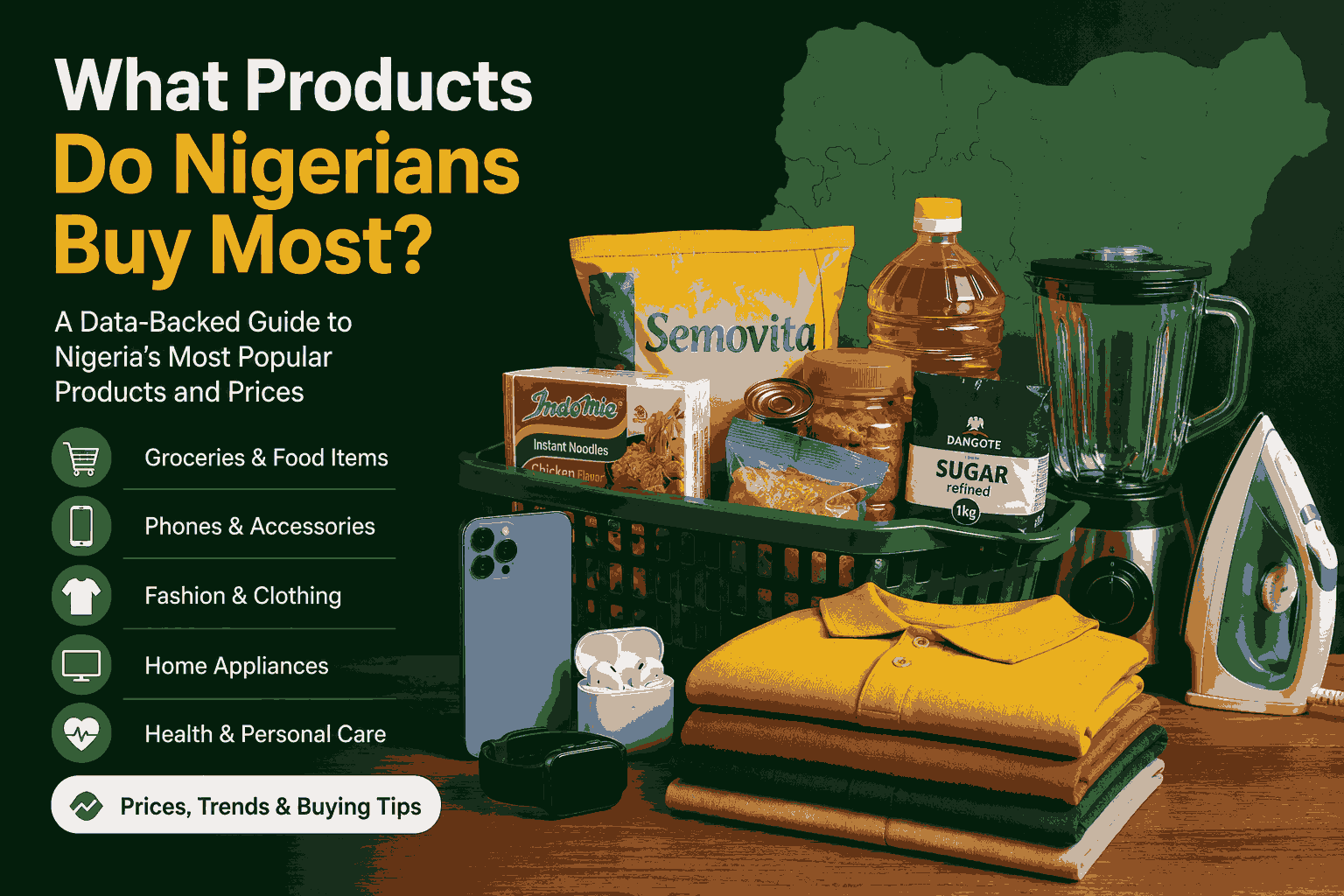
Instead of simply producing a “top-selling products” list, this article distinguishes between everyday consumer demand, online shopping demand and high-value purchases. It also explains why food and household essentials dominate everyday consumption while fashion and electronics can dominate online spending by value.
There is no single market-wide price for the products Nigerians buy most, because the question covers dozens of categories and thousands of individual products.
Current online listings illustrate the wide range. For example, Jumia’s Nigerian marketplace currently shows basic mobile phones from roughly ₦7,800, while popular official-store smartphone examples include Samsung Galaxy A06 listings around ₦119,000, Samsung Galaxy A07 models around ₦130,000–₦159,000, and Xiaomi Redmi models around ₦131,000–₦231,000, depending on model and storage.
Fashion is similarly broad: current Jumia dress listings include discounted products below ₦5,000, while other dresses and gowns are around ₦8,500–₦11,500 or more. Beauty and personal-care products range from inexpensive everyday items to premium products costing considerably more; Jumia currently describes the category as spanning approximately ₦500 to ₦150,000.
These are retail examples, not national average prices. Prices can change because of exchange rates, import costs, promotions, location, seller margins, stock levels, product condition and brand.
What Products Do Nigerians Buy Most? Top Consumer Products in Nigeria in 2026
If you are asking what products do Nigerians buy most, the answer depends on what type of shopping you mean. The products bought most frequently are not necessarily the products generating the most money. Food, drinks, cleaning products and other everyday essentials are purchased repeatedly, while fashion, smartphones, electronics and beauty products are particularly important in online retail.
Recent Nigerian consumer research illustrates this difference. A 2026 report based on Sagaci Research’s shopper panel found Coca-Cola 50cl, Mr V bottled water and Viva! laundry detergent among the most frequently scanned FMCG products in Nigeria over the 12 months to May 20, 2026. Other products in the top 10 included Aquafina, CWAY bottled water, Fanta, Hypo bleach, Peak milk sachets, Eva bottled water and Beloxxi biscuits.
Online shopping tells a somewhat different story. Statista’s latest Nigeria e-commerce data says fashion was the largest online spending category in 2025, followed by electronics, with furniture, beauty and personal care, and food also among the major categories.
That distinction matters.
A bottle of water may be bought far more frequently than a smartphone, but a single smartphone transaction is worth vastly more. Therefore, anyone researching what products Nigerians buy most should look at both purchase frequency and spending value.
This guide examines the major product categories Nigerians buy, explains what drives demand, considers current prices where reliable retail examples are available, and identifies the products that offer the strongest opportunities for buyers and sellers.
What Products Do Nigerians Buy Most?
There is no universal ranking covering every Nigerian purchase. The country’s retail market is highly fragmented, with consumers buying from supermarkets, open markets, neighbourhood shops, specialist stores, social-media sellers and e-commerce platforms.
However, available market evidence points to several consistently important categories:
- Food and groceries
- Beverages and bottled water
- Household and cleaning products
- Fashion and clothing
- Mobile phones and accessories
- Beauty and personal-care products
- Home appliances and electronics
- Personal and household essentials
- Children’s products
- Automotive and transport-related products
The ranking changes depending on whether the measurement is frequency, total spending, online sales or consumer interest.
For example, Nigeria’s National Bureau of Statistics maintains a Selected Food Price Watch covering food prices across all 774 local government areas and the FCT. The methodology uses thousands of respondents and locations, demonstrating how significant food purchases are to household consumption.
At the other end of the market, online shopping provides stronger evidence for fashion and electronics. The U.S. Commercial Service notes that fashion and electronics generate some of the highest e-commerce sales revenues across African markets, while Nigeria’s online consumers are increasingly purchasing home electronics and toys.
So, rather than asking for one simplistic “number one product”, it is more useful to examine the categories individually.
1. Food and Groceries Remain Fundamental Purchases
Food is arguably the most important consumer category in Nigeria because it is purchased continuously rather than occasionally.
Rice, beans, garri, yam, potatoes, bread, cooking oil, tomatoes, onions, pepper, seasoning products and other staple foods form part of ordinary household spending. Unlike discretionary purchases, food demand continues even when consumers reduce spending elsewhere.
The National Bureau of Statistics’ household survey infrastructure specifically tracks the quantity and value of food consumed and purchased by households, reinforcing the importance of food in measuring Nigerian consumption.
Why food sells consistently
The biggest reason is simple: people have to eat.
But there is another important factor. Nigerian consumers often respond to price increases by changing the quantity, brand or product format rather than abandoning the category completely.
A household might move from a premium branded product to a cheaper alternative, buy smaller packages or purchase from an open market rather than a supermarket.
That makes affordability particularly important.
Popular food products
Commonly purchased categories include:
- Rice
- Beans
- Garri
- Yam
- Bread
- Cooking oil
- Tomato products
- Onions and pepper
- Seasonings
- Pasta
- Cereals
- Milk
- Biscuits
- Snacks
- Frozen foods
- Processed foods
The U.S. Commercial Service also identifies processed food, beverages, condiments, sauces, spices and tree nuts as consumer-oriented products with online sales potential in Nigeria.
Buying consideration
When buying food, the cheapest package is not always the cheapest option.
Consumers should compare price per kilogram, litre or unit, particularly when manufacturers offer different package sizes.
A ₦1,000 pack may look cheaper than a ₦2,000 pack, but the larger pack could provide significantly better value per unit.
Bottled Water, Soft Drinks and Other Beverages
Beverages are another major part of everyday Nigerian consumption.
The latest FMCG ranking from Sagaci Research is particularly revealing. Coca-Cola’s 50cl soft drink ranked first among the most frequently scanned products tracked by the research panel, followed by Mr V bottled water and Viva! detergent. Aquafina and CWAY bottled water also appeared among the leading products.
This suggests that beverage demand is not limited to occasional purchases.
Water is particularly important because bottled and packaged water are purchased by households, commuters, offices, restaurants, students and event organisers.
Soft drinks also have a strong presence in Nigerian social life, where drinks are routinely purchased for meals, celebrations, meetings and gatherings.
Why beverages remain strong
Several factors support the category:
- Daily consumption
- Convenience
- Hot weather
- Urban lifestyles
- Events and celebrations
- Restaurants and food businesses
- Workplace consumption
- Easy availability through kiosks and informal retailers
One important feature of Nigeria’s market is distribution.
A product does not necessarily need to be sold through a major supermarket to have enormous consumer demand. Neighbourhood kiosks, roadside sellers and open markets remain important purchasing channels.
3. Household Cleaning Products
Cleaning products may receive less attention online than smartphones or fashion, but they are among the products consumers repeatedly need.
Laundry detergent, bleach, disinfectants, dishwashing products, toilet cleaners, surface cleaners and related household products are purchased regularly.
The 2026 Sagaci Research ranking placed Viva! laundry detergent and Hypo bleach among Nigeria’s leading frequently scanned FMCG products.
Why this category is attractive
Household cleaning products have an important characteristic: repeat demand.
Someone may buy a phone once every few years, but detergent may be purchased every few weeks.
That makes cleaning products particularly relevant for:
- Supermarkets
- Convenience shops
- Local retailers
- Wholesale distributors
- Online grocery businesses
- Neighbourhood stores
Current Jumia listings also show everyday cleaning and personal-care products selling at relatively accessible prices, including WAW all-purpose cleaner, Jik bleach and Dettol products.
The prices shown on marketplace listings should not be interpreted as national averages, however.
4. Fashion and Clothing Are Major Online Purchases
If the question is specifically about what products Nigerians buy online, fashion deserves to be near the top of the list.
Statista’s latest Nigeria e-commerce data identifies fashion as the largest online spending category in 2025, ahead of electronics.
This is important because online fashion is influenced by factors that do not affect basic groceries in the same way.
Social media, celebrity culture, influencers, weddings, parties, workwear and changing trends all influence fashion purchases.
What fashion products sell?
Popular categories include:
- Women’s dresses
- Men’s shirts
- Trousers
- Native wear
- Ankara clothing
- Shoes
- Sneakers
- Sandals
- Handbags
- Watches
- Jewellery
- Fashion accessories
- Children’s clothing
Current Jumia listings demonstrate the breadth of the market. Some dresses are listed below ₦5,000 during promotions, while other gowns and fashion pieces cost ₦10,000 or more.
The challenge with fashion
Price alone does not determine value.
A very cheap clothing item may have poor stitching, thin material, inaccurate sizing or a significant difference between the advertised photograph and the delivered product.
For buyers, measurements and customer reviews are therefore often more useful than simply looking at the headline price.
5. Smartphones and Mobile Accessories
Smartphones are among the most commercially important technology products Nigerians buy.
The market includes budget Android phones, mid-range smartphones, premium Android devices and iPhones, alongside a huge accessory market.
The importance of smartphones is not surprising. They are used for communication, banking, education, entertainment, social media, navigation, work and business.
GSMA’s 2025 smartphone adoption research found that 27% of Nigeria’s population owned a smartphone in 2024. The report also notes that affordability remains a major barrier and that Nigeria’s smartphone market is heavily reliant on imports.
That creates an unusual market dynamic: demand is substantial, but affordability strongly determines which models consumers choose.
What phones are Nigerians buying?
The market includes brands such as Samsung, Tecno, Infinix, Xiaomi Redmi, Apple and others.
Current Jumia listings illustrate several price levels. Examples include basic phones below ₦15,000, Samsung Galaxy A06 models around ₦119,000, Samsung Galaxy A07 models around ₦130,000–₦159,000, and Xiaomi Redmi models around ₦131,000–₦231,000 depending on configuration.
These listings should be treated as examples of current retail pricing, not a definitive national price list.
Why smartphone prices change quickly
Nigeria’s smartphone market is particularly sensitive to:
- Exchange rates
- Import costs
- Taxes
- Distribution margins
- Storage capacity
- RAM configuration
- Promotions
- New model launches
- Stock availability
GSMA notes that imported smartphones are subject to customs duty and VAT and estimates that these costs can materially increase landed prices. The organisation also points to currency depreciation as a source of price volatility.
That is why a smartphone price quoted several months ago may no longer be useful to a Nigerian buyer.
6. Phone Accessories Are a Market of Their Own
One mistake people make when analysing smartphone demand is looking only at handsets.
Every new phone potentially creates demand for additional products.
These include:
- Phone cases
- Screen protectors
- Chargers
- USB cables
- Earphones
- Bluetooth earbuds
- Power banks
- Car chargers
- Phone stands
- Wireless accessories
Jumia’s current “top selling items” section includes several power banks, with examples ranging from roughly ₦7,650 to more than ₦25,000 depending on capacity and specification.
Accessories can also be more affordable for consumers than replacing a complete smartphone.
For sellers, that creates an important distinction: high sales volume does not always require high-ticket products.
7. Beauty and Personal-Care Products
Beauty and personal care form another major Nigerian consumer category.
The market covers everything from soap and toothpaste to skincare, hair products, cosmetics, perfumes and grooming products.
Current Jumia data shows more than 150,000 products in its Beauty & Personal Care category, while individual personal-care listings include products such as toothpaste, soap, bleach, shower products and deodorants.
Why beauty products sell
Beauty purchases are driven by a combination of necessity and lifestyle.
Some products are basic household necessities, such as toothpaste and soap. Others are discretionary products purchased because consumers want a particular appearance, fragrance, hairstyle or skincare routine.
That creates several market segments:
Essential personal care
- Toothpaste
- Soap
- Deodorant
- Body wash
- Sanitary products
- Shampoo
Beauty
- Makeup
- Foundation
- Lip products
- Perfume
- Skincare
- Hair products
Professional and premium
- Wigs
- Hair extensions
- Professional cosmetics
- Salon equipment
- Premium skincare
The authenticity problem
Beauty products deserve extra caution because counterfeit or poorly stored products can create quality and safety problems.
Buyers should check the seller, packaging, expiry information, product seals and return policy rather than selecting solely on price.
8. Home Appliances and Electronics
Home electronics have become increasingly visible in Nigeria’s online retail market.
Products include:
- Electric kettles
- Blenders
- Air fryers
- Irons
- Fans
- Televisions
- Refrigerators
- Microwaves
- Washing machines
- Speakers
- Small kitchen appliances
Current Jumia “top selling items” include products such as electric kettles, blenders, electric irons, air fryers and power banks.
The U.S. Commercial Service also reports that Nigerian consumers are buying more home electronics and toys online.
Why small appliances are important
Smaller appliances often occupy an attractive middle ground.
They are more expensive than ordinary FMCG products but considerably cheaper than major appliances such as refrigerators.
For many consumers, products such as kettles, blenders and irons are practical household purchases rather than luxury goods.
9. Furniture and Home Décor
Furniture is another important online spending category.
Statista places furniture among the major Nigerian e-commerce categories by spending, alongside fashion, electronics, beauty and food.
Products include:
- Beds
- Mattresses
- Chairs
- Tables
- Wardrobes
- Sofas
- Curtains
- Rugs
- Lighting
- Wall décor
- Storage products
Furniture is different from smartphones or cosmetics because delivery, size and logistics have a much greater effect on the final purchase.
A consumer buying a ₦200,000 item may have to consider transportation or delivery charges, installation and the possibility of damage during transit.
For that reason, local sellers can have a competitive advantage over distant suppliers.
10. Children’s Products
Children’s products represent another recurring consumer category.
Parents and guardians purchase:
- Baby clothing
- School bags
- Shoes
- Toys
- Feeding products
- Baby toiletries
- Children’s furniture
- Educational materials
- School supplies
Some purchases are recurring, while others are seasonal.
School-related products, for example, can experience increased demand around the beginning of academic terms.
The main buying considerations are safety, durability, age suitability and value rather than simply the lowest price.
Why Do Nigerians Buy These Products So Frequently?
Understanding what products Nigerians buy most is only half of the story.
The more useful question is why.
Several factors repeatedly appear across the Nigerian market.
Affordability
Price remains one of the strongest influences on purchasing decisions.
When prices rise, consumers often change brands, package sizes or shopping locations.
This is particularly visible in everyday consumer goods.
Product availability
A product that is consistently available can outperform a theoretically superior product that consumers struggle to find.
This explains why distribution remains critical.
Brand recognition
Consumers may be more willing to purchase a familiar brand when the difference in price is relatively small.
This is especially important for food, beverages, personal care and household products.
Social influence
Fashion, beauty and smartphones are particularly influenced by social media and peer behaviour.
A product can become popular quickly because it appears repeatedly in videos, advertisements or influencer content.
Convenience
Online shopping makes products easier to compare and order, particularly for consumers in major urban centres.
Nigeria’s e-commerce ecosystem is supported by increasing digital payments, smartphones and online marketplaces, although infrastructure and payment challenges remain.
What Products Do Nigerians Buy Most Online?
The answer changes slightly when the focus is specifically on e-commerce.
The strongest categories include:
| Category | Online demand | Main reason |
|---|---|---|
| Fashion | Very strong | Variety, trends and social media |
| Electronics | Very strong | Easy price comparison |
| Smartphones | Very strong | High consumer interest |
| Beauty | Strong | Convenience and product variety |
| Furniture | Strong | Wider selection |
| Food | Growing | Convenience and repeat demand |
| Personal care | Strong | Everyday consumption |
| Home appliances | Strong | Practical household use |
| Toys | Growing | Convenience and gifting |
| Accessories | Strong | Lower-cost purchases |
Statista identifies fashion as the leading online spending category in Nigeria for 2025, followed by electronics.
This does not mean Nigerians buy more clothing than food overall.
It means that within the measured e-commerce market, fashion generated the largest spending value.
That distinction is essential.
Current Price Examples for Popular Nigerian Products
Because this article covers categories rather than a single product, it would be misleading to publish one “current price”.
Instead, the following figures illustrate the range visible in current online listings.
| Product/category | Current retail examples |
|---|---|
| Basic mobile phones | About ₦7,800–₦12,000+ |
| Samsung Galaxy A06 | About ₦119,000 in current Jumia listings |
| Samsung Galaxy A07 | About ₦130,000–₦159,000 |
| Xiaomi Redmi models | About ₦131,000–₦231,000 in examples checked |
| Dresses | From below ₦5,000 to ₦10,000+ in examples checked |
| Beauty/personal care | Roughly ₦500 to ₦150,000 across the broad Jumia category |
| Power banks | Roughly ₦7,600–₦25,500 in current examples |
| Electric kettle | About ₦6,300 in a current Jumia top-selling example |
| Air fryer | About ₦28,000 in a current Jumia top-selling example |
These figures are illustrative marketplace prices rather than national averages.
A buyer in Lagos, Abuja, Ibadan, Kano or another location may encounter a different price from a local retailer, official store or independent online seller.
What Makes a Product a Strong Seller in Nigeria?
A product does not necessarily need to be expensive or technologically advanced to sell well.
The strongest products often share several characteristics.
1. They solve a regular problem
Food, water, detergent and personal-care products fit this model.
2. They are affordable enough for repeated purchase
A product with a low entry price can reach a much wider consumer base.
3. They are easy to distribute
Small products are generally easier and cheaper to transport than bulky goods.
4. They have recognisable value
Consumers need to understand what the product does and why they need it.
5. They have repeat demand
This is one reason FMCG products remain commercially powerful.
6. They benefit from social trends
Fashion, beauty and smartphones can experience rapid demand changes when consumer preferences shift.
What Products Should Buyers Be Most Careful About?
Not every popular product is automatically a good purchase.
Smartphones
Check the exact model, RAM, storage, network compatibility, warranty and seller.
Do not assume that a phone with a familiar-looking name is the same as an official model.
Beauty products
Authenticity is more important than a small price difference.
Fashion
Check measurements rather than relying solely on the stated size.
Electronics
Look at warranty terms, power requirements, replacement parts and after-sales support.
Food
Check expiry dates, packaging and storage conditions.
Popularity should never replace due diligence.
What Products Do Nigerians Buy Most for Business?
If the question is being asked from a business perspective, the answer requires another distinction.
The best-selling products are not automatically the most profitable products.
A retailer might sell thousands of low-margin FMCG items while another business sells fewer smartphones but earns more profit per transaction.
Potentially attractive categories include:
Fast-moving consumer goods
These offer repeat demand but can have tight margins and strong competition.
Fashion
Margins can be attractive, but returns, sizing and changing trends create risks.
Phone accessories
Accessories can benefit from smartphone ownership without requiring customers to spend hundreds of thousands of naira.
Beauty products
The category offers a broad range of price points and repeat purchases, but authenticity is crucial.
Small electronics
Kettles, blenders, irons, fans and similar appliances can appeal to households seeking practical products.
Food and packaged products
Demand is broad, but businesses must carefully manage storage, expiry dates, transportation and margins.
Where Do Nigerians Buy These Products?
Nigeria has a highly diverse retail system.
Consumers buy from:
- Open markets
- Neighbourhood shops
- Supermarkets
- Brand outlets
- Shopping malls
- Specialist retailers
- Social-media sellers
- E-commerce marketplaces
- Direct distributors
- Informal traders
This matters because online data cannot represent the entire Nigerian retail market.
The U.S. Commercial Service identifies Jumia and Konga among Nigeria’s established online retail platforms, while also noting the growth of specialised online businesses.
For online shopping, consumers can compare current listings on Jumia Nigeria and Konga.
For expensive purchases, buyers should also check whether the seller is an official store or authorised retailer.
How to Get the Best Price When Buying in Nigeria
The cheapest advertised price is not necessarily the best deal.
A better approach is to compare the total cost of ownership.
For a smartphone, that may include:
- Phone price
- Delivery
- Charger
- Case
- Screen protector
- Warranty
- Repair costs
For an appliance:
- Purchase price
- Delivery
- Electricity consumption
- Warranty
- Spare parts
- Repairs
For clothing:
- Product price
- Delivery
- Alterations
- Return costs
This approach gives a more realistic picture of value.
Are Expensive Products Better?
Not necessarily.
In Nigeria’s price-sensitive market, a mid-range product can sometimes provide better value than a premium model.
For example, a consumer who mainly needs WhatsApp, calls, banking, YouTube and social media may not benefit enough from a flagship smartphone to justify paying several times the price of a capable mid-range device.
The same principle applies to appliances, fashion and personal-care products.
The right question is not:
“What is the most expensive option?”
It is:
“What product meets my needs without paying for features I will not use?”
What Products Do Nigerians Buy Most During Economic Pressure?
Economic pressure tends to change how people buy as much as what they buy.
Consumers may:
- Switch brands
- Buy smaller quantities
- Delay non-essential purchases
- Search for promotions
- Buy used products
- Compare multiple sellers
- Repair products rather than replace them
- Choose locally available alternatives
Smartphones provide a good example.
GSMA’s Nigeria research highlights affordability as a significant obstacle to smartphone adoption and notes that currency depreciation has increased price volatility.
This helps explain why the market contains both very inexpensive phones and premium devices.
Consumers are not all shopping at the same price level.
Common Misconceptions About Nigerian Consumer Demand
“The most expensive products sell the most.”
Not necessarily.
High-value products generate more revenue per transaction, but everyday products can be purchased vastly more frequently.
“Online best sellers represent the whole country.”
They do not.
A large part of Nigerian commerce still occurs offline.
“A popular brand is always the best choice.”
Popularity can indicate availability and consumer familiarity, but it does not guarantee that a particular model or product is best for every buyer.
“The cheapest price is the best price.”
A suspiciously low price can indicate a counterfeit, used product, missing accessories, weak warranty or unreliable seller.
“Imported products are always better.”
Local and regional brands can provide strong value, particularly when they understand local pricing, distribution and consumer needs.
What Products Are Likely to Remain in High Demand?
Predicting future demand with certainty is impossible, but products linked to fundamental needs are generally more resilient than products dependent entirely on short-lived trends.
Food, beverages, household cleaning products, personal care, affordable mobile devices and basic household goods are likely to remain important because they serve recurring needs.
Fashion, beauty, consumer electronics and entertainment products are more trend-sensitive.
The strongest future opportunities are likely to come from products that combine affordability, convenience and genuine usefulness.
Nigeria’s expanding digital ecosystem should also continue to influence how consumers discover, compare and purchase products. However, infrastructure, purchasing power, foreign-exchange conditions and logistics will remain important constraints.
Also Read: What Is the Best App to Earn Money
How to Choose Products Based on Your Budget
Knowing what products Nigerians buy most is useful, but popularity should not be the only factor when deciding what to purchase. Your budget, how often you will use the product, the cost of maintaining it and the consequences of buying a poor-quality item all matter.
For everyday household spending
Start with products that solve an immediate need and compare the cost per unit. Food, drinks, cleaning supplies and personal-care products may appear inexpensive individually, but repeated purchases can become a significant part of a household budget. A useful approach is to record what you spend over a month and identify which categories consume the largest share.
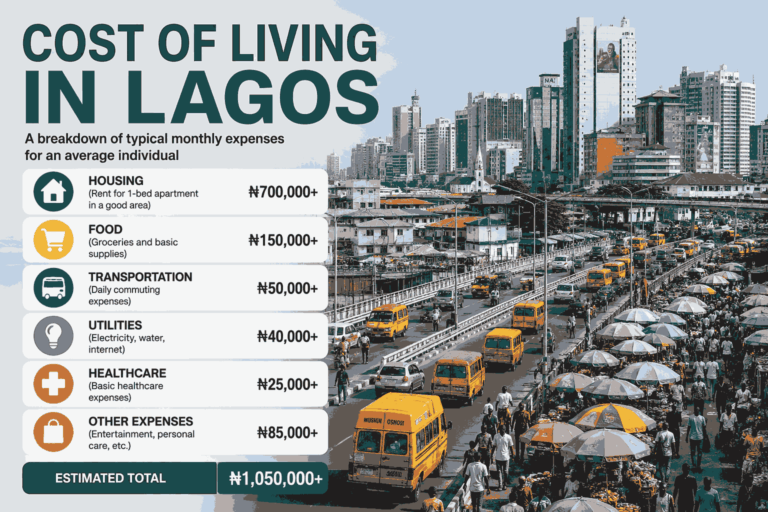
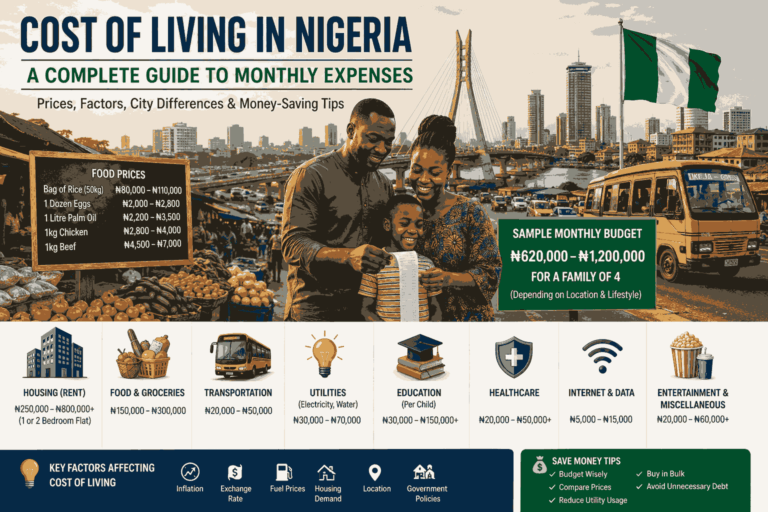
For a broader view of household budgets, see our guide to the cost of living in Nigeria. Readers in Lagos can also compare typical expenses in our Lagos cost-of-living guide.
For phones and electronics
Do not choose a device simply because it is popular. Compare the exact model, storage, RAM, warranty, battery, network compatibility and expected length of use. A less expensive phone that meets your needs can be more practical than paying for specifications you will rarely use.
Our detailed guides to Samsung phone prices in Nigeria, Tecno phones and prices and Redmi phones and prices can help when comparing specific models.
For fashion, beauty and personal care
Quality, authenticity and suitability should come before a low headline price. Check measurements for clothing, ingredients and expiry information for beauty products, and the seller’s return policy for online purchases. Products that look inexpensive can become costly if they do not fit, arrive damaged or need to be replaced quickly.
How Sellers Can Identify Products With Real Demand
If you are researching this topic because you want to start a small business, avoid assuming that the most popular product is automatically the most profitable. A better method is to test demand with a limited quantity before committing significant capital.
Measure the complete economics
For every product, calculate the buying cost, transportation, packaging, platform or payment fees, expected selling price, damaged or unsold stock and the profit left after all expenses. This gives you a clearer picture than looking at sales revenue alone.
Test before expanding
Start with a small stock level, record enquiries and completed sales, and identify which products customers ask for repeatedly. If a product sells quickly but leaves very little profit, compare it with an alternative before increasing your stock.
If your goal is daily cash flow, our guide on products you can sell to make money every day in Nigeria provides a more focused look at repeat-demand products. You can also see practical ways to earn ₦1,000 daily and ways to target ₦5,000 per day.
Watch repeat purchases
A customer who buys once is useful, but a customer who returns regularly can make a business more predictable. This is one reason food, household supplies, personal care and selected accessories can remain important even when individual transaction values are modest.
How to Compare Popular Products Before Buying
Use a simple comparison before spending money. Write down the purchase price, delivery cost, expected lifespan, warranty, repair or replacement cost and the main purpose of the product. Then compare at least two or three sellers or models where practical.
- Need: What problem does the product solve?
- Budget: Can you comfortably afford the complete cost?
- Quality: Is the product genuine and suitable for the intended use?
- Durability: How long is it reasonably expected to last?
- Support: Is there a warranty, return option or accessible replacement service?
- Value: Are you paying for useful features rather than features you will not use?
This approach is especially important when comparing expensive purchases. For example, someone considering a smartphone should compare the full ownership cost rather than focusing only on the advertised handset price. The same principle applies to appliances, furniture and other products where delivery, maintenance or accessories add to the final expense.
What Product Demand Can Tell a Small Business Owner
Consumer demand is useful market information, but it should be treated as a starting point rather than a guarantee of profit. Before investing, consider your location, target customer, competitors, available capital, storage needs, supplier reliability and how quickly stock can be replaced.
A person starting with limited capital may need a different strategy from someone with several million naira available. Our guide on businesses you can start with ₦500,000 in Nigeria discusses how capital can be matched with a realistic business model. For broader business comparisons, see business models to consider in Nigeria.
The key lesson is simple: strong consumer demand is valuable only when the seller can source the product reliably, price it competitively and retain enough margin after expenses.
Editorial Verdict
So, what products do Nigerians buy most?
The most accurate answer is that Nigeria has two overlapping consumer markets.
The first is the everyday consumption market, where food, beverages, water, detergents, personal-care products and other FMCG goods dominate because people need to purchase them repeatedly.
The second is the discretionary and online retail market, where fashion, electronics, smartphones, beauty products, furniture and household appliances account for substantial consumer spending.
Recent evidence supports this distinction. FMCG shopper data shows everyday brands such as Coca-Cola, bottled water and detergent appearing prominently among frequently scanned products, while e-commerce data places fashion and electronics at the top of online spending.
For consumers, this means there is no universal “best-selling product” that automatically represents the Nigerian market.
For businesses, it means product selection should depend on purchase frequency, consumer income, competition, margins, distribution costs and repeat demand rather than popularity alone.
The strongest products are usually those that solve a real problem at a price consumers can reasonably afford.
Buying Recommendation
If you are buying for personal use, prioritise value, authenticity and suitability for your needs rather than simply choosing the product that appears most popular.
For smartphones and electronics, compare specifications and warranty. For fashion, check measurements and seller reviews. For beauty products, prioritise authenticity. For household goods and FMCG products, compare the cost per unit rather than the package price.
If you are researching this market from a business or reselling perspective, the most interesting categories are not necessarily the products with the highest selling prices. Repeat-purchase categories such as FMCG, personal care and selected accessories can be attractive because consumers return to them regularly, while fashion, smartphones and electronics can provide larger individual transactions.
Verification Notes
- National consumer demand: There is no single authoritative 2026 database ranking every product Nigerians purchase across formal and informal retail channels. The article therefore distinguishes between consumer frequency, e-commerce spending and retail examples.
- FMCG demand: The 2026 Sagaci Research shopper-panel ranking reported by BusinessDay provides useful evidence about frequently scanned consumer products in Nigeria.
- E-commerce categories: Statista’s latest published Nigeria e-commerce data identifies fashion as the largest online spending category in 2025, followed by electronics.
- Food consumption: NBS maintains household food-consumption data and a nationwide Food Price Watch covering all 774 LGAs and the FCT.
- Smartphone market: GSMA’s 2025 research reports 27% smartphone ownership in Nigeria in 2024 and highlights affordability and currency-related price pressure.
- Retail prices: Jumia listings were used only as current retail examples, not as official national averages. Individual listings can change at any time.
- Price updates: Smartphone, fashion, beauty and electronics prices should be rechecked before publication because promotions, exchange rates, stock and seller pricing can change rapidly.
Final Quality Assessment
Original value: The article does not simply produce a generic “top 10 products” list. It separates frequently purchased everyday goods from high-value online purchases, which is a more accurate way to answer the underlying question.
Additional analysis: It examines consumer behaviour, affordability, distribution, social influence, e-commerce, product authenticity, pricing and the difference between sales volume and revenue.
Difference from ordinary product pages: A conventional product page normally gives a product name, specification and price. This article instead explains why particular categories sell, who buys them, how pricing works and what buyers should consider.
Evidence quality: The analysis combines NBS data resources, GSMA research, U.S. Commercial Service market information, current e-commerce marketplace listings, Statista’s category-level e-commerce data and recent Nigerian FMCG reporting.









+ There are no comments
Add yours