






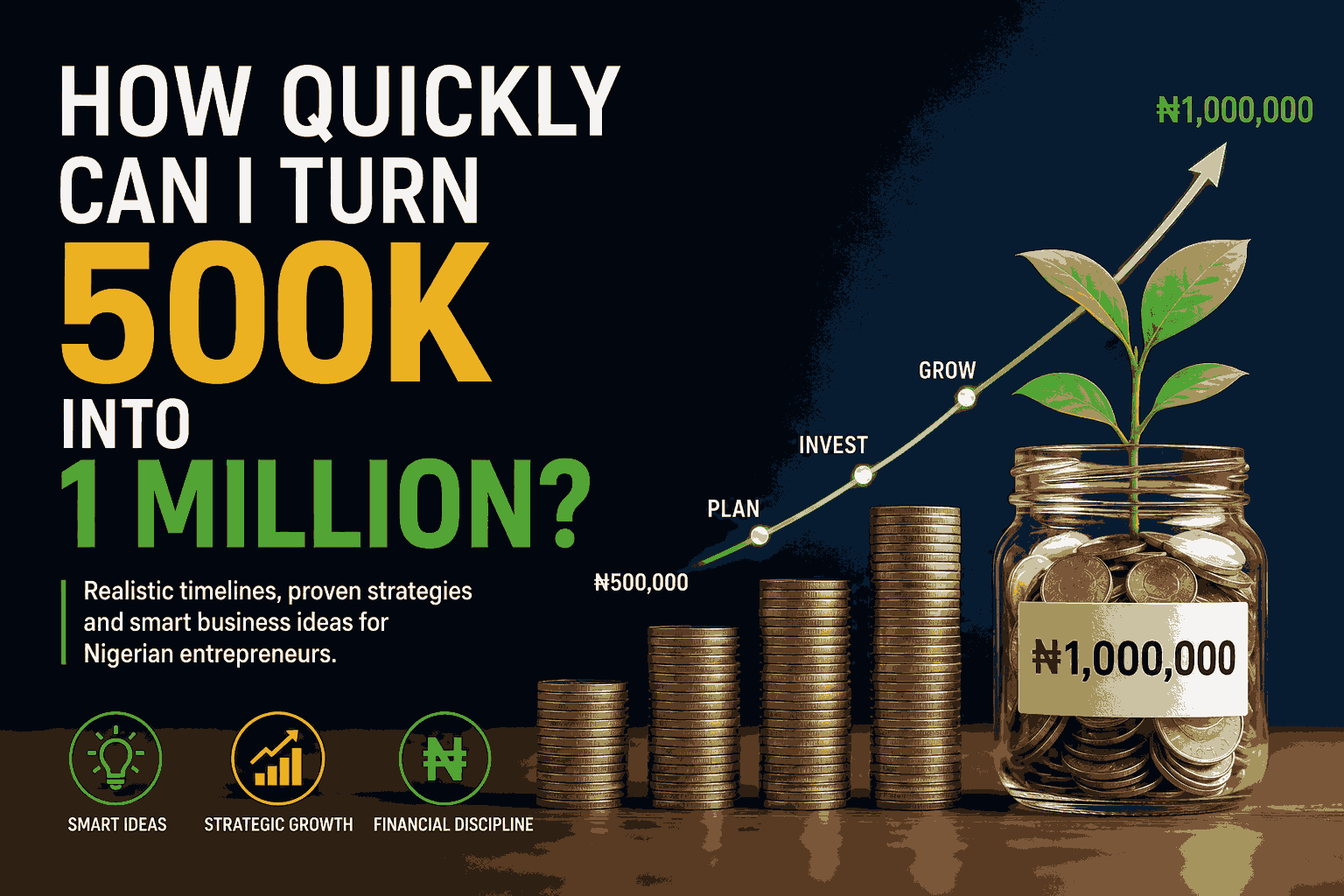
Instead of presenting ₦500,000 as money that can magically double, this article treats it as business working capital. The central question is not simply what business can double ₦500k?, but what combination of margin, sales volume, reinvestment and time would actually be required to reach ₦1 million?
The analysis also separates revenue from profit, explains why very fast doubling usually involves substantially higher risk, and examines business models that can potentially work with relatively modest starting capital in Nigeria.
Current Price Summary
Because the subject is business capital rather than a physical product, there is no conventional retail price to report.
| Item | Amount |
|---|---|
| Starting capital | ₦500,000 |
| Target amount | ₦1,000,000 |
| Profit required | ₦500,000 |
| Required return on original capital | 100% |
| Main strategy examined | Business growth and reinvestment |
| Guaranteed timeframe | None |
A crucial point is that turning ₦500,000 into ₦1 million means generating ₦500,000 in additional net value. It does not mean merely recording ₦1 million in sales.
How Quickly Can I Turn 500k into 1 Million? A Realistic Business Strategy for Nigerians
If you have ₦500,000 and want to know how quickly you can turn 500k into 1 million, the honest answer is that there is no guaranteed timeframe. It could take a few months in a highly profitable business, considerably longer in a slower business, or you could lose part or all of the capital if the business is poorly selected or badly managed.
The important question is therefore not simply, “What business can double my money quickly?” A better question is: What business can generate enough genuine profit from ₦500,000, while allowing me to reinvest that profit without taking unreasonable risks?
To go from ₦500,000 to ₦1 million, you need an additional ₦500,000 in net value. That is a 100% increase in your original capital.
For example, if you invest ₦500,000 in inventory and eventually sell everything for ₦650,000, you have not doubled your money. You have generated ₦150,000 in gross profit before considering transport, advertising, packaging, damaged goods, rent, transaction charges and other expenses.
This distinction between sales, gross profit and net profit is one of the most important things to understand before attempting to double business capital.
How Quickly Can I Turn 500k into 1 Million?
The speed depends primarily on four things:
- Your profit margin.
- How quickly you can sell your products or services.
- How much of the profit you reinvest.
- How much money is lost to operating expenses, bad debts, unsold stock and other risks.
Suppose, purely as a mathematical example, that a business could genuinely produce a 20% net return on its capital each cycle and that all profits were reinvested.
Starting with ₦500,000:
- After one cycle: ₦600,000
- After two cycles: ₦720,000
- After three cycles: ₦864,000
- After four cycles: approximately ₦1.04 million
That does not mean a real Nigerian business will reliably produce 20% net profit every cycle. It is simply an illustration of how reinvestment can accelerate growth.
At a consistent hypothetical monthly return of 10%, doubling would take roughly 7–8 months. At 15%, it would take about five months. At 20%, it would take about four months.
Those figures should not be interpreted as investment promises. Maintaining such returns consistently is difficult, and actual businesses experience slow sales, unexpected expenses, price changes, competition and losses.
The difference between a mathematical target and a business plan
A spreadsheet can assume that your money grows by the same percentage every month.
A business cannot.
One month may be excellent. Another may be slow. A supplier may increase prices. A customer may fail to pay. Your advertising may become more expensive. Stock can remain unsold. Equipment can break down.
Therefore, if your goal is to turn ₦500,000 into ₦1 million, you should think in terms of profit targets and business cycles, rather than a guaranteed number of days.
What Does It Actually Take to Double ₦500,000?
The target sounds simple:
₦500,000 → ₦1,000,000
But your business needs to create another ₦500,000 after costs.
Consider three hypothetical net-margin scenarios.
| Net profit margin | Sales needed to generate ₦500,000 profit |
|---|---|
| 10% | ₦5,000,000 |
| 20% | ₦2,500,000 |
| 30% | Approximately ₦1,667,000 |
| 40% | ₦1,250,000 |
This table demonstrates why chasing a high-margin business is not the only consideration.
A business with a 10% net margin may require enormous sales volume, while a business with a 30% margin may need substantially less revenue. However, a higher margin does not automatically mean the business is better. High-margin businesses can have fewer customers, greater competition, higher skill requirements or higher failure rates.
For many people starting with ₦500,000, the objective should be to find a business with a combination of:
- reasonable demand;
- manageable operating costs;
- quick inventory turnover or fast service delivery;
- repeat customers;
- controllable risk;
- sufficient margin; and
- room to reinvest.
That combination is more valuable than simply looking for the highest advertised profit percentage.
Business Models That Can Potentially Grow ₦500,000
There is no single business that is guaranteed to double ₦500,000. The best option depends heavily on your location, skills, customer base and ability to sell.
However, several categories can be considered.
1. Fast-Moving Product Reselling
Reselling is one of the most straightforward ways to use ₦500,000 as working capital.
The concept is simple: purchase products at a competitive wholesale price and sell them at a higher retail price.
Potential categories include:
- phone accessories;
- household products;
- beauty products;
- fashion items;
- small electronics;
- food products;
- personal-care products;
- school-related products;
- locally produced goods.
The biggest advantage is that you do not necessarily need to manufacture anything.
Your job is to identify products people already want, source them efficiently and create a reliable sales channel.
The biggest danger is buying products simply because you personally like them.
A product can look profitable on paper while sitting in your room for six months.
How to make reselling work better
Before committing the entire ₦500,000, test demand.
Instead of buying ₦500,000 worth of one product, consider using a smaller amount to determine:
- how many people ask about the product;
- how many actually pay;
- how long it takes to sell;
- which price customers accept;
- which competitors already dominate the market;
- how much delivery costs;
- how frequently customers return.
A product that sells quickly at a moderate margin may be more valuable than a product promising a large margin but moving very slowly.
2. Food and Snack Business
Food is another area where relatively small businesses can generate recurring sales.
Depending on your location and expertise, opportunities may include:
- snacks;
- pastries;
- lunch delivery;
- small-scale catering;
- frozen foods;
- packaged local foods;
- drinks;
- office food delivery;
- event food services.
The advantage of food is that demand can be frequent.
The disadvantage is that food businesses can lose money through spoilage, poor portion control, inconsistent quality, expensive ingredients and weak inventory management.
If you already know how to cook or produce a particular food item, ₦500,000 may be more useful because you are not spending heavily to learn the basic skill before starting.
A sensible approach is to begin with a limited menu rather than attempting to sell everything.
For example, instead of opening a business with 20 different products, identify two or three products with strong demand and build your operation around them.
3. Digital Services
For someone who already has a useful digital skill, a service business can be particularly attractive because it may require less money to operate than an inventory-heavy business.
Possible services include:
- graphic design;
- website development;
- social media management;
- video editing;
- photography;
- copywriting;
- digital marketing;
- virtual assistance;
- bookkeeping;
- tutoring;
- consulting;
- business documentation.
The major advantage is that your primary asset is your skill rather than physical inventory.
If you already possess the skill, part of the ₦500,000 can be preserved as working capital instead of being spent on stock.
For example, money might be allocated towards a better computer, software, internet access, branding, advertising and customer acquisition while keeping a substantial emergency reserve.
The challenge is customer acquisition.
Having a skill does not automatically produce customers.
You need a system for finding clients, demonstrating your results, pricing your services and collecting payment.
4. Phone Accessories and Small Electronics
Phone-related products can offer opportunities because smartphones are widespread and accessories are frequently replaced or upgraded.
Products might include:
- charging cables;
- chargers;
- screen protectors;
- phone cases;
- holders;
- adapters;
- earphones;
- power accessories.
However, this market can be highly competitive.
Price comparison is easy, and customers may choose another seller if the difference is small.
Your advantage therefore needs to come from something beyond simply being available.
You might compete through:
- reliable products;
- attractive packaging;
- quick delivery;
- installation assistance;
- bundles;
- after-sales support;
- convenient location;
- online ordering.
The lesson is important: a competitive product does not automatically produce a competitive business.
5. Fashion and Clothing Reselling
Fashion can also be operated at a relatively small scale.
Instead of opening a large physical shop immediately, a ₦500,000 budget could be used for a carefully selected collection and online marketing.
Potential models include:
- ready-to-wear clothing;
- thrift fashion;
- footwear;
- bags;
- modest fashion;
- children’s clothing;
- accessories;
- niche fashion products.
The major challenge is inventory risk.
Fashion trends change, and the wrong sizes, colours or styles can remain unsold.
This is why a small test batch can be safer than committing all your capital to one collection.
6. Cleaning and Home Services
Service businesses are often overlooked because they do not look as exciting as product trading.
However, services can have an important advantage: customers pay for labour and expertise rather than only for a physical product.
Potential services include:
- residential cleaning;
- office cleaning;
- post-construction cleaning;
- laundry pickup and delivery;
- fumigation services where properly licensed and operated;
- gardening;
- home maintenance coordination.
A service business can potentially grow by obtaining repeat customers.
For example, a customer who pays once for a service may become a weekly or monthly customer.
Recurring customers make revenue more predictable and can reduce the cost of finding new customers constantly.
7. Agricultural Trading Rather Than Starting a Farm
Agriculture is often presented as an easy way to make money, but starting a farming operation with a limited budget can involve substantial risks.
Land, labour, feed, seedlings, transportation, weather, disease and market prices can all affect results.
For someone with ₦500,000, agricultural trading may sometimes be easier to understand than starting a full farming operation.
The trader buys an agricultural product where it is relatively cheaper and sells it into a market where demand and pricing are better.
But this still requires market knowledge.
You should understand:
- seasonal price movements;
- storage requirements;
- transportation;
- spoilage;
- buyer demand;
- supplier reliability;
- local regulations.
Agriculture can create opportunities, but it should never be treated as guaranteed profit.
The Most Important Strategy: Protect the Original ₦500,000
One of the biggest mistakes people make when trying to turn ₦500,000 into ₦1 million is putting all the money into the business immediately.
Imagine you spend the entire ₦500,000 on inventory and then discover that sales are much slower than expected.
You may have no money left for:
- transportation;
- marketing;
- emergencies;
- restocking profitable products;
- unexpected business expenses.
A more disciplined approach is to divide the money into functions.
For example, a hypothetical allocation could look like this:
| Purpose | Example allocation |
|---|---|
| Core inventory/equipment | ₦300,000 |
| Marketing and customer acquisition | ₦75,000 |
| Operations and logistics | ₦50,000 |
| Emergency/business reserve | ₦75,000 |
| Total | ₦500,000 |
This is not a universal formula.
A digital service business may require much less inventory, while a product business may require more working capital.
The principle is what matters: do not confuse money available to invest with money you can afford to lose.
How Reinvestment Can Help You Reach ₦1 Million
Reinvestment is one of the strongest mechanisms available to a small business owner.
Suppose a business begins with ₦500,000 and generates ₦100,000 in genuine net profit.
If you withdraw the entire ₦100,000, your business remains around ₦500,000.
If you reinvest the profit, the next business cycle can potentially operate with approximately ₦600,000.
If the larger capital base produces another ₦120,000 in profit, you could have approximately ₦720,000.
The process can continue.
This is the basic idea behind compounding.
However, compounding only works if the business is actually profitable.
Reinvesting money into a losing business does not create wealth. It simply increases the amount of money exposed to the loss.
A Practical ₦500k-to-₦1m Growth Framework
Rather than asking, “How can I double ₦500,000 in 30 days?”, consider using four stages.
Stage One: Validate
Use the first stage to establish that people will actually pay.
Find out:
- Who is your customer?
- What problem are you solving?
- What price will they pay?
- Who are your competitors?
- How much does it cost to acquire one customer?
- What is your actual profit after expenses?
Do not rely solely on social-media comments saying that a product is “hot”.
Actual payments are more useful evidence than likes.
Stage Two: Establish a Repeatable Process
Once you discover something that sells, document the process.
Know:
- where you buy;
- what your costs are;
- what you sell for;
- how you deliver;
- how customers pay;
- how you record sales;
- how you handle complaints.
A business becomes easier to scale when the owner understands exactly how money moves through it.
Stage Three: Reinvest Carefully
Do not increase spending merely because sales increase.
Reinvest into areas that have demonstrated value.
For example, if ₦20,000 of advertising reliably produces profitable customers, increasing the advertising budget may make sense.
If ₦20,000 of advertising produces no sales, spending ₦100,000 more is not a scaling strategy.
It is simply a bigger loss.
Stage Four: Scale What Works
Only after establishing demand should you consider:
- larger inventory;
- additional employees;
- a larger location;
- more advertising;
- additional product lines;
- wholesale purchasing;
- delivery partnerships;
- expansion into another location.
The goal is to scale a working business model, not to scale an untested idea.
What Can Make ₦500,000 Reach ₦1 Million Faster?
Several factors can accelerate growth.
High Stock Turnover
If you can buy and sell inventory quickly, the same capital can potentially be deployed multiple times.
A ₦500,000 inventory position that turns over every month is fundamentally different from ₦500,000 worth of stock that takes six months to sell.
Repeat Customers
A repeat customer is often more valuable than a one-time buyer because you do not have to start the sales process from zero each time.
Strong Gross Margin
A larger gross margin gives you more room to absorb expenses.
But remember that gross margin is not the same as net profit.
Low Fixed Costs
Rent, salaries, utilities and other fixed expenses can consume profits before the owner realises what is happening.
A lean operation can sometimes grow faster because more revenue remains available for reinvestment.
Good Record-Keeping
If you do not know how much you spent, how much you sold and how much you actually made, you cannot accurately determine whether you are getting closer to ₦1 million.
Revenue Is Not the Same as Profit
This deserves special attention.
Suppose you buy goods for ₦500,000 and sell them for ₦700,000.
You may think:
“I made ₦200,000.”
Not necessarily.
You might have spent:
- ₦30,000 on transportation;
- ₦20,000 on advertising;
- ₦10,000 on packaging;
- ₦15,000 on payment and miscellaneous costs.
Your actual profit may now be closer to ₦125,000.
If you repeatedly confuse revenue with profit, you may believe that your business is growing when your capital is actually shrinking.
Every serious attempt to turn ₦500,000 into ₦1 million should therefore include proper bookkeeping.
Can You Turn ₦500k into ₦1 Million in 30 Days?
It is possible for an individual business to achieve extraordinary growth in a short period, but it would be irresponsible to present doubling ₦500,000 in 30 days as a normal or dependable outcome.
To double your capital in one month, you need an exceptionally strong combination of:
- high demand;
- strong margins;
- rapid turnover;
- excellent execution;
- low expenses;
- sufficient customers;
- reliable suppliers.
If someone tells you that they can guarantee that your ₦500,000 will become ₦1 million in 30 days with little or no risk, treat that claim very cautiously.
Nigeria’s Securities and Exchange Commission has specifically warned in 2026 about unregistered online investment schemes promising unrealistic or guaranteed returns. It advises investors to verify the registration status of investment operators before committing funds.
The warning is particularly relevant to anyone searching for a “quick” way to double money.
What About Crypto, Forex and Online Investments?
These options are sometimes promoted as fast ways to turn ₦500,000 into ₦1 million.
The problem is that speed works in both directions.
An investment capable of doubling rapidly may also be capable of losing a substantial percentage of your money rapidly.
That makes speculative trading fundamentally different from building a business with identifiable customers and measurable operating economics.
If you are considering an investment platform, do not judge it solely by screenshots of profits or testimonials.
Ask:
- Is the operator properly registered?
- What exactly generates the return?
- What are the risks?
- Can you independently verify the business?
- What happens if the market moves against you?
- Are withdrawals properly documented?
- Is the promised return realistic?
The SEC has repeatedly identified guaranteed or unusually high returns, recruitment-based schemes and unregistered operators as warning signs.
A fast doubling target should never cause you to abandon basic due diligence.
How Inflation Changes the Meaning of ₦1 Million
There is another issue that is easy to overlook.
Turning ₦500,000 into ₦1 million is a nominal doubling of your money.
It does not necessarily mean your purchasing power has doubled.
Nigeria’s economic environment has experienced significant inflation and exchange-rate changes in recent years. The Central Bank of Nigeria’s July 2026 monetary-policy decision, for example, retained the Monetary Policy Rate at 26.5%, illustrating that the cost of money remains an important part of the economic environment.
Therefore, the objective should not simply be:
“I want to see ₦1 million in my account.”
A stronger objective is:
“I want to build a profitable business that grows my capital faster than my costs and allows me to preserve and increase purchasing power.”
That is a much more useful financial target.
How Much Should You Reinvest?
There is no universal percentage.
If your business is still small and growing, reinvesting a large share of genuine profit can help increase working capital.
However, taking nothing out indefinitely can also create personal financial pressure.
One possible framework is to divide net profit between:
- business reinvestment;
- emergency savings;
- personal income;
- future expansion.
For example, a business owner might decide to reinvest 60% of net profit, keep 20% as a reserve and take 20% as personal income.
Another business might require 80% reinvestment during its early growth stage.
The correct percentage depends on the business.
What matters most is that the decision is made after calculating actual net profit, not simply after looking at money entering the business account.
Common Mistakes That Can Prevent ₦500k from Becoming ₦1m
Buying Too Much Stock
A large quantity does not automatically mean a better deal.
Cheap stock that does not sell is expensive capital.
Chasing Trends
A product going viral today may have little demand next month.
Test demand before committing substantial capital.
Mixing Business and Personal Money
If you use business funds for personal expenses without recording them, you may believe the business is underperforming when money is simply leaving the business.
Ignoring Small Expenses
₦2,000 here and ₦5,000 there can become a significant amount over dozens of transactions.
Giving Too Much Credit
Selling goods on credit can create impressive sales figures while leaving you without cash to restock.
Expanding Too Early
A successful small operation does not automatically justify opening a large shop or hiring several employees.
Scale when the numbers support it.
Borrowing Aggressively
Debt can increase growth, but it also increases the consequences of failure.
It is generally safer to understand your business economics before taking on significant borrowing.
What If You Do Not Have Business Experience?
If ₦500,000 represents a substantial portion of your savings, starting a completely unfamiliar business with all of it may be unnecessarily risky.
You could begin with a smaller test allocation.
For example, instead of committing ₦500,000 immediately, you might use ₦100,000–₦200,000 to test a business concept while preserving the rest.
If the test demonstrates real demand and healthy margins, you can increase the capital gradually.
This approach has a major advantage:
you are paying a relatively small amount to learn whether your idea works.
That is often preferable to spending the entire capital before discovering the business model is wrong.
Should You Start a Business or Invest the ₦500k?
The answer depends on your skills, risk tolerance and financial goals.
A business can potentially produce higher returns than conservative investments, but it also requires work and carries operational risk.
An investment may require less day-to-day involvement, but expected returns are generally tied to the specific investment and its risk level.
You should not compare a business’s potential profit directly with an investment’s expected return without considering:
- your time;
- operating costs;
- taxes and regulatory costs where applicable;
- risk of losing capital;
- liquidity;
- skill requirements;
- market conditions.
If you are experienced in a particular business, your knowledge may give you an advantage that you would not have in an unfamiliar investment.
Where Can Nigerian Entrepreneurs Get Business Support?
You do not necessarily have to build everything alone.
The Small and Medium Enterprises Development Agency of Nigeria (SMEDAN) provides programmes focused on entrepreneurship training, business development, access to opportunities and MSME support. Its current programme portfolio includes initiatives covering business skills, digital development, agriculture, textiles and micro-business growth.
The Bank of Industry also provides business advisory and financing support for qualifying businesses. Its MSME activities focus on helping enterprises develop sustainable business models and access financial and advisory support.
These programmes do not mean that every applicant will receive funding, and eligibility varies by programme. They are better viewed as potential sources of training, information, financing or business-development assistance rather than guaranteed shortcuts to ₦1 million.
A Realistic Way to Think About the ₦1 Million Target
Instead of giving yourself an arbitrary deadline, create milestones.
Milestone 1: ₦500,000 → ₦600,000
Your first objective is to prove that the business can generate genuine profit without destroying the original capital.
Milestone 2: ₦600,000 → ₦750,000
Now focus on increasing turnover while controlling costs.
Milestone 3: ₦750,000 → ₦900,000
At this point, the business should have a clearer understanding of its best customers, products and sales channels.
Milestone 4: ₦900,000 → ₦1,000,000+
The final stage should not encourage reckless spending simply because you are close to the target.
Protect the profit.
The objective is to reach ₦1 million with a functioning business, rather than reaching ₦1 million once and then returning to ₦300,000 because the capital was withdrawn or wasted.
What Is the Safest Business Strategy for ₦500k?
There is no completely safe business.
However, a relatively disciplined strategy is to choose a business you understand, start small, verify demand, keep overhead low, track every transaction and reinvest only proven profits.
If you already have a marketable skill, a service business may deserve serious consideration because it can reduce inventory exposure.
If you already understand a particular product market, controlled reselling may make more sense.
If you have strong local demand for a food product and understand production costs, food may be appropriate.
The best business is usually not the one someone says is “trending”.
It is the one where you understand the customer, understand the numbers and have a realistic way to reach customers repeatedly.
Also Read: How to Earn 5k Per Day in Nigeria
How to Protect Your ₦500,000 While Growing It
Trying to double business capital does not mean every naira should be placed at risk. A stronger growth plan gives you enough room to continue operating when sales are slower than expected. Before committing your money, separate working capital, operating expenses and a reserve rather than treating the entire ₦500,000 as stock-buying money.
Your reserve is especially important when the ₦500,000 represents most of your available savings. A business can need unexpected transport, repairs, replacement stock, marketing or customer-service costs. Keeping some liquidity can prevent you from selling stock cheaply or borrowing simply because one expense appeared at the wrong time.
Track capital separately from profit
At the end of each business cycle, calculate how much of the original capital remains and how much genuine profit has been created. Money moving through a bank account is not automatically profit. If you spend business money personally, record it. If customers owe you money, record the outstanding amount. If stock remains unsold, include its realistic value rather than treating it as cash.
Use Your Existing Strength Before Choosing a New Business
A common mistake is choosing a business because it is popular instead of choosing one where you already have an advantage. Your advantage might be product knowledge, an existing customer network, a useful skill, a convenient location, supplier relationships or experience serving a particular group of customers.
If you are still deciding how to deploy the money, compare this article with our guide on businesses you can start with ₦500,000 in Nigeria. The purpose is not to find a guaranteed winner, but to match your available capital with a business model you can actually operate.
Measure Progress With Business Milestones
Instead of focusing only on a deadline, create measurable milestones. Your first milestone could be proving that customers will pay. Later milestones can focus on monthly net profit, repeat customers and working-capital growth.
| Milestone | What to measure |
|---|---|
| Validation | Real customers and completed sales |
| Break-even | Recovery of setup and operating costs |
| Early growth | Consistent positive net profit |
| Scale | Higher sales without uncontrolled expenses |
| ₦1 million target | Capital plus retained profit reaching the target |
If sales are increasing but cash is not, investigate inventory, credit sales, operating expenses and withdrawals before putting more money into the business.
When to Stop or Change a Business Idea
Protecting capital sometimes means accepting that an idea is not working. Do not keep adding money simply because you have already spent money. Review customer demand, gross margin, net margin, sales speed, repeat purchases and the cost of reaching each customer.
If a product consistently sells below its profitable price, customers rarely return, or operating costs consume most of the margin, changing the model may be more sensible than trying to force the original plan to work. The goal is to protect the capital and find a repeatable source of profit.
For people interested in building income before committing substantial capital, our guide on legitimate ways to make quick money in Nigeria can help you compare lower-capital income models. Readers working toward a larger long-term financial goal can also review how to become a millionaire in Nigeria.
Buying Recommendation
Since this is a business-capital question rather than a product purchase, my recommendation is:
Do not treat ₦500,000 as money that must be doubled as quickly as possible. Treat it as working capital that must first be protected.
For most beginners, I would favour a small-scale, low-overhead business they already understand over an unfamiliar scheme promising exceptionally fast returns.
A particularly sensible starting framework is:
- Test first: deploy only part of the ₦500,000.
- Measure: calculate actual net profit rather than sales.
- Reinvest: put proven profits back into the business.
- Reserve: retain some cash for unexpected costs.
- Scale: increase capital only when demand is demonstrated.
The SEC’s current warning against unregistered online investment schemes and unrealistic or guaranteed returns is especially relevant to anyone looking for a shortcut.
Verification Notes
- ₦500,000 → ₦1 million requires ₦500,000 of additional value, equivalent to a 100% gain on the starting capital.
- The article deliberately does not assign a fixed “price” to a business because business startup costs vary substantially by model, location and scale.
- The hypothetical compounding examples are mathematical illustrations, not expected investment returns.
- SMEDAN currently lists programmes covering business skills, micro-business development, digital development, agriculture, textiles and other MSME areas.
- BOI currently provides MSME-focused financing and business-advisory support, with several intervention programmes available or being developed.
- The CBN’s July 2026 MPC decision retained the Monetary Policy Rate at 26.5%, an indication that financing conditions remain an important consideration for Nigerian businesses.
- The SEC issued a May 2026 public notice warning Nigerians about unregistered online investment schemes, particularly schemes promising unrealistic or guaranteed returns.
- The article intentionally avoids claiming that any particular business can reliably produce a specific profit percentage because such claims would require business-specific evidence.
Information that should be updated periodically: economic conditions, interest rates, financing programmes, government interventions, regulatory requirements and any business-specific costs or market prices.
Final Quality Assessment
This article provides more value than a conventional “business ideas with ₦500k” page because it addresses the economics behind the target, not merely a list of businesses.
Its original analysis includes:
- the difference between revenue, gross profit and net profit;
- the actual mathematics behind doubling ₦500,000;
- hypothetical compounding scenarios;
- sales requirements at different profit margins;
- capital-allocation considerations;
- inventory turnover;
- reinvestment strategy;
- business validation;
- cash-reserve protection;
- inflation and purchasing-power considerations;
- risks surrounding guaranteed-return schemes;
- practical milestones from ₦500,000 to ₦1 million.
It also avoids pretending that there is a universally profitable Nigerian business or a guaranteed 30-day method. That is important because the SEC has specifically warned against unrealistic guaranteed-return schemes.
Unlike an ordinary price or affiliate-style page, the article focuses on whether the reader can realistically achieve the financial objective and how to think about the risks before deploying the money.
The main information requiring future updates is Nigeria’s economic environment, financing conditions, government MSME programmes and any specific business costs or market prices that may be added in a later revision.













[…] your main goal is to create more monthly cash flow, compare this plan with our guide on how quickly to turn ₦500k into ₦1 million in Nigeria. Looking at the first milestone separately can make the larger ₦5 million target easier to […]
[…] Also Read: How Quickly Can I Turn 500k into 1 Million in Nigeria? […]