






Instead of presenting “make money online” as a collection of unrealistic promises, this article treats ₦1,000 per day as a small business target. The focus is on repeatable transactions, low-cost services and skills that can realistically produce ₦1,000 in profit rather than merely ₦1,000 in sales.
The central editorial argument is simple: earning ₦1,000 once is easy; building a system that can consistently produce ₦1,000 a day is the real objective.
Instead, the relevant figures are startup costs and potential transaction margins. These vary considerably by business model.
For example, current Nigerian data-reselling platforms advertise discounted data for resellers, while one 2026 guide gives an example of buying 1GB for ₦225 and selling it for ₦300, producing a ₦75 gross margin per transaction. Another reseller platform currently advertises a 1GB MTN reseller price of ₦440 against a suggested ₦550–₦600 retail price. These are platform-specific examples, not guaranteed market-wide prices, and they can change.
For freelancing, there is no meaningful fixed Nigerian startup price: the main investment is usually internet access, a smartphone or computer, time and a marketable skill. Upwork, for example, allows freelancers to create profiles and find work, but charges freelancer service fees and may require Connects for proposals.
10 Practical Business Ideas That Can Generate ₦1,000 a Day
If you are searching for how to earn 1k daily in Nigeria, you do not necessarily need a large business, expensive equipment or thousands of naira in starting capital. A target of ₦1,000 per day can be approached through small services, reselling, digital work and simple businesses that solve everyday problems.
However, there is an important distinction between making ₦1,000 once and building a business capable of producing ₦1,000 consistently. A person might make ₦5,000 from a single sale today and nothing for the next week. Another person might make ₦1,000 from several small transactions every day. The second model is generally more useful if your objective is dependable daily income.
This guide examines practical ways Nigerians can work towards that target, including options that require little capital. It also explains the mathematics behind each idea, the risks involved and why some popular “easy money” methods should be treated with caution.
What Does “Earning ₦1,000 Daily” Actually Mean?
Before choosing a business, define the target correctly.
If your goal is ₦1,000 profit per day, then:
- ₦1,000 × 7 days = ₦7,000 per week
- ₦1,000 × 30 days = ₦30,000 per 30-day month
- ₦1,000 × 365 days = ₦365,000 per year
These figures assume you actually make the target every day, which is not how most small businesses operate.
A more realistic approach is to calculate a monthly target.
For example, if you want approximately ₦30,000 per month, you could make ₦2,000 on some days and nothing on others while still reaching your monthly objective.
This is why successful small businesses focus on average profit, rather than expecting exactly the same amount every day.
The Most Important Question: Revenue or Profit?
This is one of the biggest mistakes beginners make when researching how to earn 1k daily in Nigeria.
Suppose you sell a product for ₦1,000 but bought it for ₦850.
Your revenue is:
₦1,000
Your gross profit is:
₦150
You have not earned ₦1,000.
The same principle applies to data reselling, food sales, fashion, digital products and almost every other commercial activity.
Therefore, throughout this article, the objective is ₦1,000 in profit, not merely ₦1,000 in sales.
1. Start Data and Airtime Reselling
Data reselling is one of the more straightforward low-capital business models to investigate in Nigeria because customers regularly need mobile data and airtime.
The basic model is simple:
Buy at a reseller rate → sell to customers → keep the margin.
Current Nigerian reseller platforms actively market discounted data and airtime to people operating reseller businesses. SMEPlug, for example, describes its service as a data-reselling platform with automated delivery, while Eazy Data advertises discounted MTN, Airtel, Glo and 9mobile data for resellers.
How can you reach ₦1,000?
Suppose your gross profit is ₦50 per transaction.
You need:
₦50 × 20 customers = ₦1,000
If your margin is ₦100, you need:
₦100 × 10 customers = ₦1,000
The exact margin depends on the platform, network, bundle, selling price and market conditions. Published reseller examples illustrate why margins can vary significantly between providers.
How to get customers
Do not simply register on a VTU platform and wait.
Instead, start with people who already know you:
- classmates
- colleagues
- neighbours
- church or community members
- family members
- small businesses
- WhatsApp contacts
Create a simple WhatsApp message explaining what you sell, the networks supported and how customers can order.
The major disadvantage
Margins can be thin.
You may need considerable transaction volume before the business becomes worthwhile. You also depend on reliable delivery, working networks and a reseller platform that maintains its advertised pricing.
Verdict: Good for people who already have a network of potential customers, but not a guaranteed ₦1,000-per-day income stream.
2. Offer a Simple Digital Service
If you have a smartphone or computer, selling a service can be more profitable than reselling products because you are selling your time and skill, rather than buying inventory.
You could offer services such as:
- CV formatting
- document typing
- proofreading
- Canva designs
- social-media post design
- short-video editing
- transcription
- basic website updates
- article formatting
- presentation design
- data entry
- social-media page assistance
You do not need to become an expert in ten different areas.
Choose one service and become good enough to solve a specific problem.
Example
Suppose you charge ₦2,000 to format a CV.
One customer can produce more than your ₦1,000 daily target in gross revenue.
Or perhaps you charge ₦1,000 for a basic Canva flyer.
One customer equals your target.
The important part is making sure the price covers your time, internet costs and other expenses.
Why services can be better than reselling
With reselling, you normally need customers to purchase repeatedly.
With services, one customer can be worth several transactions.
For instance, a small business owner might need:
- five promotional graphics
- a menu design
- WhatsApp status adverts
- product photographs edited
- several social-media captions
Instead of chasing ten ₦100 margins, you could potentially secure one client who pays for a larger package.
Verdict: One of the strongest long-term options if you are willing to learn a marketable skill.
3. Freelance Online for Nigerian or International Clients
Freelancing can turn a skill into an online business.
Platforms such as Upwork provide marketplaces where freelancers can create profiles, submit proposals and sell services to clients. Upwork also supports both hourly and fixed-price work, although freelancer fees and payment-processing rules apply.
Upwork’s current documentation states that freelancers can withdraw through available payment methods including bank transfers and third-party providers, although available options vary. Payment timing also differs by contract type; for example, fixed-price funds generally become available after the applicable security period following client approval.
Fiverr is another marketplace where freelancers sell defined services through listings known as Gigs. Fiverr’s current help documentation says freelancers receive 80% of the purchase amount for completed orders, before other applicable considerations.
Services beginners can consider
If you are starting from scratch, investigate:
Writing
Blog articles, product descriptions, proofreading and editing.
Graphic design
Flyers, social-media graphics, thumbnails and simple business materials.
Video editing
Short-form videos for TikTok, Instagram, YouTube Shorts and business pages.
Virtual assistance
Email organisation, research, scheduling and administrative support.
Website assistance
Basic WordPress updates, formatting and content uploading.
One important warning
Freelancing is not necessarily a same-day-income method.
You may need to:
- Learn the skill.
- Build examples of your work.
- Create a profile.
- Apply for jobs.
- Win your first client.
- Deliver the work.
- Wait for payment clearance.
That means freelancing is better viewed as building an income-producing skill, not a magic ₦1,000 button.
Verdict: Excellent long-term option, particularly if you can build a skill that clients are willing to pay for.
4. Sell Products Through WhatsApp and Social Media
You do not always need a physical shop to sell products.
A simple social-commerce model can work if you find products people already want and have a reliable way of sourcing and delivering them.
Possible categories include:
- fashion accessories
- phone accessories
- beauty products
- household items
- food products
- stationery
- gift items
- locally produced goods
The key is not to buy large quantities before proving demand.
Use pre-orders where possible
Suppose you find a product supplier selling an item for ₦4,000.
Instead of buying ten units immediately, you could advertise the product, obtain legitimate customer orders and then source the quantity you can actually sell, provided your supplier and delivery arrangement make this practical.
This reduces inventory risk.
WhatsApp can be particularly useful
Your WhatsApp Status can function as a free mini-shop.
Instead of posting random advertisements all day, create useful content around the product:
- product demonstrations
- prices
- customer reviews
- before-and-after examples
- availability updates
- FAQs
- delivery information
The objective is to make potential customers comfortable enough to ask for the product.
Verdict: Potentially profitable, but your success depends heavily on sourcing, trust, pricing and customer acquisition.
5. Become a Local Errand or Convenience-Service Provider
Not every way to earn ₦1,000 daily needs to happen online.
Many people are willing to pay for convenience.
Depending on your location and what is legally and practically possible, you could provide services such as:
- local shopping assistance
- document delivery
- queue assistance
- laundry pickup/drop-off coordination
- basic household errands
- market sourcing
- small business delivery assistance
The business principle is straightforward:
You save someone time, and they pay you for that convenience.
If you charge ₦1,000 for a legitimate service, one customer could reach your daily gross-income target.
If your transport costs ₦300, however, your net profit is only ₦700.
This is why every small business needs basic bookkeeping.
6. Offer Social-Media Management to Small Businesses
Thousands of small businesses do not need a large marketing agency.
They may simply need someone who can consistently:
- create posts
- write captions
- respond to basic enquiries
- update WhatsApp Status
- create simple promotional graphics
- organise their product catalogue
- schedule content
This creates an opportunity for a small monthly service package.
For example, instead of charging per post, you could offer a monthly package containing a fixed number of posts and basic account support.
The important calculation is:
Monthly client fee ÷ expected working days = approximate daily value.
If you secure several small clients, your average daily income can become more predictable.
Why this is stronger than chasing individual ₦1,000 payments
Imagine a client pays ₦15,000 for a monthly service.
Three clients would produce ₦45,000 in monthly revenue before expenses.
That is already above the simple ₦30,000 monthly equivalent of ₦1,000 every day.
The challenge is obtaining and retaining those clients.
Verdict: Particularly attractive for people who understand Facebook, Instagram, TikTok, WhatsApp and Canva.
7. Teach What You Already Know
You do not necessarily need to be a university lecturer to teach.
You could provide beginner-level tutoring in an area you genuinely understand.
Examples include:
- mathematics
- English
- computer basics
- Microsoft Word
- Excel
- Canva
- basic coding
- examination preparation
- music
- a language
- a professional skill
You could teach one person privately or organise a small online class.
For example, charging several learners a modest weekly fee can create recurring income rather than requiring you to find a new customer every morning.
The critical rule
Do not teach subjects you are not qualified to teach simply because you think they are profitable.
Your reputation is an important business asset.
Verdict: Strong option for students, graduates and skilled professionals who can explain concepts clearly.
8. Create and Sell Digital Products
A digital product can be created once and sold multiple times.
Examples include:
- templates
- planners
- checklists
- study materials
- business forms
- Canva templates
- spreadsheets
- ebooks
- guides
- printable resources
The advantage is that you do not necessarily need physical inventory.
However, digital products are frequently presented online as effortless passive income. That is misleading.
Creating the file is only one part of the business.
You also need:
Product → audience → marketing → payment → delivery → customer support
Without customers, even an excellent digital product generates nothing.
A better approach
Create something that solves a narrow problem.
Instead of:
“Ultimate Business Guide”
consider a product designed around a clearly defined need, such as a bookkeeping spreadsheet for small Nigerian traders.
The more specific the problem, the easier it can be to explain why somebody should pay for the solution.
Verdict: Excellent scalability, but usually requires audience-building or marketing.
9. Buy and Resell Small, Fast-Moving Items
Traditional buying and selling remains relevant.
You can identify products with consistent local demand and purchase them at a lower price before reselling at a margin.
Potential categories include:
- phone accessories
- snacks
- drinks
- stationery
- household consumables
- fashion accessories
- small electronics accessories
The secret is turnover, not necessarily a huge margin.
Suppose you make ₦200 profit on an item.
You need five profitable sales to reach ₦1,000.
If you make ₦250, you need four.
But if you buy products that remain unsold for months, your money is trapped in inventory.
Before buying stock, ask:
- How quickly does this product sell?
- Who will buy it?
- What are competitors charging?
- How much will transportation cost?
- Can the product spoil?
- What happens if the supplier increases the price?
- Can I reorder quickly?
Verdict: Practical for people who understand their local market, but inventory risk must be controlled.
10. Use Your Phone to Find Customers for a Real Service
One of the biggest misconceptions about earning money online is that the money must come from the internet itself.
Often, the internet is simply the customer-acquisition tool.
For example, a person who knows how to edit videos could advertise locally through WhatsApp.
A person who cooks could use social media to find customers.
A photographer could use Instagram to display previous work.
A tutor could use WhatsApp to communicate with parents.
A graphic designer could use Facebook groups and direct outreach to find businesses.
The phone is therefore not necessarily the business.
The phone is the distribution and communication tool.
That distinction can change how you approach the problem.
How to Earn ₦1,000 Daily Without Capital
This is where expectations need to be realistic.
“Without capital” does not mean “without investment”.
You may have no cash to invest, but you still invest:
- time
- electricity
- internet data
- transportation
- skills
- equipment
- reputation
If you already own a smartphone and have internet access, the lowest-capital options are generally service-based.
For example:
Writing
Find someone who needs a document written or edited.
Design
Create simple promotional graphics for small businesses.
Tutoring
Teach a subject or skill you understand.
Virtual assistance
Perform straightforward administrative tasks for a client.
Commission-based selling
Find customers for an existing seller and agree on a legitimate commission before making the sale.
The key is to avoid businesses that require you to spend money you cannot afford to lose.
How to Earn ₦1,000 Daily With Your Phone
A smartphone can support several business models.
The strongest approach is not downloading dozens of “earning apps”. It is using the phone to sell something valuable.
For example:
Phone + Canva = design service
Phone + writing ability = content service
Phone + video editing = short-video service
Phone + WhatsApp = social-commerce channel
Phone + teaching ability = tutoring service
Phone + reseller platform = data/airtime business
This is generally more sustainable than relying on reward applications that promise money for clicking, watching advertisements or completing endless tasks.
Community discussions about online income in Nigeria also tend to emphasise freelancing, digital products, social-media services and other skill-based approaches over simply chasing quick-money schemes.
Can Students Earn ₦1,000 Daily in Nigeria?
Yes, but the method should fit around their education.
A student could investigate:
- tutoring
- typing and formatting
- graphic design
- social-media assistance
- video editing
- data reselling
- selling snacks or small products
- commission-based sales
- proofreading
- photography
- campus convenience services
The best choice is usually one that does not interfere with studying.
A student who spends six hours every day trying to make ₦1,000 may be making a poor trade-off if the same time could be used to acquire a skill capable of producing significantly more income later.
Is ₦1,000 a Day Still Worth Targeting?
Absolutely, but think of ₦1,000 as a starting milestone rather than the final destination.
Once you can consistently generate ₦1,000, you can ask:
How can I turn ₦1,000 into ₦2,000?
Then:
How can I reach ₦5,000?
Eventually, the business may stop depending on individual transactions.
For example:
Stage 1: One ₦1,000 sale
Stage 2: Five ₦1,000 sales
Stage 3: Ten customers
Stage 4: Repeat customers
Stage 5: Monthly packages
Stage 6: Hiring someone to help
That is the difference between a side hustle and a scalable business.
What About POS Business?
POS and agency banking can generate transaction income, but it should not be presented as an automatic ₦1,000-per-day machine.
A typical POS model involves registering as an agent, obtaining a terminal, maintaining transaction float and operating where customers need cash withdrawals, transfers and related services. A recent 2026 Nigerian POS business guide describes these as core components of the model.
Your actual profit depends on:
- transaction volume
- your location
- customer demand
- provider charges
- cash availability
- operating expenses
- competition
- security
- the services you offer
If you are considering POS, calculate net profit after expenses, rather than simply adding up customer charges.
What About “Earn ₦1,000 Every Hour” Apps?
Be careful.
There is a large difference between:
“This platform allows users to complete tasks.”
and:
“You will definitely make ₦1,000 every day.”
The second statement is an income guarantee and should immediately make you investigate the platform more carefully.
Before joining an online earning platform, check:
- who owns it
- how long it has operated
- its withdrawal rules
- minimum withdrawal amount
- payment evidence from independent sources
- whether it requires an upfront fee
- whether it depends mainly on referrals
- its terms and conditions
- whether it has a verifiable business presence
Never send money simply because somebody promises that you will receive more money later.
Common Mistakes People Make When Trying to Earn ₦1,000 Daily
Chasing too many opportunities
Opening accounts on ten different platforms can feel productive while generating no income.
Choose one method and test it properly.
Confusing revenue with profit
A ₦10,000 sale does not mean ₦10,000 profit.
Always subtract costs.
Changing business every few days
A new opportunity often looks more attractive than an existing one because you have not yet experienced its difficult parts.
Give a viable model enough time to produce evidence.
Ignoring customer acquisition
A good product without customers is not a business.
You need a deliberate way to find buyers.
Spending profits too quickly
If your first ₦5,000 profit is immediately spent, your business may never grow.
Consider dividing money into:
- personal use
- business reinvestment
- emergency reserve
Believing screenshots
A screenshot of somebody else’s earnings does not prove that you will earn the same amount.
Judge the business model, not the testimonial.
A Simple ₦1,000 Daily Business Plan
If you are starting with limited money, consider this approach.
Week 1: Choose one skill or business
Pick one:
- design
- writing
- tutoring
- reselling
- social-media management
- video editing
- local convenience service
Do not choose five.
Week 2: Create an offer
Make your service easy to understand.
For example:
“I create professional WhatsApp and Instagram flyers for small businesses.”
That is clearer than:
“I do digital marketing.”
Week 3: Find potential customers
Contact businesses and individuals who could genuinely benefit.
Do not spam random people.
Show examples of your work and explain the value.
Week 4: Improve the system
Track:
- number of people contacted
- enquiries
- sales
- revenue
- expenses
- profit
- repeat customers
At the end of the month, you will have actual evidence rather than guesses.
Where Can You Find Customers?
You do not need to rely on a single platform.
Useful for people who already know and trust you.
Useful for community groups and local businesses.
Particularly useful for visual services and products.
TikTok
Useful for demonstrating products, skills and services.
Freelance marketplaces
Upwork and Fiverr can provide access to clients beyond your immediate network, although competition, platform fees and payment-clearing periods must be considered.
Direct outreach
This is often overlooked.
If you can identify a business that clearly needs your service, a professional message can be more effective than waiting for an algorithm to find a customer for you.
Comparison: Which Method Is Best for ₦1,000 Daily?
| Method | Capital Requirement | Main Challenge | Income Potential | Best For |
|---|---|---|---|---|
| Data reselling | Low | Small margins | Moderate | People with many contacts |
| Digital services | Very low | Finding clients | High | Skilled beginners |
| Freelancing | Low | Competition | High | People with marketable skills |
| Social-media management | Very low | Client acquisition | High | Social-media users |
| Product reselling | Low–medium | Inventory | Moderate–high | Local sellers |
| Tutoring | Very low | Finding learners | Moderate | Students and graduates |
| Digital products | Low | Marketing | High | Creators |
| Errand services | Low | Time and transport | Moderate | People serving local areas |
| POS | High | Capital, location and operations | Moderate–high | Established local operators |
| Content creation | Low–medium | Audience growth | Potentially high | Consistent creators |
These are business-model comparisons, not guaranteed income figures.
Which Method Has the Lowest Risk?
Generally, a service business can have a lower financial risk than an inventory-heavy business because you do not have to purchase large quantities of products before finding customers.
For example, if you already own a phone and know how to create graphics, your first investment may primarily be time and internet access.
By contrast, purchasing ₦100,000 worth of stock introduces inventory risk.
If the products do not sell, your capital remains tied up.
This does not mean services are risk-free. Your biggest risks become wasted time, unpaid work, difficult customers and inconsistent demand.
How to Turn ₦1,000 Daily Into a Real Business
The smartest strategy is not to remain permanently focused on ₦1,000.
Use the first target to prove that customers will pay.
Then improve one variable at a time.
Increase your price
If your service produces genuine value, gradually charge more.
Increase transaction volume
Find more customers without sacrificing quality.
Increase repeat purchases
Recurring customers are usually more valuable than constantly finding new ones.
Create packages
Instead of selling one service, combine related services.
Automate repetitive tasks
Use appropriate software to reduce time spent on routine work.
Build a reputation
Collect legitimate reviews and examples of completed work.
Reinvest
Put part of the profit into tools, advertising, inventory or training where doing so has a reasonable chance of increasing future profit.
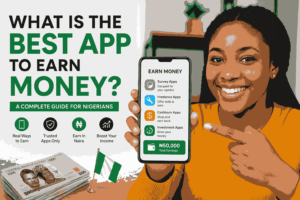
Also Read: What Is the Best App to Earn Money
How to Choose the Right ₦1,000-a-Day Strategy
The best way to approach how to earn 1k daily in Nigeria is to match the method with what you already have: a skill, a customer network, available capital, transport, equipment or time. A person with no inventory budget may be better suited to a service, while someone with local customers may be able to start a small reselling operation.
Start with the asset you already have
If you already know how to write, design, teach, edit videos, manage social media or repair something, test that skill before spending money on stock. If you already have access to a reliable supplier and know what people around you buy, product reselling may make more sense.
For readers considering product sales, our guide on what you can sell to make money every day in Nigeria explains how to test demand, manage stock and calculate real profit.
Think in monthly averages
Daily income will naturally fluctuate. Instead of becoming discouraged because one day produces nothing, track your total weekly and monthly profit. A business that produces ₦7,000 across a week is still meeting the mathematical equivalent of ₦1,000 per day on average.
If you want to move beyond the first milestone, compare this guide with our article on how to earn ₦5,000 per day in Nigeria. The important progression is to increase the value of each customer, improve repeat purchases or serve more customers without allowing expenses to grow faster than revenue.
How to Turn Small Daily Earnings Into Working Capital
Making the first ₦1,000 is only useful if you manage it carefully. Consider separating business money from personal spending. If every small profit is immediately withdrawn for personal use, the business may remain at the same size indefinitely.
- Record the sale: Write down what came in.
- Subtract direct costs: Include stock, transport, data, packaging or platform charges.
- Set aside operating money: Keep enough to serve the next customer.
- Reinvest deliberately: Spend only where additional capital can reasonably improve the business.
- Keep a reserve: Small businesses can experience slow days, damaged stock or unexpected expenses.
Readers who already have capital can also compare this approach with our guide on how to make money with ₦500,000 and our guide to businesses that can be started with ₦500,000. More capital does not automatically produce more profit; the business model still has to work.
How to Test an Income Idea Before Spending More Money
A simple test can prevent many beginners from losing money. Define one customer, one problem, one offer and one price. Then try to obtain a small number of genuine customers before buying more equipment or inventory.
For example, someone offering social-media graphics could create three sample designs and approach local businesses that clearly need promotional material. Someone selling phone accessories could begin with a small quantity of products instead of filling a room with stock. Someone offering tutoring could start with one or two learners and improve the lesson process before expanding.
Track evidence instead of excitement
After the test, record how many people were contacted, how many responded, how many bought, how much was spent to acquire each customer and how much net profit remained. This evidence is more useful than screenshots showing someone else’s income.
If your goal eventually becomes larger wealth rather than only a daily side income, you can also read our guide on becoming a millionaire in Nigeria. The same principle applies: build measurable income first, then improve saving, reinvestment and business capacity over time.
Editorial Verdict
If your goal is simply to earn your first ₦1,000, there are many possible routes.
If your goal is to earn ₦1,000 consistently, the answer is different.
The strongest approach is usually to build around one of three assets:
A skill, a customer base or a repeatable business system.
Data reselling can work when you have sufficient customer volume. Product reselling can work when you understand your market and control inventory. Freelancing and digital services can become more attractive as your skills improve. Social-media management and tutoring can also turn individual transactions into recurring monthly income.
The most important lesson is not to search endlessly for an app that magically pays ₦1,000 every morning.
Instead, find a problem people already pay to solve.
Then solve that problem consistently.
That is how ₦1,000 a day can become the beginning of a genuine business rather than another short-lived online-money experiment.
Business-model recommendation:
Best option for someone with almost no capital
Start with a service.
Graphic design, writing, tutoring, video editing, virtual assistance and social-media management can be started with relatively little financial investment if you already have access to a smartphone or computer.
Best option for someone with many local contacts
Consider data/airtime reselling or small-product reselling.
Your existing network can reduce the hardest part of the business: finding customers.
Best option for someone seeking long-term income growth
Develop a marketable digital skill and pursue freelancing or direct clients.
This has greater potential to move beyond the ₦1,000-a-day target because your earning capacity can increase as your skill, portfolio, reputation and client base improve.
What I would avoid
I would not build the strategy around:
- guaranteed-money apps
- betting
- pyramid-style schemes
- suspicious investment platforms
- “double your money” offers
- expensive courses promising instant wealth
- businesses requiring large upfront payments without a clear revenue model
The objective should be repeatable profit, not excitement.
Verification Notes
- The article treats ₦1,000 per day as a profit target, not a guaranteed income level.
- Current Nigerian data-reselling examples were checked against reseller-platform and industry sources. Prices and margins are not universal and can change.
- Upwork’s current documentation confirms that freelancers can create profiles, seek hourly/fixed-price work and withdraw through available payment methods, while fees and payment-clearance periods apply.
- Fiverr’s current documentation states that completed orders credit freelancers with 80% of the purchase amount, with withdrawal and clearance rules applying.
- The POS discussion is based on a recent Nigerian 2026 business guide and is intentionally presented as a business model rather than a guaranteed income source.
- No single “current price” is supplied because the primary keyword concerns income generation rather than a physical product.
- Income examples in this article are illustrations for understanding the mathematics of a business model, not promises of earnings.
- Business costs, data prices, platform fees, exchange rates, consumer demand and payment rules can change and should be checked before making financial decisions.
Final Quality Assessment
Original value provided
The article goes beyond a list of “10 ways to make money” by distinguishing revenue from profit, calculating the actual ₦1,000 target and explaining why daily income should ultimately be treated as an average rather than a guaranteed amount every single day.
Additional analysis included
It examines:
- startup requirements
- customer acquisition
- margins
- inventory risk
- service businesses
- recurring customers
- freelancing
- data reselling
- social-commerce
- digital products
- POS
- student-friendly options
- phone-based businesses
- common scams and misconceptions
- how to scale from ₦1,000 to a larger business
How it differs from ordinary money-making pages
A typical “earn money online” article may simply list apps and attach attractive income claims. This article instead evaluates how the money is actually generated, what has to happen before profit appears and what can make a business sustainable.
It also avoids treating third-party earning claims as guaranteed results.
Information that requires future updates
The following should be reviewed whenever the article is updated:
- data and airtime reseller prices
- platform fees
- payment and withdrawal methods
- Nigerian business regulations
- POS requirements
- exchange rates affecting international freelance income
- availability of online platforms
- product and operating costs
- consumer demand and market pricing
Editorial conclusion: The article is strongest when it frames “How to earn 1k daily in Nigeria?” as a small-business problem rather than a quick-money problem. That gives the reader a practical path from a modest ₦1,000 target towards repeat customers, higher-value services and a more sustainable income model.











+ There are no comments
Add yours