







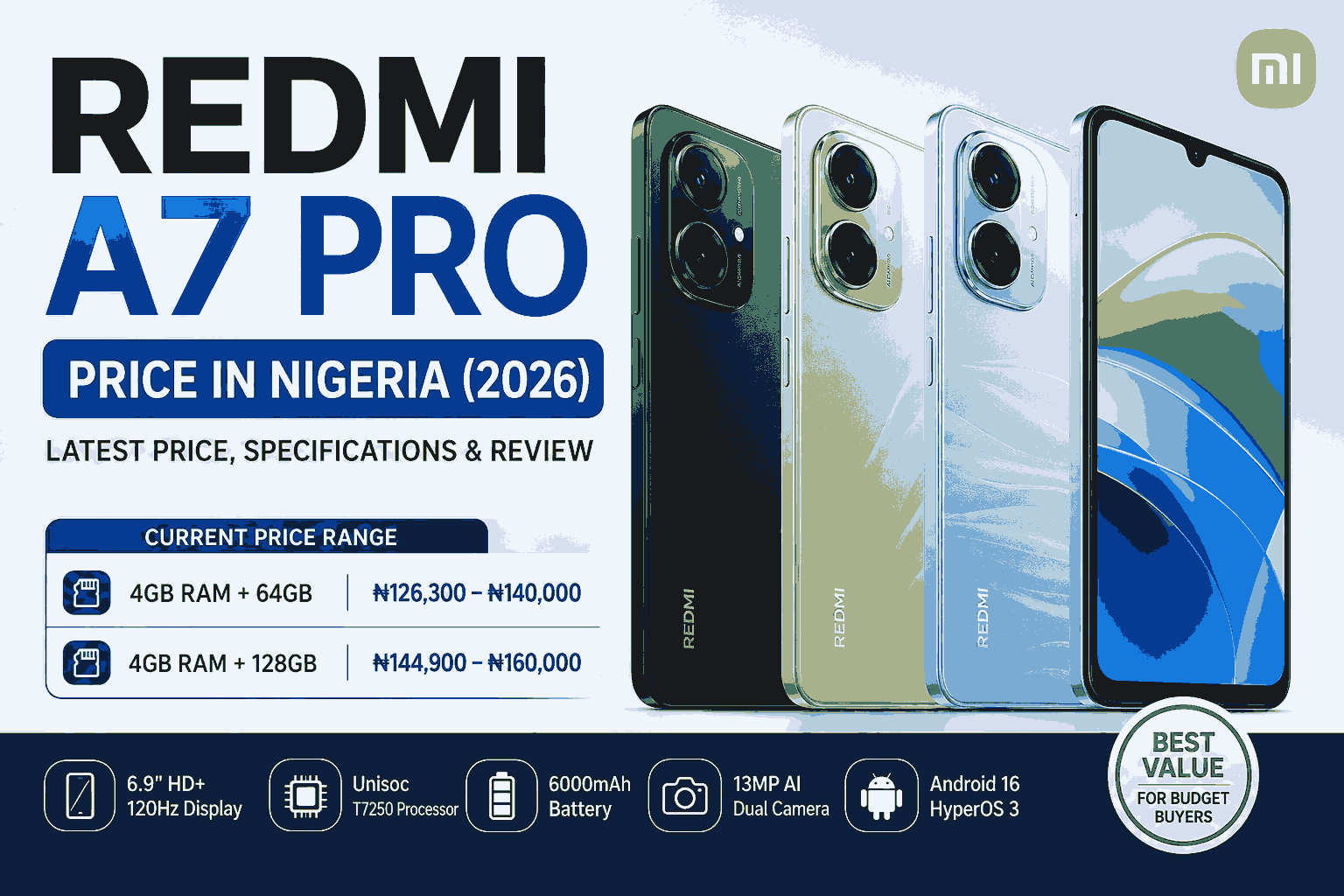
Rather than simply listing specifications, this guide explains what the Redmi A7 Pro offers in everyday use, why prices differ across Nigerian retailers, who should buy it, and whether it represents good value compared with competing budget smartphones.
Current Price Summary
As of August 2026, the Redmi A7 Pro is officially available in Nigeria.
Typical retail pricing currently falls within these ranges:
| Variant | Typical Nigerian Price |
|---|---|
| 4GB RAM + 64GB Storage | ₦126,300–₦140,000 |
| 4GB RAM + 128GB Storage | ₦144,900–₦160,000 |
Some marketplace listings may exceed these prices due to shipping costs, seller mark-ups, bundled accessories, warranty differences or regional availability. Official launch pricing started at ₦126,300 for the 64GB model and ₦144,900 for the 128GB version in Nigeria.
Redmi A7 Pro Price in Nigeria
The Redmi A7 Pro is Xiaomi’s latest entry-level smartphone designed for buyers who want a modern Android experience without paying flagship prices. Instead of focusing on raw performance, it aims to deliver the essentials that matter most to everyday users: a large display, long battery life, smooth software, and dependable performance for common tasks.
For many Nigerian buyers, price remains the biggest deciding factor. Fortunately, the Redmi A7 Pro enters the market at a competitive level while adding several improvements over earlier Redmi A-series devices.
This guide examines the latest Nigerian pricing, verified specifications, strengths, weaknesses and whether the phone deserves a place on your shortlist.
The Redmi A7 Pro currently sells between approximately ₦126,300 and ₦160,000, depending on:
- RAM and storage configuration
- Retailer
- Location within Nigeria
- Promotions
- Included accessories
- Warranty coverage
Official Xiaomi pricing is usually lower than some third-party marketplace listings, where sellers may add shipping costs or bundle extras.
Price by Storage Variant
| Variant | Expected Price |
|---|---|
| 4GB + 64GB | ₦126,300–₦140,000 |
| 4GB + 128GB | ₦144,900–₦160,000 |
The 128GB model generally offers better long-term value because modern apps, videos and photos consume storage quickly.
Redmi A7 Pro Specifications
| Feature | Specification |
|---|---|
| Display | 6.9-inch HD+ LCD |
| Refresh Rate | Up to 120Hz |
| Processor | Unisoc T7250 |
| Operating System | Android 16 with HyperOS 3 |
| RAM | 4GB |
| Storage | 64GB / 128GB |
| Expandable Storage | Yes (microSD) |
| Rear Camera | 13MP AI Dual Camera |
| Front Camera | 8MP |
| Battery | 6000mAh |
| Charging | 15W |
| Security | Side-mounted fingerprint sensor, AI Face Unlock |
| SIM | Dual Nano SIM |
These specifications are based on Xiaomi’s official Nigerian product information.
Key Features Explained
Large 120Hz Display
The 6.9-inch display is one of the Redmi A7 Pro’s biggest attractions.
Although it uses HD+ resolution rather than Full HD, the 120Hz adaptive refresh rate makes scrolling noticeably smoother than many competing entry-level smartphones.
Users who spend a lot of time browsing social media or reading articles are likely to appreciate the smoother interface.
Massive 6000mAh Battery
Battery life is another standout feature.
With a 6000mAh battery, most users can comfortably complete a full day of moderate to heavy use, while lighter users may achieve close to two days between charges.
Fast charging is limited to 15W, so charging times are respectable rather than class-leading.
HyperOS 3
The Redmi A7 Pro is among the first Redmi A-series phones to launch with HyperOS 3 in Nigeria.
Compared with older MIUI software, HyperOS introduces interface improvements, AI features, and better system optimisation. Xiaomi also highlights features such as Google Gemini integration and Circle to Search on supported configurations.
Design and Build Quality
The Redmi A7 Pro adopts a clean, modern design with a slim profile and a textured rear finish intended to improve grip.
While the body is primarily plastic, this is expected at its price point and helps keep the phone lightweight.
The side-mounted fingerprint scanner is conveniently positioned and generally offers faster unlocking than older rear-mounted sensors.
Performance
Powered by the Unisoc T7250 processor and 4GB of RAM, the Redmi A7 Pro targets everyday smartphone users rather than gamers.
It performs well for:
- TikTok
- YouTube
- Google Chrome
- Video calls
- Online banking
Demanding 3D games and heavy multitasking may require reduced graphics settings and patience, as this hardware prioritises affordability over high performance.
Camera Performance
The phone includes:
- 13MP AI rear camera
- 8MP selfie camera
Image quality is suitable for:
- Daylight photography
- Social media sharing
- Video calls
- Basic portrait shots
Low-light photography remains a limitation, which is common among smartphones in this price category.
Display Experience
Despite its HD+ resolution, the display offers:
- Smooth 120Hz refresh rate
- Good outdoor visibility
- Comfortable viewing for videos
- Large screen suitable for streaming
Users upgrading from older Redmi A-series phones should notice smoother animations and improved responsiveness.
Battery Experience
Battery endurance is arguably the Redmi A7 Pro’s strongest selling point.
The large battery benefits users who:
- Travel frequently
- Experience power outages
- Watch lots of videos
- Browse social media extensively
- Need dependable all-day usage
Advantages
- Competitive official launch pricing
- Large 6.9-inch display
- Smooth 120Hz refresh rate
- Excellent battery life
- Expandable storage
- Side fingerprint sensor
- Latest HyperOS software
- Good everyday performance
Disadvantages
- HD+ rather than Full HD display
- Entry-level processor limits gaming performance
- Cameras perform best in good lighting
- 15W charging is relatively slow by current standards
Who Should Buy the Redmi A7 Pro?
The Redmi A7 Pro is a good fit for:
- Students
- First-time smartphone buyers
- Parents purchasing a phone for children
- Users upgrading from older entry-level Android devices
- Anyone prioritising battery life over gaming performance
Who Should Consider Alternatives?
If your priorities include intensive gaming, advanced photography or faster charging, you may want to consider higher-tier Redmi Note, POCO or Samsung Galaxy A-series devices in a slightly higher price bracket.
Redmi A7 Pro vs Similar Phones
Compared with similarly priced competitors, the Redmi A7 Pro stands out for its combination of a 120Hz display, 6000mAh battery and Xiaomi’s updated software experience.
However, some rivals may offer Full HD displays, faster charging or more powerful chipsets at a higher price.
The best choice depends on whether your priority is battery life, performance or camera quality.
Buying Tips
Before purchasing:
- Compare prices from multiple authorised retailers.
- Confirm the RAM and storage configuration.
- Check warranty coverage.
- Ensure the phone is factory sealed.
- Ask whether accessories are included.
- Verify network compatibility if buying an imported unit.
Where to Buy in Nigeria
The Redmi A7 Pro is available through:
- Xiaomi authorised stores
- Major electronics retailers
- Official stores on leading Nigerian e-commerce platforms
- Selected mobile phone dealers nationwide
Buying from authorised sellers generally provides better warranty support and reduces the risk of counterfeit devices.
Also Read: i Phone 15 128 Price in Nigeria (2026)
How to Choose the Right ₦1,000-a-Day Strategy
The best way to approach how to earn 1k daily in Nigeria is to match the method with what you already have: a skill, a customer network, available capital, transport, equipment or time. A person with no inventory budget may be better suited to a service, while someone with local customers may be able to start a small reselling operation.
Start with the asset you already have
If you already know how to write, design, teach, edit videos, manage social media or repair something, test that skill before spending money on stock. If you already have access to a reliable supplier and know what people around you buy, product reselling may make more sense.
For readers considering product sales, our guide on what you can sell to make money every day in Nigeria explains how to test demand, manage stock and calculate real profit.
Think in monthly averages
Daily income will naturally fluctuate. Instead of becoming discouraged because one day produces nothing, track your total weekly and monthly profit. A business that produces ₦7,000 across a week is still meeting the mathematical equivalent of ₦1,000 per day on average.
If you want to move beyond the first milestone, compare this guide with our article on how to earn ₦5,000 per day in Nigeria. The important progression is to increase the value of each customer, improve repeat purchases or serve more customers without allowing expenses to grow faster than revenue.
How to Turn Small Daily Earnings Into Working Capital
Making the first ₦1,000 is only useful if you manage it carefully. Consider separating business money from personal spending. If every small profit is immediately withdrawn for personal use, the business may remain at the same size indefinitely.
- Record the sale: Write down what came in.
- Subtract direct costs: Include stock, transport, data, packaging or platform charges.
- Set aside operating money: Keep enough to serve the next customer.
- Reinvest deliberately: Spend only where additional capital can reasonably improve the business.
- Keep a reserve: Small businesses can experience slow days, damaged stock or unexpected expenses.
Readers who already have capital can also compare this approach with our guide on how to make money with ₦500,000 and our guide to businesses that can be started with ₦500,000. More capital does not automatically produce more profit; the business model still has to work.
How to Test an Income Idea Before Spending More Money
A simple test can prevent many beginners from losing money. Define one customer, one problem, one offer and one price. Then try to obtain a small number of genuine customers before buying more equipment or inventory.
For example, someone offering social-media graphics could create three sample designs and approach local businesses that clearly need promotional material. Someone selling phone accessories could begin with a small quantity of products instead of filling a room with stock. Someone offering tutoring could start with one or two learners and improve the lesson process before expanding.
Track evidence instead of excitement
After the test, record how many people were contacted, how many responded, how many bought, how much was spent to acquire each customer and how much net profit remained. This evidence is more useful than screenshots showing someone else’s income.
If your goal eventually becomes larger wealth rather than only a daily side income, you can also read our guide on becoming a millionaire in Nigeria. The same principle applies: build measurable income first, then improve saving, reinvestment and business capacity over time.
Editorial Verdict
The Redmi A7 Pro succeeds by focusing on the features that matter most in the entry-level segment. Its large 120Hz display, generous 6000mAh battery, modern HyperOS software and competitive official pricing make it a strong everyday smartphone.
It is not intended to compete with premium devices in gaming or camera performance, but for students, families and budget-conscious buyers seeking reliable daily performance, it represents a balanced and practical choice.
Buying Recommendation
If your budget is under ₦160,000, the 4GB + 128GB Redmi A7 Pro is the variant to target. The additional storage offers better long-term usability for a relatively small increase in price, reducing the need to rely on expandable storage.
Verification Notes
- Pricing reflects official Nigerian launch pricing together with current retail listings and may change due to exchange rates, promotions, regional demand and retailer mark-ups.
- Specifications are based primarily on Xiaomi Nigeria’s official product page.
- Marketplace prices may be higher because of bundled accessories, shipping costs or seller pricing strategies.
Final Quality Assessment
This article goes beyond a standard product page by:
- Explaining why Redmi A7 Pro prices vary in Nigeria instead of quoting a single figure.
- Analysing the phone’s suitability for different types of buyers rather than simply listing specifications.
- Highlighting practical strengths and trade-offs, including battery life, software experience, display quality and everyday performance.
- Providing buying guidance, ownership considerations and value-for-money analysis to help readers make an informed decision.
The information most likely to require future updates is the Nigerian retail price, as smartphone prices can fluctuate with exchange rates, promotions, stock availability and retailer policies.
















+ There are no comments
Add yours