







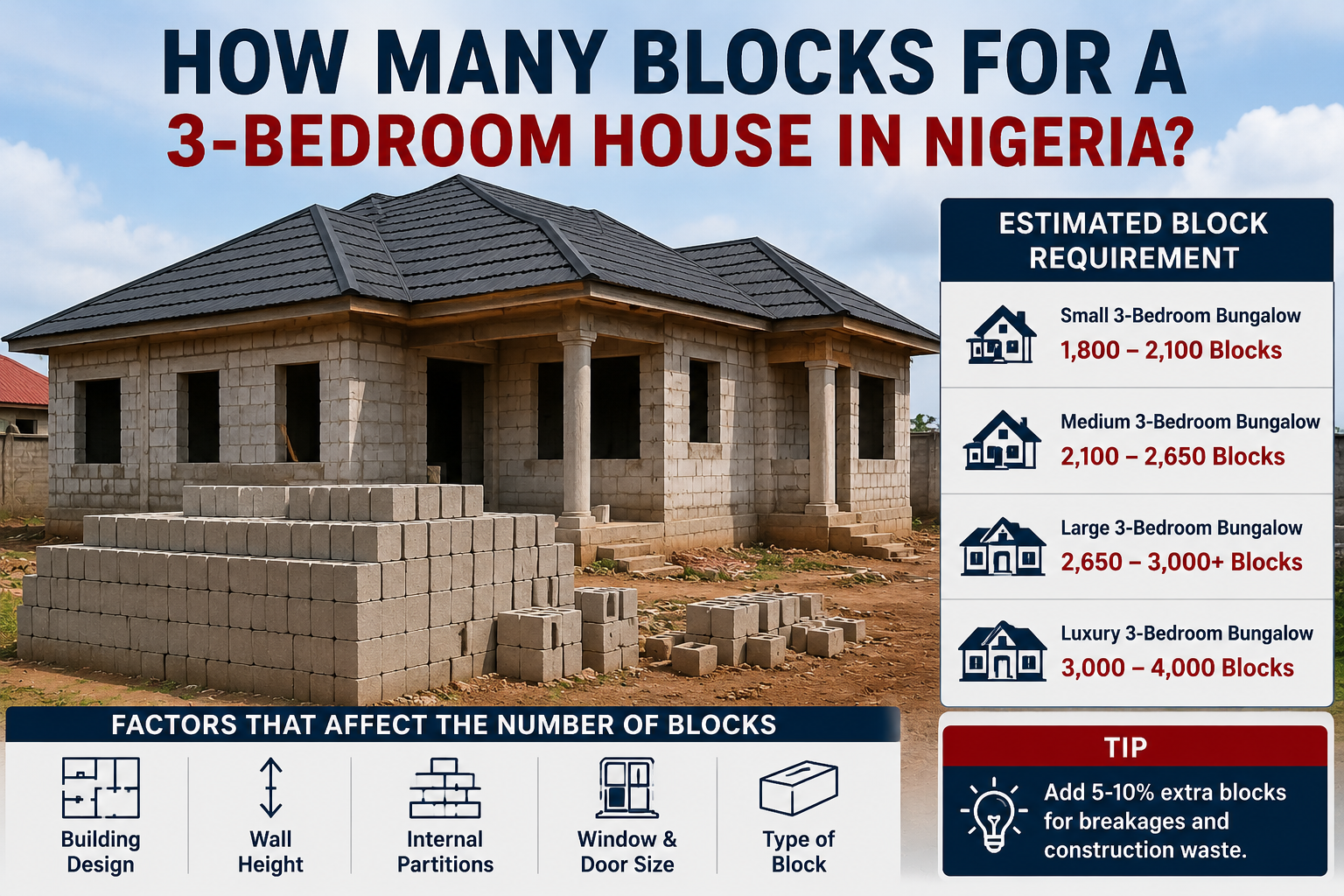
How many blocks for a 3-bedroom house in Nigeria, Building a house in Nigeria requires careful planning, and one of the most common questions prospective homeowners ask.
The answer depends on several factors, including the house design, wall height, block size, number of rooms, and architectural complexity. However, for a typical 3-bedroom bungalow in Nigeria, you can expect to use between 1,800 and 3,000 blocks, while larger designs and more complex floor plans may require even more. Construction estimates from Nigerian building professionals commonly place standard 3-bedroom bungalow requirements around 1,800–2,650 blocks, with larger projects approaching 3,000 blocks or more.
This detailed guide explains everything you need to know about how many blocks for a 3-bedroom house in Nigeria, how to calculate block quantities accurately, factors affecting block usage, estimated costs, and practical tips for reducing waste during construction.
Why Knowing the Number of Blocks Matters
Before purchasing building materials, understanding the required block quantity helps you:
- Prepare an accurate budget
- Avoid unnecessary expenses
- Prevent material shortages
- Reduce project delays
- Improve construction planning
- Negotiate better supplier prices
Many people make the mistake of buying blocks based on rough guesses. This often leads to wastage or multiple trips to suppliers, increasing construction costs.
When building a 3-bedroom house in Nigeria, blocks represent one of the most significant material expenses after cement, roofing materials, and reinforcement steel.
How Many Blocks for a 3-Bedroom House in Nigeria?
Standard Estimate
For a typical Nigerian 3-bedroom bungalow, the estimated block requirement is:
| House Size | Estimated Blocks |
|---|---|
| Small 3-bedroom bungalow | 1,800 – 2,100 |
| Medium 3-bedroom bungalow | 2,100 – 2,650 |
| Large 3-bedroom bungalow | 2,650 – 3,000+ |
| Luxury 3-bedroom bungalow | 3,000 – 4,000 |
Industry estimates commonly place a standard 3-bedroom bungalow at approximately 1,800–2,650 blocks depending on the design and wall arrangement.
Therefore, if someone asks how many blocks for a 3-bedroom house in Nigeria, a practical answer is:
Expect between 2,000 and 3,000 blocks for most standard 3-bedroom bungalow projects.
Factors That Affect How Many Blocks for a 3-Bedroom House in Nigeria
1. Building Design
A compact bungalow uses fewer blocks than a complex design with:
- Multiple corridors
- Extended verandas
- Guest toilets
- Box rooms
- Walk-in closets
The more internal partitions included in the floor plan, the more blocks are required.
Example
A simple rectangular 3-bedroom bungalow may require:
- 2,000–2,300 blocks
A luxury L-shaped bungalow may require:
- 2,800–3,500 blocks
Even though both contain three bedrooms, the wall lengths differ significantly.
2. Wall Height
Wall height directly impacts block consumption.
Typical wall heights in Nigeria include:
- 3.0m
- 3.3m
- 3.6m
Higher walls mean additional block courses.
A house with 3.6-meter walls can consume hundreds more blocks than a house with 3-meter walls.
3. Number of Internal Partitions
Every partition wall increases the number of blocks needed.
Examples include:
- En-suite bathrooms
- Passage walls
- Store rooms
- Dressing areas
- Laundry spaces
A self-contained 3-bedroom design generally uses more blocks than a simple family bungalow.
4. Size of Windows and Doors
Larger openings reduce block usage.
For example:
- Floor-to-ceiling windows
- Sliding glass doors
- Large entrance doors
These features reduce wall surface area and therefore reduce block requirements.
5. Type of Block Used
In Nigeria, builders commonly use:
6-Inch Blocks
Usually used for:
- Internal walls
- Partition walls
9-Inch Blocks
Usually used for:
- External walls
- Load-bearing walls
The block size affects the quantity needed and the overall cost.
How to Calculate Blocks for a 3-Bedroom House in Nigeria
Instead of relying solely on estimates, builders can calculate block quantities using wall dimensions.
Construction professionals generally follow a wall-area calculation approach.
Step 1: Calculate Total Wall Length
Assume a typical bungalow has:
- External wall perimeter = 60 meters
- Internal wall length = 90 meters
Total wall length:
60 + 90 = 150 meters
Step 2: Multiply by Wall Height
Assuming wall height is 3 meters:
150 × 3 = 450 square meters
Total wall area = 450m²
Step 3: Deduct Openings
Subtract areas occupied by:
- Doors
- Windows
- Ventilation openings
Assume total opening area:
50m²
Net wall area:
450 – 50 = 400m²
Step 4: Determine Block Coverage
A standard block covers approximately 0.1–0.12m² depending on dimensions and mortar joints.
400 ÷ 0.12 ≈ 3,333 blocks
This figure is only an example and varies according to actual design specifications.
Estimated Block Requirement for Each Building Section
Understanding where blocks are used can help homeowners estimate quantities more accurately.
Foundation Level
Approximate requirement:
- 300–600 blocks
Depends on:
- Soil condition
- Foundation depth
- Building footprint
DPC to Window Level
Approximate requirement:
- 500–800 blocks
This stage forms a significant portion of the wall structure.
Window to Lintel Level
Approximate requirement:
- 400–700 blocks
The exact figure depends on the number and size of windows.
Lintel to Roof Level
Approximate requirement:
- 500–900 blocks
This is often the largest block-consuming section.
Cost of Blocks for a 3-Bedroom House in Nigeria
The cost of blocks varies by state, manufacturer, and quality.
Current market prices fluctuate regularly, but quality blocks often cost several hundred naira each depending on location and size.
Example Calculation
Assume:
- 2,500 blocks needed
- ₦700 per block
Total:
2,500 × ₦700
= ₦1,750,000
If the same project requires 3,000 blocks:
3,000 × ₦700
= ₦2,100,000
This calculation excludes:
- Cement
- Sand
- Labour
- Transportation
- Reinforcement
Common Mistakes When Estimating Blocks
Many first-time builders underestimate material requirements.
Ignoring Waste
Construction waste is unavoidable.
Always add:
- 5–10% extra blocks
This covers:
- Breakages
- Transportation damage
- Site handling losses
Not Following the Approved Plan
Some homeowners estimate based on another person’s house.
This often leads to inaccurate calculations because:
- Room sizes differ
- Wall heights differ
- Architectural layouts differ
Buying Cheap Blocks
Low-quality blocks may crack during:
- Transportation
- Loading
- Construction
Always purchase from reputable manufacturers.
Tips to Reduce Block Costs
If you’re concerned about construction expenses, consider the following.
Choose a Compact Design
Simple rectangular layouts require fewer blocks than complicated shapes.
Minimize Unnecessary Partitions
Open-plan living areas reduce internal walls and lower block consumption.
Use Accurate Material Estimates
Hiring a quantity surveyor can save significant money by preventing over-purchasing.
Compare Multiple Suppliers
Request quotations from at least three block manufacturers before purchasing.
This can result in substantial savings.
Other Materials Needed Alongside Blocks
When calculating how many blocks for a 3-bedroom house in Nigeria, remember that blocks are only one component of the project.
Additional materials include:
- Cement
- Sand
- Granite
- Reinforcement rods
- Timber
- Roofing sheets
- Electrical materials
- Plumbing materials
- Doors
- Windows
- Paint
Useful construction resources include:
- Nigerian Institute of Building
- Council of Registered Builders of Nigeria (CORBON)
- Nigerian Society of Engineers
These organizations provide guidance on professional construction standards and best practices.
Should You Mould Your Own Blocks or Buy Them?
This is another common question among builders.
Buying Blocks
Advantages:
- Faster construction
- Less supervision
- Immediate availability
Disadvantages:
- Quality may vary
Moulding Blocks Yourself
Advantages:
- Better quality control
- Potential cost savings
Disadvantages:
- Requires labour
- Requires space
- Requires curing time
For large projects, many contractors prefer moulding blocks on-site to maintain quality standards.
Expert Recommendation
If you’re planning a standard 3-bedroom bungalow in Nigeria, budgeting for 2,000–3,000 blocks is a realistic starting point. However, the final figure should always come from your architectural drawings and a professional material schedule. Estimates found online are useful, but no estimate is as accurate as calculations based on your specific building plan.
A professional quantity surveyor can provide a detailed bill of quantities that includes:
- Exact block count
- Cement requirement
- Reinforcement schedule
- Finishing materials
- Labour projections
This helps prevent costly surprises during construction.
Conclusion
So, how many blocks for a 3-bedroom house in Nigeria?
The answer depends on the size, layout, wall height, and overall complexity of the building. For most standard 3-bedroom bungalows, the required quantity typically falls between 1,800 and 3,000 blocks, with many average designs requiring approximately 2,000–2,650 blocks.
To obtain the most accurate estimate, always work from approved architectural drawings and consult a qualified quantity surveyor. Doing so will help you budget properly, minimize waste, and complete your dream home efficiently.
Frequently Asked Questions (FAQs)
1. How many blocks are needed for a standard 3-bedroom bungalow in Nigeria?
A standard 3-bedroom bungalow typically requires between 2,000 and 3,000 blocks, depending on the design and wall layout.
2. How much will blocks cost for a 3-bedroom house?
The total cost depends on the current market price per block and the quantity required. For example, 2,500 blocks at ₦700 each would cost approximately ₦1.75 million.
3. Can I calculate the exact number of blocks myself?
Yes. By measuring total wall lengths, multiplying by wall height, deducting openings, and dividing by block coverage area, you can estimate block requirements. However, for maximum accuracy, engage a quantity surveyor.















+ There are no comments
Add yours